

Barely halfway through 2024, the rapidly rising tower of US public debt has reached yet another milestone. Two hundred and six days after reaching $34 trillion, America’s debt pile has reached $35 trillion. To put this in perspective, the debt at the end of World War II was about $259 billion, making the current debt more than 135 times that amount. The US has now borrowed amounts larger than the combined GDPs of China, Japan, and Germany.
It is increasingly difficult to grasp that only a bit more than four decades ago the US national debt was $907 billion, and that the surpassing of the $1 trillion mark in 1981 was seen as a watershed moment. The amount of debt undertaken by the Biden administration alone now stands at $7.2 trillion, an amount equal to the amount of national debt incurred between the presidencies of two Georges: Washington (who assumed office in 1789) and the younger Bush (who left office in 2009). This is still less than was taken on by the Trump administration ($7.8 trillion), but if the borrowing needs of the current administration are what they are projected to be, the Biden administration may set a new record by having added over $8 trillion in debt.
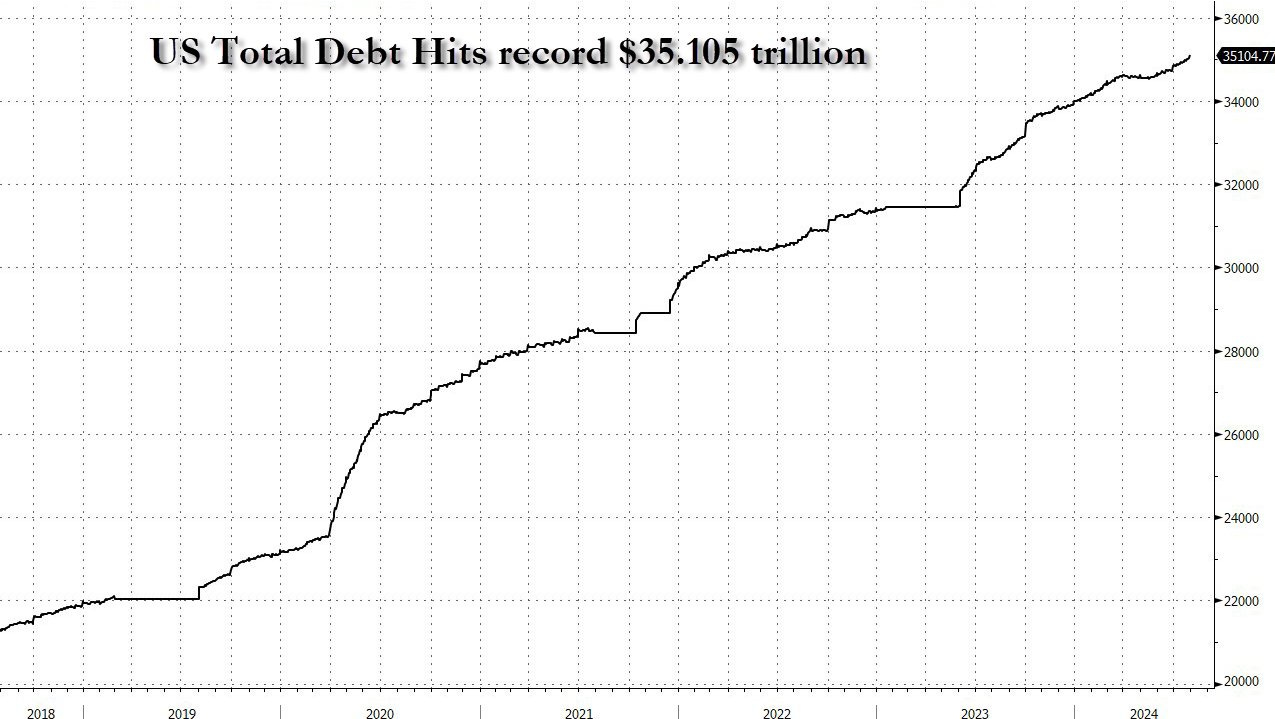
But it is not just the amassing of debt, but the timing of it that has generated great vulnerabilities for the US economy. At the start of 2008 America’s debt pile sat at a now-quaint $9.2 trillion. During the seven years between late 2008 and late 2015, nominal interest rates were barely above zero as the debt burden essentially doubled to exceed $18 trillion. Low interest rates, even if artificially engineered, make enthusiastic borrowing more palatable. Even during the aborted attempt to increase rates between 2015 and mid-2019 — in which interest rates made a brief stop at roughly 2.4 percent — another six trillion dollars worth of debt was taken on. The outbreak of the COVID-19 pandemic saw another 18 months of rock-bottom interest rates, during which five-and-a-half trillion more dollars of debt was piled on. And so it was with $30 trillion worth of debt that, owing to the outbreak of inflation (which was proved non-transitory) that the Fed raised short-term interest rates to their highest levels in sixteen years. And even then, with the debt-service levels spiraling higher, another five trillion dollars of debt has been added. Between 2020 and 2024, the United States has voluntarily encumbered itself with nearly $12 trillion in debt; debt that will at some point need to be repaid, defaulted upon, or subjected to some modification.
The federal government is projected to run a $1.9 trillion deficit this year, which would be the third-largest in US history following the deficits of $3.1 trillion in 2020 and $2.7 trillion in 2021 during peak pandemic-era spending. In fiscal year 2023, interest payments on the debt alone amounted to over $658 billion, surpassing the budgets of many major federal agencies combined. At this point, federal debt service costs amount to approximately $900 billion, which is 17 percent of total federal spending. Once again, US citizens should consider what they are willing to live without or see others go without. Social Security? National Parks? Unemployment benefits? The Environmental Protection Agency? Marginal gains in unwinnable and/or eternal wars? Funding for public education?
Landmarks of escalating liability are being surpassed with increasing frequency; so much so that absurd spending pledges have become nearly commonplace. This is in no small part due to national debt emerging as another in a growing list of third rail issues. But while succumbing to pessimism may be rational, it is ultimately unproductive. The economic risk posed to future generations is too significant to overlook, despite the repetitive nature of our warnings.
Now read:
James Lavish Explains The Entire U.S. Debt Crisis In An Hour
Crash Or Bear Market, Either Way Stocks Going "Down, A Lot": Mark Spiegel
The U.S. Is A "Runaway Train": Chris Martenson On Debt, Immigration & War

QTR’s Disclaimer: Please read my full legal disclaimer on my About page here. This post represents my opinions only. In addition, please understand I am an idiot and often get things wrong and lose money. I may own or transact in any names mentioned in this piece at any time without warning. Contributor posts and aggregated posts have been hand selected by me, have not been fact checked and are the opinions of their authors. They are either submitted to QTR by their author, reprinted under a Creative Commons license with my best effort to uphold what the license asks, or with the permission of the author. This is not a recommendation to buy or sell any stocks or securities, just my opinions. I often lose money on positions I trade/invest in. I may add any name mentioned in this article and sell any name mentioned in this piece at any time, without further warning. None of this is a solicitation to buy or sell securities. These positions can change immediately as soon as I publish this, with or without notice and at any point I can be long, short or neutral on any position. You are on your own. Do not make decisions based on my blog. I exist on the fringe. The publisher does not guarantee the accuracy or completeness of the information provided in this page. These are not the opinions of any of my employers, partners, or associates. I did my best to be honest about my disclosures but can’t guarantee I am right; I write these posts after a couple beers sometimes. I edit after my posts are published because I’m impatient and lazy, so if you see a typo, check back in a half hour. Also, I just straight up get shit wrong a lot. I mention it twice because it’s that important.
Adding to my frustration is the knowledge that when this erupts, the sensible people who provide value will be blamed. The rulers won’t admit fault or responsibility. They won’t cut spending or eject the freeloaders. Just like they blamed short sellers and the unvaccinated in times past, they will blame those with gold / bitcoin/ paid off assets and accuse them of being greedy capitalists responsible for the collapse.
To pass a spending cut requires, in most cases, sacrifice on the part of an individual or a small subgroup of elected officials. Congress must devour itself in small bites. To pass a tax increase requires green lighting spending for the marginal votes needed to get to 218. So expecting Congress to fix this is a pipe dream.
Instead we will see a universal tax, applied to all money, as the Fed monetizes the debt the Treasury cannot pay. It will happen slowly, meeting the coupon payments of an ever increasing debt while adding continuously to the principal. So long as the debt is denominated in dollars, by definition it can be serviced by the Fed. But this is just circling the drain and, to borrow from Hemingway, this demise will proceed slowly, then suddenly.