

By Peter C. Early, AIER’s The Daily Economy
Gold has crossed $4,000 per ounce just 200 days after it passed $3,000. What began as a slow march from crisis to crisis has transformed into an accelerated sprint that is reshaping how savers, investors, and policymakers worldwide view the world’s oldest monetary metal. Beyond the simple symbolism of a round number, the current moment captures the increasingly uneasy intersection of macroeconomic stress, geopolitical instability, and feedback loops of momentum.
Several overlapping and reinforcing forces are driving gold’s surge:
Volatile trade policies, central bank division, and persistent fiscal dysfunction have fueled demand for safe assets. The US government’s repeated shutdown standoffs and spiraling debt dynamics make gold particularly attractive as “insurance;” particularly in the current shutdown, which seems likely to endure.
There is a tiresome critique that gold pays no dividend and has no yield, but that becomes an advantage when real (inflation-adjusted) rates turn negative. As the Federal Reserve has embarked upon an easing campaign, the opportunity cost of holding gold declines, giving the metal a fresh tailwind.
With the US dollar sliding, gold becomes cheaper for overseas buyers and more desirable as a reserve diversifier.
From Beijing to Brazil, central banks have been steadily adding to gold reserves. These moves are partly about diversifying away from the dollar and partly about hedging against sanctions or geopolitical shocks.
Exchange-traded funds backed by physical gold are attracting fresh capital. Some of this is retail money, but a large portion is institutional flows — allocations made with the intention of sticking through volatility.
Unlike oil or grain, gold production cannot be scaled quickly. Mines face capital shortages, political risk, and geological limits. Recycling adds some supply, but nowhere near enough to offset surging demand.
Rising public debt, unconventional fiscal policies, and questions about central bank independence are corroding faith in fiat currency. Each new episode of political dysfunction adds to the case for holding tangible assets.
For some investors, gold is not just an investment but a hedge against extreme scenarios: war, defaults, or sudden inflation spikes. These convex, “lottery ticket” flows add depth to the rally.
The result is a perfect storm of forces reinforcing one another. Gold is not rising for one reason; It is rising for many.
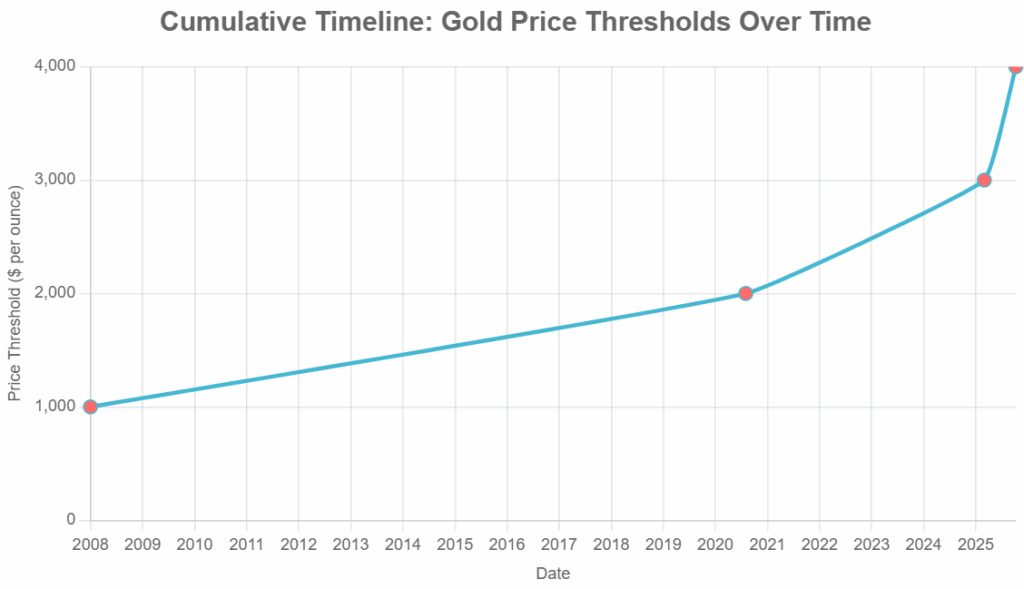
The temptation is usually to dwell on the neatness of round numbers: $4,000 per ounce is a record high: higher (obviously) than $3,000 per ounce with eyes already focused on $5,000 per ounce.
But a more revealing story emerges when we consider how quickly gold has moved between these thresholds. Gold first crossed $1,000 per ounce in 2008, during the financial crisis. It would take until August 2020 — nearly 12 years, or roughly 4,400 days — before gold finally broke through the $2,000 per ounce level. The journey from $2,000 in 2020 to $3,000 per ounce in March 2025 took about five years, or roughly 1,700 days. The latest leap has been the most astonishing. Gold cleared $3,000 per ounce in March 2025 and crossed $4,000 per ounce by October 2025. That’s a span of only about seven months (roughly 200 days).
This contraction in “days per new-thousand-dollar-ounces” is dramatic: from twelve years, to five, to less than one. It suggests a regime shift: either an accelerating loss of confidence in financial systems, or an extraordinary momentum cycle that could itself become self-reinforcing. The speed of these price leaps offers a richer narrative than psychological milestones alone. In practical terms, it raises questions: if the time to each new level is shrinking, are we watching a bubble — or are we witnessing a structural repricing of gold’s role in the financial system?
Quantifying the intervals provides an investigative framework: one can map “days per new-thousand-dollar-ounces” against macro factors such as real yields, central bank reserves, or debt-to-GDP ratios. If gold’s acceleration lines up with deteriorating fundamentals, it’s possible that the price move reflects more than momentum; it signals a profound market reassessment.
Gold at $4,000 per ounce is more than a headline. It is the sum of overlapping uncertainties: inflation, currency instability, debt, central bank policy, and geopolitical turbulence. But it is also a story told in numbers. The shrinking intervals between each successive $1,000 price gain speak both of, and to, a world that is changing faster than before. One where safe havens are sought not gradually, but urgently. It’s now quite clear that gold can reach $5,000 per ounce. The outstanding issue is how quickly it will take to do so, and what that speed tells us — if anything — about the evolving state of the global economy.

QTR’s Disclaimer: Please read my full legal disclaimer on my About page here. This post represents my opinions only. In addition, please understand I am an idiot and often get things wrong and lose money. I may own or transact in any names mentioned in this piece at any time without warning. Contributor posts and aggregated posts have been hand selected by me, have not been fact checked and are the opinions of their authors. They are either submitted to QTR by their author, reprinted under a Creative Commons license with my best effort to uphold what the license asks, or with the permission of the author.
This is not a recommendation to buy or sell any stocks or securities, just my opinions. I often lose money on positions I trade/invest in. I may add any name mentioned in this article and sell any name mentioned in this piece at any time, without further warning. None of this is a solicitation to buy or sell securities. I may or may not own names I write about and are watching. Sometimes I’m bullish without owning things, sometimes I’m bearish and do own things. Just assume my positions could be exactly the opposite of what you think they are just in case. If I’m long I could quickly be short and vice versa. I won’t update my positions. All positions can change immediately as soon as I publish this, with or without notice and at any point I can be long, short or neutral on any position. You are on your own. Do not make decisions based on my blog. I exist on the fringe. If you see numbers and calculations of any sort, assume they are wrong and double check them. I failed Algebra in 8th grade and topped off my high school math accolades by getting a D- in remedial Calculus my senior year, before becoming an English major in college so I could bullshit my way through things easier.
The publisher does not guarantee the accuracy or completeness of the information provided in this page. These are not the opinions of any of my employers, partners, or associates. I did my best to be honest about my disclosures but can’t guarantee I am right; I write these posts after a couple beers sometimes. I edit after my posts are published because I’m impatient and lazy, so if you see a typo, check back in a half hour. Also, I just straight up get shit wrong a lot. I mention it twice because it’s that important.
“The shrinking intervals between each successive $1,000 price gain speak both of, and to, a world that is changing faster than before. “
Not to mention basic math.
$3 to $4 is 33%.
$4 to $5 is 25%.
$5 to $6 is 20%.
Of course the time interval is shrinking, the percent increase in price is shrinking as well.
Price clearing round numbers alone lacks significance.
Now a column on logarithmic growth rates increasing would be important.
Among the many yet to be accomplished promises of the Trump Administration (meaningfully cutting spending, reducing the size of government, moving the FBI headquarters to Des Moines, running a bunch of congresspeople through the judicial sytem and into the penal system, etc.), why hasn't Trump told us how much gold we hold, in Fort Knox or elsewhere? Aren't there only two possible scenarios: 1) we have so much it would be massiviely destabillizing, or 2) we have so little (or none) it would be massively destabilizing? I'm betting on #2.