

My Substack compatriot Michael Burry had all the headlines on Wednesday after revealing, in the midst of a royal market porking, that he had temporarily reversed much of his bearish positioning and was now almost entirely long.
Naturally, the financial media latched onto the reversal, but I think there are several more interesting angles to the story.
First, Burry is a phenomenal example of just how difficult it is to be short in financial markets. Burry shuttered his fund about one year ago to the day. In December, he gave a great interview with Michael Lewis about how the AI buildout had overshot the market that I repeatedly linked back to all year for my subscribers.
In late 2025, Wedbush analyst Dan Ives likened Burry’s bearish warnings to “yelling fire in a crowded theater,” adding that AI skeptics had repeatedly been wrong throughout the bull market. Jim Cramer pushed back against Burry's bearish positioning, declaring Nvidia “the best tech company I have ever seen,” while admitting that he didn't know how to value it.
And about one year ago to the day, I wrote in response to Burry shuttering his fund:
When the liquidity recedes, when passive flows slow, when earnings disappointment finally matters again, when the bid that has kept garbage alive evaporates, the snapback will happen quickly. The fundamentals Burry sees will still be there. The distortions won’t be.
When reality returns, Burry won’t look wrong. He’ll look early. Right up until the moment he looks inevitable. Patience and reality haven’t disappeared; they’ve just been buried under liquidity. But they always re-emerge. Slowly, then violently. Godspeed, Mr. Burry.
And then for almost all of 2026, Burry was laughed at, mocked and told that he didn’t understand the new paradigm. In July, Nvidia CEO Jensen Huang dismissed concerns about circular financing arrangements as “ridiculous,” despite those arrangements being central to Burry’s bearish thesis. In September, Nvidia bulls celebrated the company’s rebuttal of Burry’s GPU depreciation thesis.
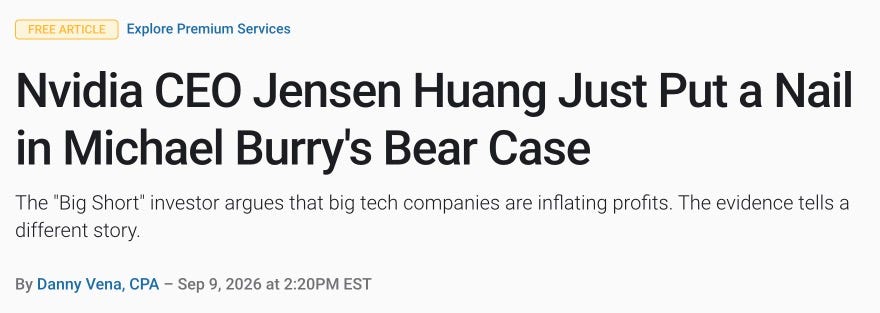
On September 9, The Motley Fool published an article entitled “Nvidia CEO Jensen Huang Just Put a Nail in Michael Burry’s Bear Case,” going so far as to declare Nvidia stock a steal.
The very next day, speaking at Goldman Sachs’ technology conference, Huang again mocked concerns about circular financing, asking: “Is that circular? If that is, let’s do more of that.”
And then, seemingly out of nowhere, you wake up one morning and those Nvidia, semiconductor and NASDAQ puts you’ve been sitting on have paid off handsomely. And ridiculously. Depending on his entry prices, strikes and the expansion in implied volatility, some of Burry’s puts could have appreciated several hundred percent over the last month alone, with certain Nvidia contracts potentially generating four-digit percentage returns, by my estimates on what’s publicly available.
That’s the beauty of owning downside convexity before everybody else realizes they need it. You’re not just getting paid on the decline in the underlying security; you’re getting paid on the panic itself and the increase in premiums.
I had been following Burry’s analysis of this AI bubble since last year. Back in August, when I made my call that the AI crash would start this year, he was one of 8 bear cases I told my readers they should familiarize themselves with heading into the back end of the year.

Burry is the living lesson that as a short seller, sometimes you have to stand with your face in the wind for an extraordinarily long time before you’re proven right. You have to endure the mark-to-market losses, the opportunity cost and the endless criticism from people who mistake rising stock prices for intellectual superiority.
There are very few people who have the analytical ability and psychological fortitude to do this consistently. Burry is among the best of the best.
In his Wednesday Substack post, Burry disclosed that he had sold the remaining half of his Nasdaq-100 puts, leaving him temporarily almost entirely long. He retained his bearish positions in Palantir and MetLife and was sitting on approximately 25% cash, much of it generated from profitable bearish trades and additional capital.
Interestingly, Burry also purchased deeply out-of-the-money Nvidia calls the previous Friday, which had already doubled in value, while indicating that he’d look to short Nvidia again closer to $200 during a period of renewed market optimism.

One thing Burry is very, very right about is the cost of buying puts in this environment. This is a substantially better environment to be writing premium than buying it, assuming you’re comfortable with the underlying exposure (please understand what the fuck you’re doing before you sell options).
And the VIX is really only in the 30–35 neighborhood. At 50–60, options can become almost prohibitively expensive. You can be completely right about the direction of a stock and still lose money on your puts because of what you paid for implied volatility. The time to buy insurance is when nobody thinks they need it, not when the house is already on fire.
On the long side, Burry disclosed positions in MercadoLibre, Temple & Webster, JD.com, Adobe, Birkenstock, Deckers, Molina Healthcare, HCA Healthcare, Lululemon, Fiserv, Veeva Systems, PayPal and Build-A-Bear, among other investments.
I don’t mind his disclosed longs at all. The one name I personally wouldn’t touch is JD.com. My experience with U.S.-listed, China-based companies has left me with a level of distrust in their financial reporting that I don’t think I’ll ever get over, regardless of how large or established the company is. That’s not an accusation against JD specifically; it’s simply an investment universe I have no interest in participating in again. Here’s the trailer to a great movie to watch (you can rent on YouTube) if you haven’t yet:
Perhaps most interestingly, Burry is already looking to short the market’s remaining generals, specifically drawing attention to Apple, Costco and Walmart, and has disclosed a bearish bet against private equity. Historically, the generals are often the last to fall, as investors retreat into the perceived safety of the market’s most recognizable names while everything else deteriorates.
I particularly love his take on Apple. Just a few weeks ago, I wrote that, for the first time in nearly two decades, Apple was not a stock I would love to own. At roughly 40 times earnings, I have a very difficult time reconciling its valuation with its growth profile.

I’m less inclined to go after Costco, which trades at a premium for a reason and has for a very long time. Its membership economics, customer loyalty and consistency of execution are exceptional. That doesn’t make it immune to multiple compression, but Apple strikes me as the more interesting short candidate at these valuations.
Ultimately, what I appreciate about Burry’s update is that he’s not married to his positioning. He’s willing to monetize his shorts, buy beaten-down equities, make money on a countertrend rally and patiently wait for the market to hand him another attractive opportunity to get short. There’s a big difference between having conviction in your thesis and being dogmatic about how you trade it.
The broader takeaway from all of this is that Burry was right to identify the vulnerability in the AI trade, and he has now been able to monetize a meaningful portion of that bearish positioning.
After months of ridicule, dismissiveness and people falling over themselves to explain why Michael Burry supposedly “didn’t understand” the AI revolution, perhaps a little intellectual humility is in order. Here’s the headlines that were breaking around the same time I called for the AI crash to start this year: