

The U.S. Securities and Exchange Commission is now proposing to let public companies file financial reports twice a year instead of quarterly, cutting mandatory disclosures from four reports annually to just two and giving companies longer periods to keep investors in the dark.
Meanwhile, I was just thinking to myself what U.S. markets desperately needed was less transparency. That’s sarcasm, of course. The idea that we are going to remove transparency in a day and age where securities basically trade 24/7 is counterintuitive to the direction public markets and public company investing is going. We should be going the way of having AI produce monthly earnings KPIs instead of spacing out disclosures with enough time in between them to complete medical school.

Look, public companies already have no shortage of ways to bury bad news, massage earnings narratives, and drag out accountability when things go sideways. I’ve written about this dozens of times. So why would we give them even more time between mandatory disclosures? Yes, it costs money to put out earnings quarterly, but that is the cost that comes with the ridiculous privilege of being a public company and having a main vein of access to trillions of dollars in global liquidity.
Let’s be honest: companies already commit fraud that is often blatant, well-documented, and obvious in hindsight, and many executives still walk away untouched. Enron imploded after years of deception. Wirecard somehow convinced markets that billions in missing cash were real until the whole thing collapsed. Nikola Corporation rolled a truck downhill and called it innovation. Luckin Coffee fabricated hundreds of millions in sales out of thin air. And that’s just the headline-grabbing stuff people remember. The best headlines haven’t even been written yet.
If you ask me, it feels like so many of the executives who are party to misconduct are just never held accountable and people can already say and do whatever they want. Here’s Jim Chanos pointing out CEO commentary from earnings yesterday that, on its face, appears to just be outright false.
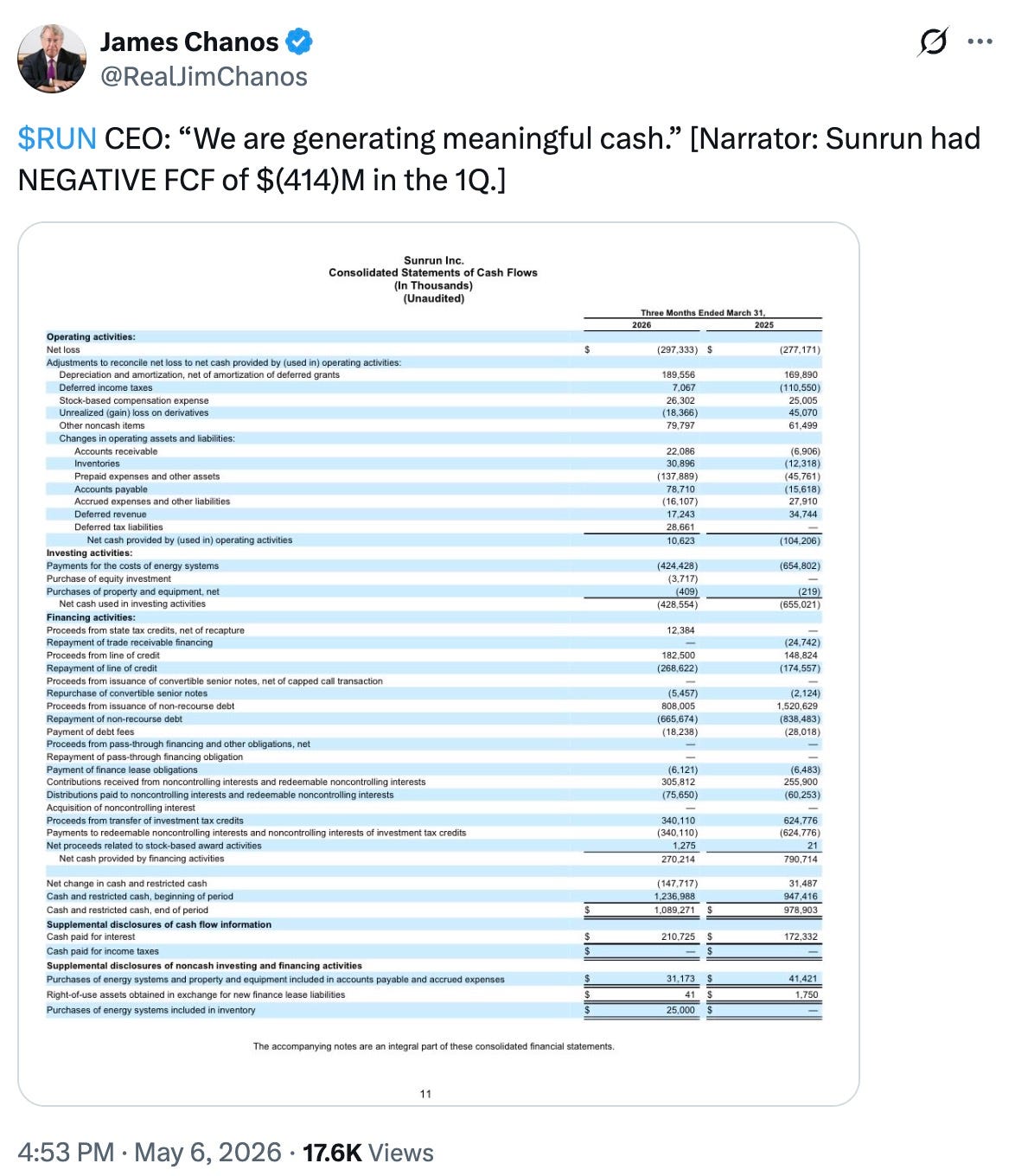
This happens every quarter, every call, every day on public markets already. And we can’t wrangle control of it with the amount of transparency we already have. Why would we cut reporting frequency in half and make detection even harder?
This proposal feels like a setup for ordinary investors to get crushed. Retail investors, pension funds, retirement accounts, and public-worker funds depend on timely disclosures because they don’t have private backchannels with CEOs, hedge funds, or Wall Street insiders. When information gets delayed, insiders still find ways to protect themselves…everyone else gets left holding the bag when the truth finally drops six months later.
Being a public company is supposed to come with annoying obligations because you are taking money from the public. If executives think filing regular disclosures is too much work, they are welcome to stay private.
Before we start making it easier for companies to hide problems longer, maybe we should first figure out how to hold companies accountable for the fraud that is already happening in broad daylight. Until then, this looks less like reform and more like an engraved invitation for more opacity, more misconduct, and bigger losses for everyday investors saving for retirement.

QTR’s Disclaimer: Please read my full legal disclaimer on my About page here. This post represents my opinions only. In addition, please understand I am an idiot and often get things wrong and lose money. I may own or transact in any names mentioned in this piece at any time without warning. Contributor posts and aggregated posts have been hand selected by me, have not been fact checked and are the opinions of their authors. They are either submitted to QTR by their author, reprinted under a Creative Commons license with my best effort to uphold what the license asks, or with the permission of the author.
This is not a recommendation to buy or sell any stocks or securities, just my opinions. I often lose money on positions I trade/invest in. I may add any name mentioned in this article and sell any name mentioned in this piece at any time, without further warning. None of this is a solicitation to buy or sell securities. I may or may not own names I write about and are watching. Sometimes I’m bullish without owning things, sometimes I’m bearish and do own things. Just assume my positions could be exactly the opposite of what you think they are just in case. If I’m long I could quickly be short and vice versa. I won’t update my positions. All positions can change immediately as soon as I publish this, with or without notice and at any point I can be long, short or neutral on any position. You are on your own. Do not make decisions based on my blog. I exist on the fringe. If you see numbers and calculations of any sort, assume they are wrong and double check them. I failed Algebra in 8th grade and topped off my high school math accolades by getting a D- in remedial Calculus my senior year, before becoming an English major in college so I could bullshit my way through things easier.
The publisher does not guarantee the accuracy or completeness of the information provided in this page. These are not the opinions of any of my employers, partners, or associates. I did my best to be honest about my disclosures but can’t guarantee I am right; I write these posts after a couple beers sometimes. I edit after my posts are published because I’m impatient and lazy, so if you see a typo, check back in a half hour. Also, I just straight up get shit wrong a lot. I mention it twice because it’s that important.
Retail is simply exit liquidity.
Less reporting to me means more opportunity to hide relevant information. The numbers normally speak for themselves (unless you’re CVNA😡)and give frames of reference that have some validity. Could you imagine trying to trade something you only get a real number on every 6 months?
Doesn’t sound like a great idea to me.