

One of the more batshit insane developments in modern financial markets recently is that owning profitable, dividend-paying blue-chip companies somehow became an unfashionable investment strategy.
What started with Alan Greenspan innocently taking a few hits off the monetary crack pipe under a bridge eventually turned into a full-blown, twenty-year addiction, with the entire financial system living on financial skid row waiting for its next fix.

Between 0% interest rates, quantitative easing and central banks treating every market hiccup like a life-threatening withdrawal, we’ve managed to create a financial system so thoroughly addicted to cheap money and rising asset prices that investors are practically embarrassed to own businesses that generate actual cash and pay it back to shareholders.
Instead, we’ve conditioned an entire generation to chase whatever speculative growth narrative happens to be inflating at the moment while ignoring enormous distortions in asset prices, capital allocation and risk.
The most remarkable part is that virtually nobody, aside from a couple of us tin-foil hat wearing permabear “grifters” writing newsletters seem to give a shit about any of it, provided the nominal price of their stocks, homes and other financial assets keeps going up. We’ve spent twenty years confusing asset price inflation with genuine prosperity, speculation with investing and central bank liquidity with actual wealth creation. It’s our financial Matrix.

So perhaps it shouldn’t be surprising that one of my more interesting investment ideas heading into 2027 is something that would have been considered perfectly ordinary a generation ago but is hated now: buying a boring, profitable sector that pays dividends.
I was worried heading into 2027 that I wouldn’t have a broader outlook on the market, but now some ideas are starting to emerge organically. I have a sneaking suspicion that one of the biggest investment themes of 2027 is going to be something that would have seemed perfectly ordinary twenty or thirty years ago, but today feels almost revolutionary: owning boring, profitable, dividend-paying blue-chip stocks.
You know. Old school shit.

What happened to the kind of companies our parents and grandparents might have owned, with recognizable businesses, established customers, predictable earnings and dividends that actually contribute something meaningful to an investor’s total return?
Before every investment pitch required some combination of explanation of how a company’s total addressable market was larger than the Earth’s economy, there was a time when investors seemed to care a little more about how much money a business actually made relative to how much they were paying for it.

I think we may be getting ready to revisit that blue chip era, particularly if I’m right about the kind of market turmoil that could be heading our way over the next six to twelve months. And while I don’t expect investors to abandon technology or growth investing altogether, I suspect there could be a meaningful shift toward companies whose appeal rests primarily on the cash they generate today rather than the earnings investors hope they’ll generate ten years from now.
A couple of days ago, I wrote about a sector that I’ve almost never highlighted before, but which has suddenly caught my attention as I begin thinking about my 2027 watchlist. Essentially, I was looking at businesses that have spent years frustrating shareholders. They’re mature, relatively unexciting, capital-intensive and have largely been abandoned in favor of faster-growing companies with more compelling stories to tell.
They have legitimate risks, including substantial debt burdens and limited organic growth, but they also provide services people need regardless of the economic environment, generate recurring revenue and, in some cases, return meaningful amounts of cash to shareholders.
A recent piece of news sent several of these stocks sharply lower, and instead of convincing me to stay away, it made me more interested. It got me thinking about how many other perfectly respectable businesses have been left behind as investors have spent the better part of the last decade chasing increasingly narrow growth narratives.
I wonder whether this could be a preview of a broader rotation heading into 2027, not just toward traditionally defensive sectors, but toward old-school blue chips in general: established industrial companies, mature technology businesses, select financial institutions, energy producers and consumer companies that may not be growing at spectacular rates but are generating real profits and returning capital to shareholders.
According to State Street’s July 2026 analysis, the Russell 1000 Value Index was trading at approximately 17.5x forward earnings, compared with 24.2x for the Russell 1000 Growth Index. That represents a nearly 40% premium for growth stocks based on those multiples, illustrating just how much more investors have been willing to pay for businesses promising faster earnings expansion.
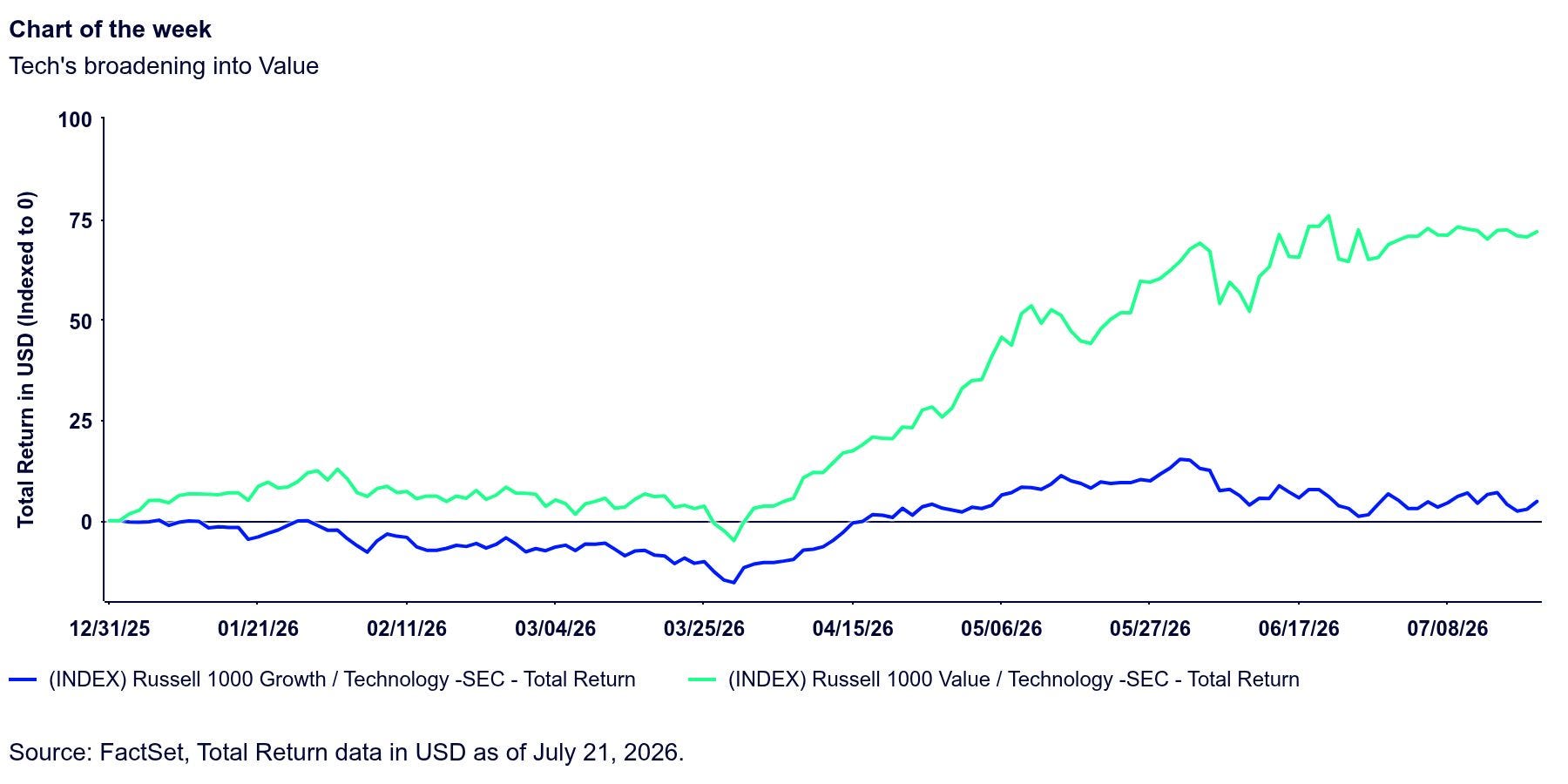
The valuation disparity is hardly a new phenomenon. During the late 1990s, investors similarly abandoned many traditional businesses in favor of technology stocks, with the Russell 1000 Growth Index subsequently losing more than 60% from its 2000 peak to its 2002 trough. Value stocks weren’t immune to the bear market, but their relative performance was substantially better. It’s an imperfect comparison, but an instructive reminder that the market’s favorite investment style doesn’t necessarily remain its favorite forever.
More recently, J.P. Morgan Asset Management noted that the ten largest companies accounted for more than 40% of the S&P 500’s market capitalization in its July 2026 data, while the combined weight of technology and communication services had grown from 22% of the index in 2014 to 47% in 2026.
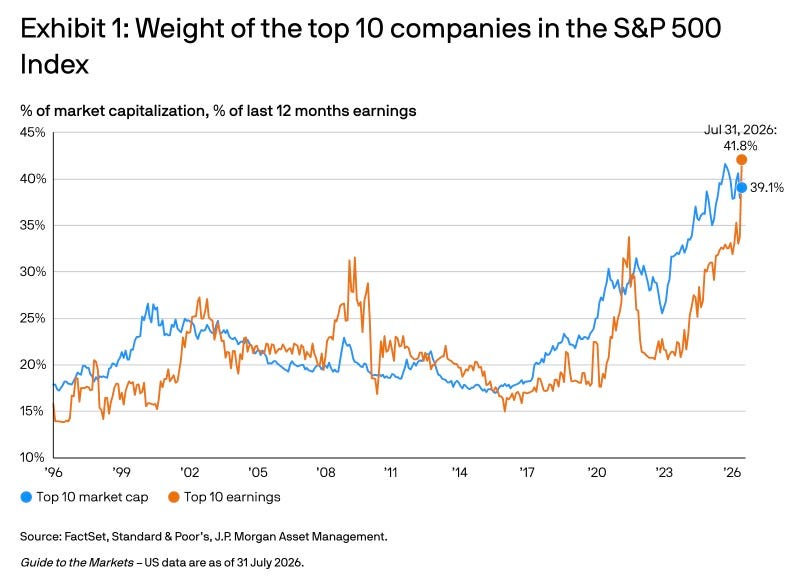
That’s a remarkable amount of concentration for a benchmark that millions of Americans rely on for diversified equity exposure. It also means the fortunes of the broader index have become unusually dependent on a handful of enormous companies, many of which are exposed, directly or indirectly, to the same artificial intelligence investment cycle. It’s why I look at long-term index investing slightly differently for those who decide to stay in the market long-term and ride out dips.

My concern isn’t necessarily with the quality of these businesses. Some are among the most profitable enterprises in history, with extraordinary competitive advantages and enormous free cash flow. My concern is with the valuations investors have assigned to them and the increasingly optimistic assumptions required to justify those prices.
And I think we got a small taste of what could happen when those assumptions are questioned during last week’s selloff.
On October 8, a report suggesting that OpenAI’s annualized revenue was approximately $20 billion below an earlier projection prompted selling across several major AI-related stocks. The Nasdaq Composite fell roughly 1.25%, while the S&P 500 declined just 0.47% and the Dow Jones Industrial Average actually finished slightly higher.
There were legitimate questions about whether the OpenAI figures were being compared on an apples-to-apples basis, so I wouldn’t necessarily interpret the report as evidence that AI demand was suddenly deteriorating. What interested me was how quickly investors reacted to the possibility that one of the assumptions supporting the AI trade might be overly optimistic, and how much better other parts of the market held up.

I was watching the relative resilience of stocks in other industries. The divergence was interesting because it suggested that investors were initially much more aggressive about selling companies directly associated with the AI narrative than they were about abandoning equities indiscriminately.
That’s not definitive evidence of a lasting rotation, but it fits with my suspicion that businesses trading on more conventional earnings and valuation metrics could begin attracting greater interest if confidence in the market’s most crowded growth trades starts to fade.
I’ve spent much of this year arguing that the market has become dangerously dependent on artificial intelligence as an investment theme, even as the broader financial system continues to grapple with enormous debt burdens, persistent fiscal deficits and the possibility that interest rates remain higher than investors have grown accustomed to expecting.
If we get the turmoil I think is possible, I wouldn’t expect defensive stocks to be immune completely. During a genuine liquidity crisis, investors sell what they can, not necessarily what they want to, and even companies with strong fundamentals can experience substantial drawdowns. But there’s a meaningful difference between owning a company whose valuation is supported by current earnings and sustainable dividends and owning one whose valuation depends on an extraordinary series of favorable outcomes extending years into the future. I’d rather own a blue chip that goes from 17x earnings to 10x earnings than an unprofitable tech company that goes from trading at 50x sales to 5x sales.
Interestingly, some of this rotation may already be underway. An August analysis from VettaFi noted that the Russell 1000 Value Index had returned approximately 32% over the preceding year, compared with just 14% for the Russell 1000 Growth Index, while also highlighting investor inflows into value-oriented and dividend-focused ETFs.
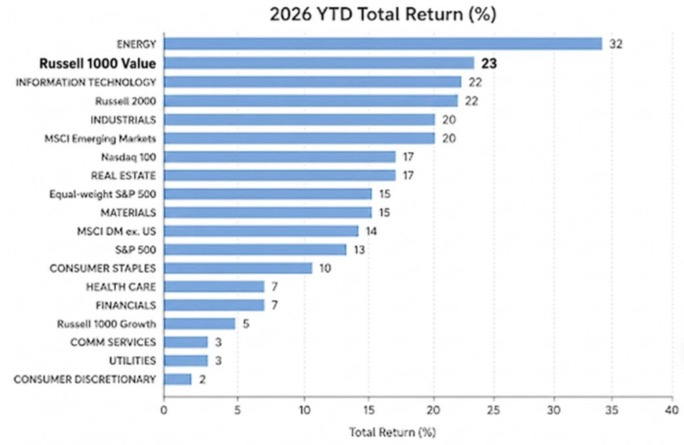
After years in which growth investing has dominated the conversation, I think the possibility of a sustained change in market leadership deserves serious consideration.
And I’m also particularly interested in the role dividends could play if that happens.
One of the things I think investors have forgotten during this extraordinary growth-stock mania is total return. A stock doesn’t need to double every eighteen months to be worthwhile. Consider a hypothetical business trading at 12x earnings, paying a sustainable 4% dividend and growing earnings by 3% annually. Assuming its valuation multiple remains unchanged and its dividend is maintained, an investor could potentially earn something approaching a 7% annual total return before taxes.
Compounded over ten years, that would nearly double an investment without requiring the market to assign the business a higher valuation. And if sentiment eventually improves enough to produce some multiple expansion, the results could be considerably better.
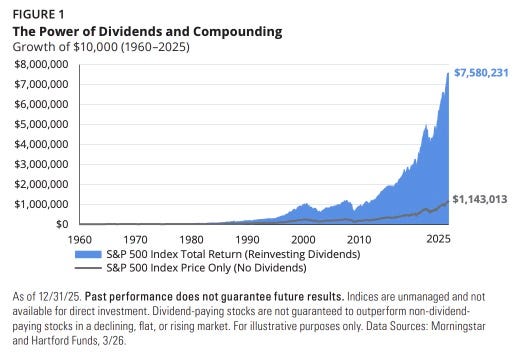
There is historical precedent for the importance of dividends. According to Hartford Funds’ long-running analysis of S&P 500 returns, dividends and their reinvestment accounted for approximately 85% of the index’s cumulative total return from 1960 through 2024, measured by comparing cumulative returns with and without reinvested dividends. That doesn’t mean dividends will provide the same contribution over the next decade, but it illustrates how important they can become when investors give compounding enough time to work.
This also brings me back to something I was discussing the other day, which I increasingly think is going to become the central thesis behind much of my investing and writing heading into 2027: eventually, reality, fundamentals, mathematics and general common sense are going to matter again, despite how little they have sometimes seemed to matter over the last ten or twenty years.
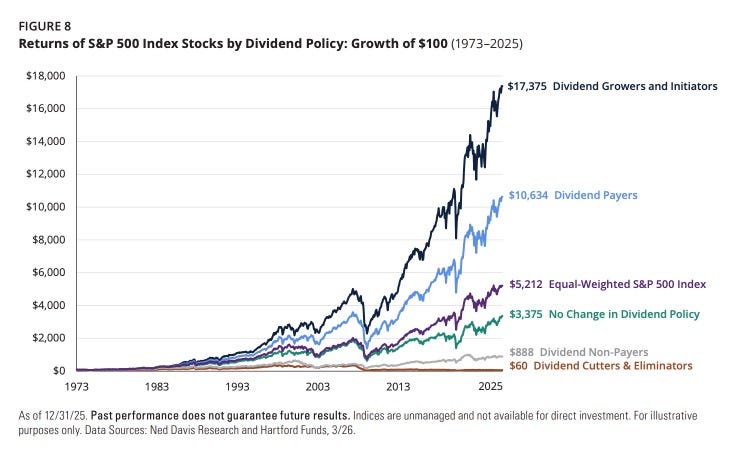
We’ve spent so much time in an environment where liquidity and narratives have overwhelmed traditional valuation considerations that investors have practically been conditioned to regard skepticism about prices as evidence that someone simply doesn’t understand the future. Between zero interest rates, quantitative easing, enormous fiscal deficits and the AI boom, it has often seemed as though the answer to every financial problem was more liquidity, more borrowing or a sufficiently compelling story about what might happen next.
But I don’t believe we’ve permanently repealed the basic principles of investing, and I certainly don’t believe that identifying a transformative technology automatically means every company associated with it deserves an extraordinary valuation.
History is full of technological revolutions that produced enormous economic benefits while simultaneously destroying investor capital. The internet is the most obvious recent example, but the same lesson applies to railroads, automobiles and telecommunications. I have no doubt artificial intelligence will produce extraordinary advances and that some of the companies developing it will ultimately justify today’s enthusiasm. But I also suspect many investors are going to discover that being correct about the importance of a technology and being correct about the price paid for an investment are two very different things.
And if that realization begins spreading through the market, I think it could create an interesting environment for businesses that have spent years being ignored precisely because they aren’t promising to reinvent the global economy.
I continue to believe the next serious financial crisis could originate in sovereign debt and interest rates rather than the traditional places investors have become accustomed to watching. If borrowing costs remain elevated or rise sharply, highly leveraged companies could find themselves under considerable pressure, regardless of how attractive their dividend yields might appear today. A genuine credit event could also drag down otherwise healthy businesses as investors liquidate assets and reassess risk across the board.
For that reason, I don’t think the answer is to rush out and buy every supposedly cheap blue chip tomorrow morning. I suspect there may be substantially better opportunities ahead, particularly if the broader market experiences the kind of correction I’ve been anticipating. One of the reasons I’m studying these companies now is that I want to have a list of businesses I’d be comfortable owning before volatility potentially creates more attractive entry points.
Ultimately, I think we’re approaching a period when investors may rediscover the appeal of companies that can deliver reasonable returns without requiring an ever-expanding valuation multiple. Whether that happens through a gradual rotation away from expensive growth stocks or a much more violent market repricing remains to be seen, but either way, I suspect the relative attractiveness of boring, cash-generating businesses is going to become increasingly difficult to ignore.
After years of Wall Street obsessing over disruption, exponential growth and the next revolutionary technology, one of the more compelling investment themes heading into 2027 may turn out to be a return to the kinds of companies that formed the backbone of investment portfolios decades ago.
I’m not suggesting every old-school blue chip is a bargain, or that a dividend will protect shareholders from a bear market. But I do think there’s a reasonable chance that the market’s willingness to pay virtually any price for growth is approaching its limits, and that investors may eventually begin assigning greater value to businesses that offer something more tangible than an exciting story about the future.
After the last several years of financial market insanity, boring is starting to look pretty damn good.

QTR’s Disclaimer: Please read my full legal disclaimer on my About page here. This post represents my opinions only. In addition, please understand I am an idiot and very often get things wrong and lose money. I may own or transact in any names mentioned in this piece at any time without warning, meaning if I’m long I could sell or if I’m short I could cover at any time. Positions can change immediately. This is not a recommendation to buy or sell any stocks or securities, just my opinions. I often lose money on positions I trade/invest in. I may add any name mentioned in this article and sell any name mentioned in this piece at any time, without further warning.
I also may or may not own names I write about and are watching. Sometimes I’m bullish without owning things, sometimes I’m bearish and own things I’m bearish on. Just assume my positions could be exactly the opposite of what you think they are just in case. If I’m long I could quickly be short and vice versa. I won’t update my positions.
I cannot guarantee the accuracy of any or all facts and figures included in this article though I made an effort to get them right. I have been wrong before and will be wrong again, and encourage you to always double check, do your own research and speak to a licensed financial professional, which I am not.
Contributor posts, guest posts and curated posts have been hand selected by me, but have not been fact checked and are the opinions of their authors. They are either submitted to QTR by their author or reprinted under a Creative Commons license with my best effort to uphold what the license asks, or with the permission of the author.
Since 2026, I have been making an attempt to no longer actively trade as much as I once did (read my story here). In an attempt to lead a healthier lifestyle, I’ve also excluded myself from most fantasy sports, sports betting, online and in-person casinos and prediction markets.
My goal is for my investing/saving to be done by recurring contributions mostly to sector ETFs and a few select equities, trusted third parties who oversee my accounts, and advisors. Such advisors or funds, through individual equities, options, index funds, mutual funds, ETFs, or other securities, may have positions in, exposure to, or holdings of names mentioned herein that I know nothing about. Basically, it is possible I could own, have exposure to, or not own anything, at any point.
You are on your own. Do not make decisions based on my blog. I exist on the fringe. Again, I get shit wrong a lot, both in the market and in life, but am trying my best. If you see numbers and calculations of any sort, assume they are wrong and double check them. I failed Algebra in 8th grade and topped off my high school math accolades by getting a D- in remedial Calculus my senior year, before becoming an English major in college so I could bullshit my way through things easier. Hence, I am a writer. I write these posts after a couple beers sometimes. Many times I edit after my posts are published because I’m impatient and lazy, so if you see a typo, check back in a half hour. Thanks, you’ve been a great crowd and don’t forget to tip your servers.
Screw the fashion police no matter what nonsense they are spewing.
The Deep State's "operations" depend on the continued existence of the "Everything Bubble" at the same time that their hatred of Trump has driven them insane with TDS so they are doing everything they can to "tank" the economy prior to the Midterms. The next 6 months after 11/3 will be quite "interesting" (in the sense of the ancient Chinese curse: "May you live in interesting times") and we may very well be entering the "crisis" phase of this Fourth Turning. Stay buckled up!