

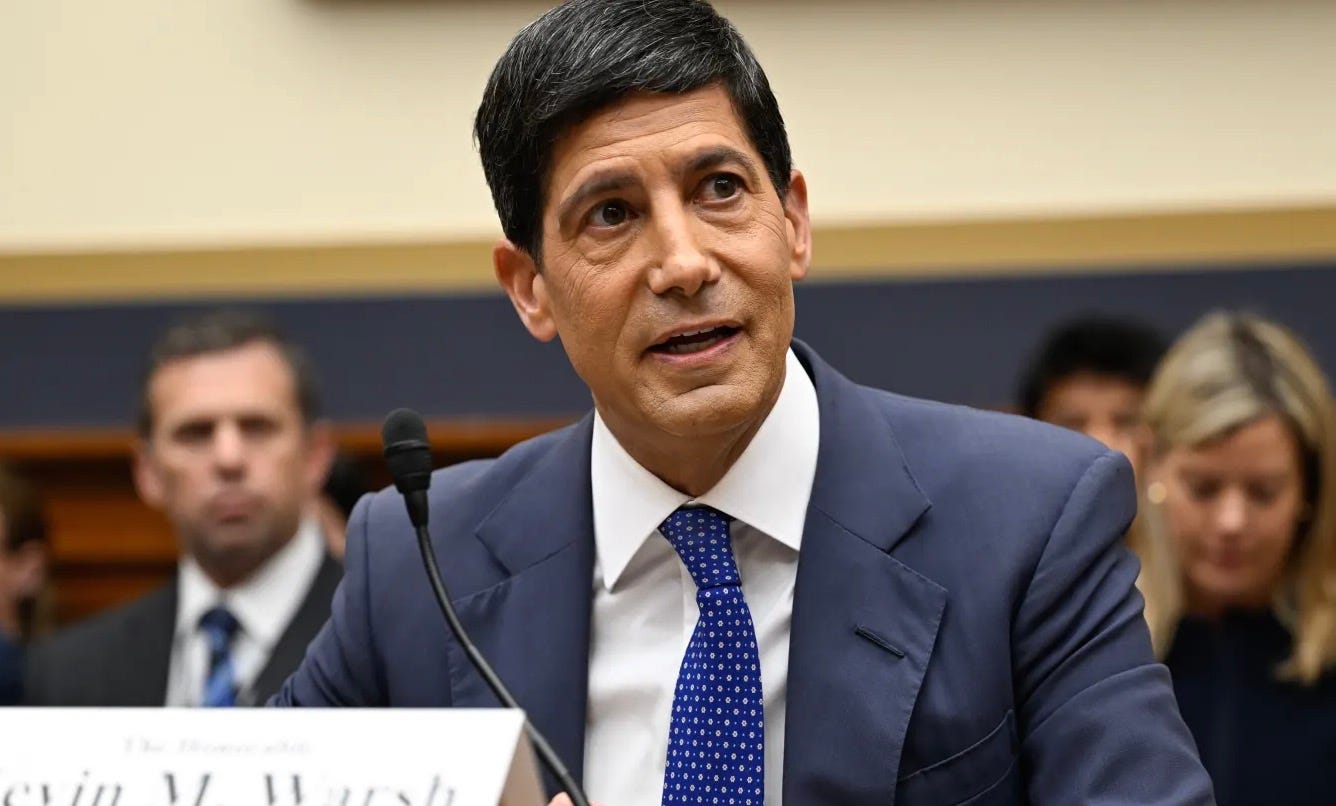
Kevin Warsh arrived on Capitol Hill today with a familiar promise. This time, the Federal Reserve is finally going to get inflation right. Hell, I guess it’s better than Janet Yellen’s term as Fed Chair in which she spent what seemed like a decade wandering around Capitol Hill like Junior Soprano with dementia and asking those around her: “What is inflation, anyways?”
“The Fed’s number one objective is to get monetary policy right, or as near to it as we possibly can,” Warsh told lawmakers today. “That is our clear and constant aim, the star we steer by.” He added that “if we get policy right, and we will, the inflation surge of the last five years will be a thing of the past.”
Those are bold words. They’re also the easiest words he’ll say during his entire tenure.
Warsh repeatedly stressed that the Fed has “no tolerance for persistently elevated inflation” and said the committee shares “a resolute commitment to restoring price stability.” He called inflation “a tax on the American people and businesses” and promised, “We plan on getting rid of that tax.”
He also took direct aim at the Fed’s 2020 flexible average inflation targeting framework, saying, “That central bank wasn’t the first central bank to ask for a little more inflation and end up with a lot more. It was a mistake.”
Serious sounding shit, right? On paper, it’s hard to disagree with much of what he said. The previous framework failed. Inflation has remained above target for years. Price stability matters.
The problem is that every Fed chair sounds like an inflation hawk until something breaks. To quote Mike Tyson, “Everyone’s got a plan until they get punched in the mouth.”
Speeches are free. Defending the currency when stocks are down 40% is slightly more complicated and expensive, both in political capital and reputation.
It’s hilarious to watch. Warsh speaks as though inflation can simply be pushed back to 2% through better decision making and institutional reform. And sure, he’s right. But what are the trade-offs? My skepticism isn’t about whether he understands the problem. It’s whether the problem is still solvable without consequences that neither Wall Street, Washington, nor the public is prepared to stomach.
The country’s fiscal and monetary policies are nothing short of fucking nightmares. They are a train that has been well off the tracks for years, never to turn back around…only waiting for a terminus. Inflation has now been running above the Fed’s target for years. Government debt has exploded. Fiscal deficits remain enormous. Asset prices continue to depend on abundant liquidity.
Getting inflation sustainably back to 2% isn’t simply a matter of declaring victory over a failed framework. Or putting task forces to work. It likely requires monetary conditions that slow growth, pressure employment, compress asset valuations, and expose the excesses built during years of artificially cheap money. In other words, all the things politicians and investors suddenly discover they hate.
That’s where the rhetoric collides with reality.
Warsh insists, “The members of our Committee have no tolerance for persistently elevated inflation.”
Yeah. Maybe. But history suggests that completely chickenshit economists, analysts, TV commentators and central banker discover an awful lot of tolerance once the S&P 500 is in freefall, credit markets seize up, and CNBC starts running countdown clocks to emergency Fed meetings.
His confidence that “if we get policy right, and we will” sounds reassuring. It also sounds awfully familiar. Every Fed chair arrives convinced they’ll succeed where their predecessors stumbled. Every Fed chair talks about discipline. Almost every Fed chair eventually finds themselves choosing between defending markets and defending the purchasing power of the dollar.
Funny how markets usually win, eh? The uncomfortable truth is that inflation may prove far stickier than policymakers expect. And if it does eventually return to 2%, there’s a very real chance it won’t happen because of elegant policy reforms or five shiny new task forces. It’ll happen because the economy finally buckles under restrictive financial conditions.
If that’s the price of restoring credibility, will the Fed actually pay it?
That’s the question missing from Warsh’s testimony. His repeated promises of “regime change” and declarations that inflation will become “a thing of the past” make for great headlines. They also make for great soundbites. The real test doesn’t come during congressional testimony. It comes when the phones start ringing from Capitol Hill, the White House, and Wall Street, all demanding the same thing: cut rates, print money and save the market.
We’ll find out what Kevin Warsh is really made of during the next serious equity market crash.
That’s when every Fed chair faces the same defining choice. Tolerate market pain in pursuit of price stability, or rescue financial assets at the expense of inflation discipline. My bet is the same one it’s been for years.
When the pressure becomes unbearable, the printing presses will win.

QTR’s Disclaimer: Please read my full legal disclaimer on my About page here. This post represents my opinions only. In addition, please understand I am an idiot and often get things wrong and lose money. I may own or transact in any names mentioned in this piece at any time without warning. Contributor posts and aggregated posts have been hand selected by me, have not been fact checked and are the opinions of their authors. They are either submitted to QTR by their author, reprinted under a Creative Commons license with my best effort to uphold what the license asks, or with the permission of the author.
This is not a recommendation to buy or sell any stocks or securities, just my opinions. I often lose money on positions I trade/invest in. I may add any name mentioned in this article and sell any name mentioned in this piece at any time, without further warning. None of this is a solicitation to buy or sell securities. I may or may not own names I write about and are watching. Sometimes I’m bullish without owning things, sometimes I’m bearish and do own things. Just assume my positions could be exactly the opposite of what you think they are just in case. If I’m long I could quickly be short and vice versa. I won’t update my positions.
As of May 20, 2026 I personally no longer actively trade (read my story here). My investing/saving is done by recurring contributions mostly to sector ETFs and a few select equities, trusted third parties who oversee my accounts, and advisors. Such advisors or funds, through individual equities, options, index funds, mutual funds, ETFs, or other securities, may have positions in, exposure to, or holdings of names mentioned herein that I know nothing about. Basically, via index funds, ETFs and individual equities it is possible I could own, have exposure to, or not own anything at any point. As of the same date, May 20, 2026, in an attempt to lead a healthier lifestyle, I’ve also excluded myself from fantasy sports, sports betting, online and in-person casinos and prediction markets.
And all positions can change immediately as soon as I publish this, with or without notice and at any point I can be long, short or neutral on any position. You are on your own. Do not make decisions based on my blog. I exist on the fringe. If you see numbers and calculations of any sort, assume they are wrong and double check them. I failed Algebra in 8th grade and topped off my high school math accolades by getting a D- in remedial Calculus my senior year, before becoming an English major in college so I could bullshit my way through things easier.
The publisher does not guarantee the accuracy or completeness of the information provided in this page. These are not the opinions of any of my employers, partners, or associates. I did my best to be honest about my disclosures but can’t guarantee I am right; I write these posts after a couple beers sometimes. I edit after my posts are published because I’m impatient and lazy, so if you see a typo, check back in a half hour. Also, I just straight up get shit wrong a lot. I mention it twice because it’s that important.
I get that you are a skeptic, especially when it comes to the Fed and inflation, as you are too young to remember the only Fed chair who actually walked the walk. But I have to say, that of all those who followed Volcker, Warsh is the first who has demonstrated any understanding of the underlying issues. remember this, the Fed is a massive institution with 100+ years of history and making changes is going to take time. you are correct that much will be learned during the first market crisis of note that comes, but then, despite your certitude that is right around the corner, it has not yet arrived.
I, for one, feel far better that he seems to understand where inflation comes from and does not worship the false gods of the Fed model of monetary policy. We shall see, but I wouldn't give up hope yet. I assure you, when Volcker was appointed, nobody thought he could do what he did either
These Zimbabwean rate hikes, are they in the room with us?