

By Jake Scott, Foundation for Economic Education
In the last month, the small nation of Malaysia has risen in the views of global investors. Drawn by the country’s political stability and economic growth, investors increasingly consider Malaysia a safe method for diversification in the Pacific region amid a softening US dollar and a tumultuous global economy. In 2025 alone, investors poured over $5 billion into local currency debt—the highest in the region—leading to the Malaysian currency, the Ringgit, reaching its highest point since 2018.
So strong is this economic growth that Malaysia has been the latest nation to claim the title of “Asian Tiger.”
This resurgence from the 1MDB scandal of 2020, that saw billions of government money disappear, should not be read as accidental or a mere coincidence of location, though that’s part of it: Malaysia sits in a “sweet spot between low-yielders, such as Singapore, Thailand, and South Korea, and high-yielders such as Indonesia and India, which come with their own set of risks,” according to portfolio manager at Eastspring Investments, Rong Ren Goh.
A major part of the repositioning of Malaysia as a desirable location for investment is a consequence of intentional strategic and structural realignment. Over the past year, Malaysia has come to be seen as a strategic node in vital global supply chains. The main reason for this is the role of the semiconductor industry in Malaysia’s economy. The state of Penang—located on the Northwest Coast of Peninsular Malaysia, and nicknamed “Silicon Island”—has long functioned as a hub for assembly and testing, but supply chain diversification, driven by US–China tensions, has pushed multinational firms to deepen operation in Southeast Asia.
As a result, Penang has now become a center of chip packaging and manufacturing as it expands capacity to absorb redirected global demand. This matters because Malaysia is not attempting to replicate, for instance, Taiwan’s fabrication dominance; it is, instead, consolidating its position in the midstream and backend of the semiconductor value chain, where reliability and skilled labor pools are decisive.
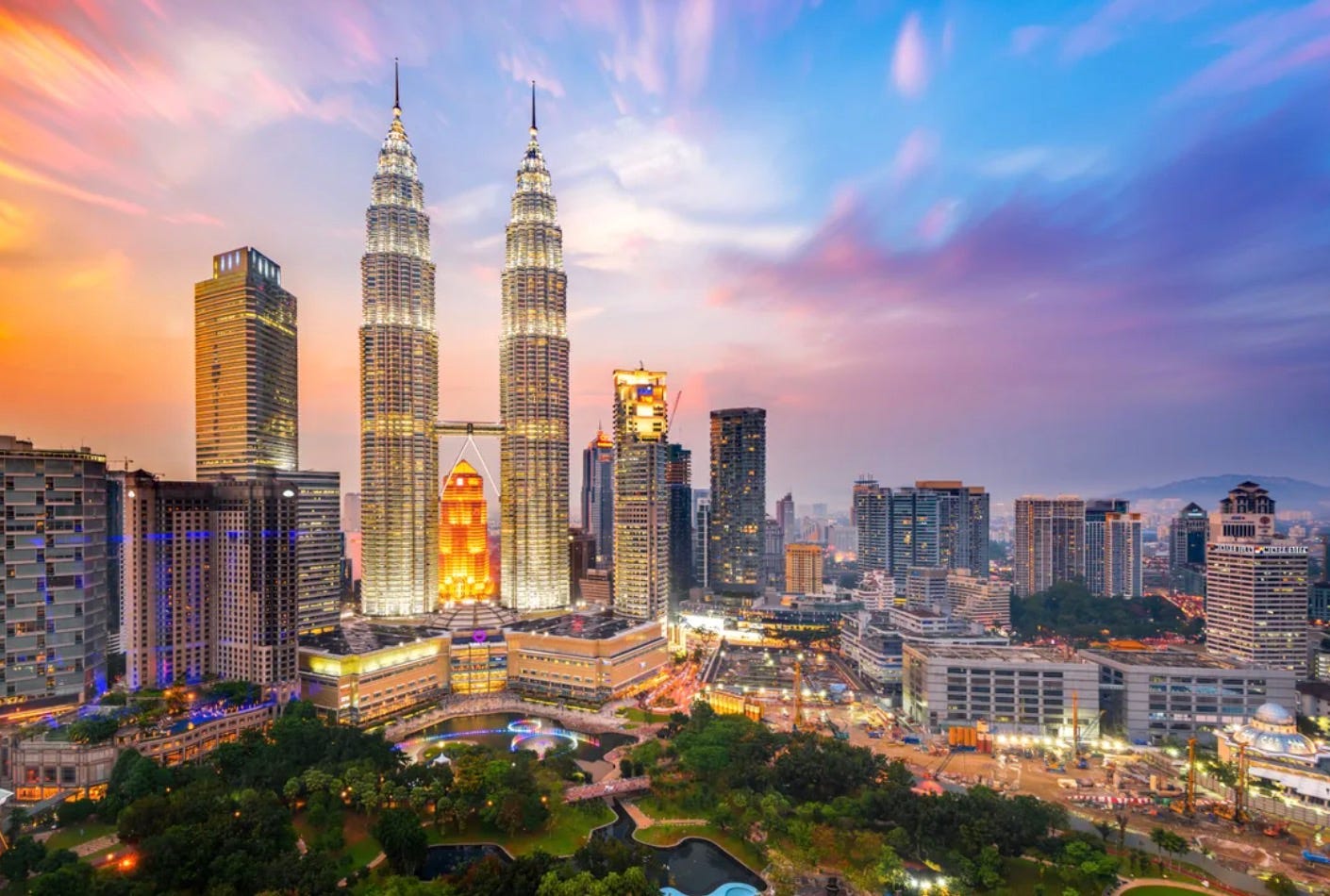
Another key reason for Malaysia’s sudden rebounding is its macroeconomic credibility. While the Ringgit experienced sustained pressure between 2015 and the pandemic period, predominantly as a result of political uncertainty and fiscal strain, the renewed foreign accumulation of Malaysian government bonds and a recovered export industry has led to a shift in dynamics.
This, in turn, is due to an extensive program of fiscal reform, signaling to global markets that Malaysia is a safe place to invest, and experiencing political continuity under the unity government of Anwar Ibrahim, Prime Minister since 2022. Malaysia has historically relied on fuel subsidies, but from June 2024 has restricted diesel subsidies in an attempt to bring prices in line with market rates, saving the Malaysian state roughly $145 million over the course of the following year.
Attempts to signal political continuity alongside social stability and fiscal flexibility are read around the world as indications that the country is safe, secure, and trustworthy, creating credibility that builds trust. As a result, Malaysia has taken advantage of global instability supported by long-term fiscal strengthening.
This recent trajectory, successful as it is, must be read against Malaysia’s recent history. The Asian Financial Crisis of 1997–1998, which saw capital flights from the region and slumping currencies, left a durable imprint on the globally exposed economies like Malaysia, especially on the political culture. An overly-cautious culture emerged, meaning that financial liberalization and free trade were viewed with skepticism and wariness. Such an institutional legacy was inherited, and is maintained, by the current administration, seeking global integration without overexposure.
For all this intentional positioning at home, Malaysia’s rise cannot be read in isolation; it is, in part, a product of the Southeast Asia region’s deepening integration as a collective economic bloc, with Malaysia increasingly being thought of as its most credible anchor. In fact, for 2025, Malaysia held the Chairmanship of the Association of Southeast Asian Nations (ASEAN), with the focus of the year on “Inclusivity and Sustainability,” while the IMF noted in February 2026 that “deeper trade and financial integration within ASEAN can boost Malaysia’s growth potential.” As a result, Malaysia is benefiting from regional cohesion and producing it at the same time; it now stands with Vietnam, Thailand, and the Philippines as the economies expected to power regional growth throughout the remainder of the 2020s. Will Malaysia remain distinct enough in that group? Perhaps by continuing to be a hub for global and Western capital investment, and leaning into that role it has carved out for itself.
Part of this major global investment is in digital transformation, especially for data centers, a sector that in Malaysia alone is projected to be valued at over $13 billion by 2030. Many of the big players—Google, Amazon, Microsoft—have established and growing presences in Malaysia, attracted by the country’s innovative “Green Lane Pathway,” and its Corporate Renewable Strategy that, as pointed out by Tim Fourteau, “allows operators to procure renewable energy directly from developers via the national grid… driving faster and more sustainable energy adoption.” Data centers are now projected to contribute RM14.1 billion ($3.5 billion) to the economy in 2025 alone, and their energy demands are in turn accelerating the construction of large-scale solar infrastructure.
But Malaysia needs to be wary; what attracts investors to the country, and has made it a regional player, is exactly what other neighboring economies are relying on. Vietnam alone recorded nearly 8% GDP growth in 2025 and attracted $38 billion in foreign direct investment (FDI), concentrated in AI infrastructure. This is the exact market that Malaysia is courting—and Vietnam offers lower labor costs. Not only this, but Malaysian goods currently experience a 19% tariff from the US, weighing on export performance.
There are both structural and political reasons, however, that mean Malaysia will continue to stand apart from its neighbors. The fact that English is taught in schools across the country means that the population’s proficiency in English is high (roughly 60% and growing), keeping an open door to the West, compared to much lower rates in Vietnam (approximately 10%) or Thailand (around 35%).
Malaysia’s fortunes are bright, and its economy is set to benefit from a global boom in the sectors it has long excelled in. It will require careful statecraft from its political elite to make hay while the sun shines, and help the nation to stand head and shoulders above its competing neighbors.

QTR’s Disclaimer: Please read my full legal disclaimer on my About page here. This post represents my opinions only. In addition, please understand I am an idiot and often get things wrong and lose money. I may own or transact in any names mentioned in this piece at any time without warning. Contributor posts and aggregated posts have been hand selected by me, have not been fact checked and are the opinions of their authors. They are either submitted to QTR by their author, reprinted under a Creative Commons license with my best effort to uphold what the license asks, or with the permission of the author.
This is not a recommendation to buy or sell any stocks or securities, just my opinions. I often lose money on positions I trade/invest in. I may add any name mentioned in this article and sell any name mentioned in this piece at any time, without further warning. None of this is a solicitation to buy or sell securities. I may or may not own names I write about and are watching. Sometimes I’m bullish without owning things, sometimes I’m bearish and do own things. Just assume my positions could be exactly the opposite of what you think they are just in case. If I’m long I could quickly be short and vice versa. I won’t update my positions. All positions can change immediately as soon as I publish this, with or without notice and at any point I can be long, short or neutral on any position. You are on your own. Do not make decisions based on my blog. I exist on the fringe. If you see numbers and calculations of any sort, assume they are wrong and double check them. I failed Algebra in 8th grade and topped off my high school math accolades by getting a D- in remedial Calculus my senior year, before becoming an English major in college so I could bullshit my way through things easier.
The publisher does not guarantee the accuracy or completeness of the information provided in this page. These are not the opinions of any of my employers, partners, or associates. I did my best to be honest about my disclosures but can’t guarantee I am right; I write these posts after a couple beers sometimes. I edit after my posts are published because I’m impatient and lazy, so if you see a typo, check back in a half hour. Also, I just straight up get shit wrong a lot. I mention it twice because it’s that important.
Malaysia and other EM's have done very well for the past year. The war in Iran has affected those markets as it has the markets in America. But once it concludes, those markets should resume the growth they had prior to the start of the war.
Regarding Malaysia, it is interesting as it has one of the very few active, rare earth processing plants in the world outside of China.
Are there Malaysia-only ETFs that allow you to invest in the country separate from those focused on a basket of Southeast Asian economies?