

Let’s talk about the one sector I think has the most upside potential in 2026, but also the biggest risk.
I wrote about psychedelic companies in 2025 and they helped our 25 names for the year vastly outperform the S&P 500. The AdvisorShares Psychedelics ETF (PSIL), my preferred way to get access to the space, finished 2025 beating the S&P 500 by about 40%. There’s also names like MNMD and CMPS that I like.
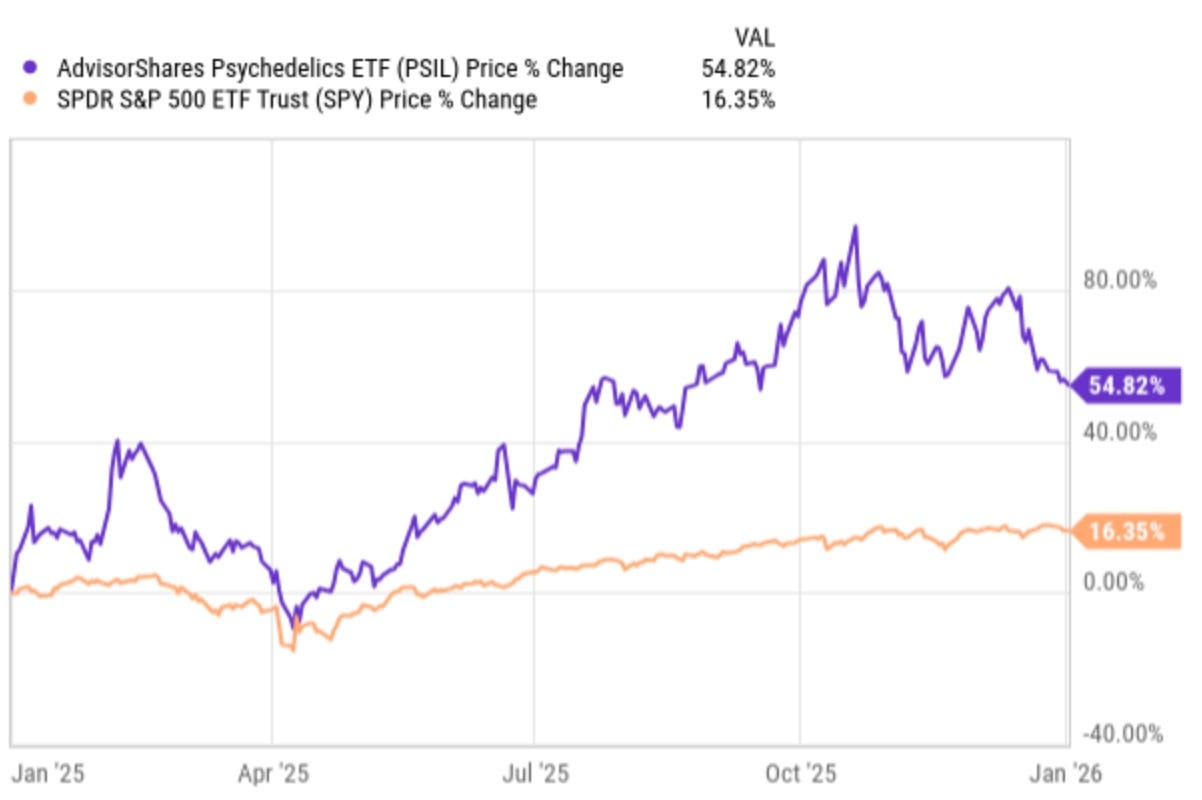
But that doesn’t mean I don’t believe they remain one of the most compelling ways to possibly buck the broader market trend in 2026 also. I’m sharing these thoughts publicly now, with one important caveat: please read the disclaimer at the bottom of this article and understand that these names are extremely high-risk.
Many are still clinical-stage, many are burning cash, and none should be treated casually. If they are not adopted, the sector could wind up crashing and staying there for years to come, so a worst case scenario here is total loss of investment.
That said, I believe psychedelic stocks may prove to be one of the most mispriced areas of the market heading into 2026. The sector is widely dismissed, lumped into the “failed promise” bucket after years of being misunderstood and regulatory setbacks. Most investors I speak with either think the FDA has effectively killed the category, or that politics will never allow these therapies to scale. When a theme is this broadly written off, it doesn’t require perfection for the upside to surprise. It simply requires reality to turn out less bad than the market is currently pricing.
And I think if the current administration so much as telegraphs they are watching the space, they potential for some of these names to skyrocket is very real.

I know personally that the therapeutic results themselves are difficult to ignore. Across depression, PTSD, addiction, and anxiety, existing treatments leave a staggering number of patients behind. What makes these compounds different is not just their efficacy, but their structure: many are not designed as “take a pill every day forever” products, but as limited-dose interventions with durable benefit. That alone makes them fundamentally disruptive to the existing pharmaceutical model. I won’t make medical claims or tell anyone what to do, but I have seen enough firsthand — in my own life and among friends — to believe the clinical signal is real.
The regulatory story is often misunderstood. Yes, MDMA-assisted therapy for PTSD received a major setback when the FDA declined approval in 2024, citing issues around trial conduct and oversight, even though the Phase 3 data showed statistically significant improvement. That was not the death of the category; it was a lesson in how serious this space has become. Psychedelic drug development is now being held to the same standards as every other therapeutic area — with all the friction and rigor that implies.
At the same time, psilocybin therapy crossed a major milestone when a large Phase 3 study in treatment-resistant depression met its primary endpoint in 2025. That combination of events reframes the story: this is no longer about whether these drugs can work, but about how cleanly they can be developed and regulated.
Underneath the headline names, the clinical pipeline continues to deepen. Psilocybin programs are advancing in depression. LSD-derived compounds are now in late-stage development for anxiety disorders. Ultra-short-acting compounds like 5-MeO-DMT are being designed for entirely new clinic models that could drastically reduce treatment time and cost. Even ibogaine — historically the most controversial and highest-risk compound in the space — is beginning to move into more formal, regulated trial environments, driven in part by the urgency of the opioid crisis.
I see this as no longer fringe science. It is organized, capitalized drug development.
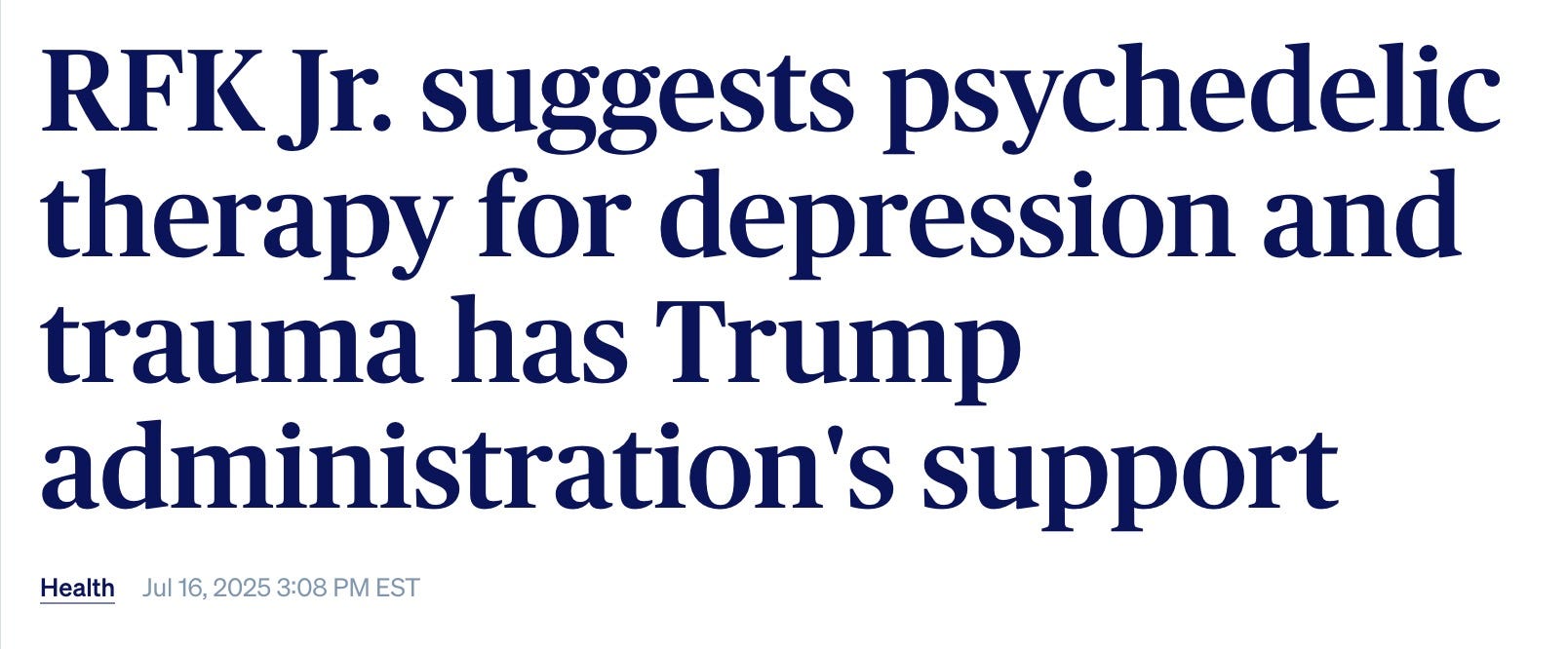
What I believe the market is underpricing most, however, is the policy shift underway in Washington. Robert F. Kennedy Jr.’s arrival as Secretary of Health and Human Services places an unusually vocal supporter of psychedelic research at the top of the federal health bureaucracy. While regulators do not approve drugs based on political enthusiasm, leadership absolutely influences funding priorities, agency posture, trial design dialogue, and the overall speed with which institutions engage new categories. That matters enormously for a sector whose largest bottleneck is institutional acceptance, not molecular science.
This political context is reinforced by the administration’s willingness to revisit controlled-substance policy more broadly. The recent push to move marijuana out of Schedule I is not directly about psychedelics, but it fundamentally weakens the long-held belief that federal drug scheduling is immovable. Once that assumption breaks, the entire landscape changes.
Perhaps the most powerful wedge issue in this transition is the veteran community. PTSD, depression, addiction, and suicide are existential problems for our veterans, and psychedelic-assisted therapy is increasingly framed not as a countercultural experiment, but as care. The VA’s growing involvement in funding and studying these treatments, combined with bipartisan interest in alternative mental-health solutions for veterans, creates a political pathway that cuts through much of the cultural noise. When a therapy is positioned around helping veterans heal, resistance softens.
None of this eliminates the risks. Regulatory setbacks remain possible. Trial execution is difficult. Commercialization models are unproven. Financing and dilution risk is real and ongoing. But when I weigh those risks against the magnitude of how undernoticed this space is, combined with what I think a small regulatory spark could do for the entire industry, it seems like a worthwhile speculative investment.

QTR’s Disclaimer: Please read my full legal disclaimer on my About page here. This post represents my opinions only. In addition, please understand I am an idiot and often get things wrong and lose money. I may own or transact in any names mentioned in this piece at any time without warning. Contributor posts and aggregated posts have been hand selected by me, have not been fact checked and are the opinions of their authors. They are either submitted to QTR by their author, reprinted under a Creative Commons license with my best effort to uphold what the license asks, or with the permission of the author.
This is not a recommendation to buy or sell any stocks or securities, just my opinions. I often lose money on positions I trade/invest in. I may add any name mentioned in this article and sell any name mentioned in this piece at any time, without further warning. None of this is a solicitation to buy or sell securities. I may or may not own names I write about and are watching. Sometimes I’m bullish without owning things, sometimes I’m bearish and do own things. Just assume my positions could be exactly the opposite of what you think they are just in case. If I’m long I could quickly be short and vice versa. I won’t update my positions. All positions can change immediately as soon as I publish this, with or without notice and at any point I can be long, short or neutral on any position. You are on your own. Do not make decisions based on my blog. I exist on the fringe. If you see numbers and calculations of any sort, assume they are wrong and double check them. I failed Algebra in 8th grade and topped off my high school math accolades by getting a D- in remedial Calculus my senior year, before becoming an English major in college so I could bullshit my way through things easier.
The publisher does not guarantee the accuracy or completeness of the information provided in this page. These are not the opinions of any of my employers, partners, or associates. I did my best to be honest about my disclosures but can’t guarantee I am right; I write these posts after a couple beers sometimes. I edit after my posts are published because I’m impatient and lazy, so if you see a typo, check back in a half hour. Also, I just straight up get shit wrong a lot. I mention it twice because it’s that important.
As someone who has successfully used heroic doses of psilocybin to help me break free of crippling anxiety, I remain skeptical. This is just my personal experience. Psilocybin breaks down walls, in a sense. We all develop rigid patterns of thought, conscious and subconscious. When those rigid patterns are maladaptive, they create depression and/or anxiety. These patterns are virtually impossible to recognize, and even with an expert therapist helping us to identify them, they are just as virtually unshakeable. Imagine trying to understand what you look like in a world with no mirrors or reflective surfaces. Now imagine trying to correct your facial deficiencies with self-guided plastic surgery. That's the closest I can come to explaining it.
Psilocybin can shatter these ingrained patterns of thinking, creating brain plasticity, and allowing new patterns to become established. One must be careful about what is offered as a new "format" at this point; replacing one set of maladaptive behaviors with another can do much more harm than good.
This is to say that psilocybin is not a silver bullet. It may be (for some, or many, or even all--I only have my experience) a new opportunity for beginning. For me it was a key that opened a door to possibilities.
I say I am skeptical about the prospects for its long-term success because the vast majority of people are unlikely to put in the effort or make the hard choices required to find that new roadmap of thought. My suspicion is that much of the early reports of success are due to self-reported wishful thinking.
My 2 cents. I hope I am wrong, because it was a crucial piece of my puzzle. I'd like it to be available for others, even if it ultimately helps a minority.
The Big Pharma lobby won’t go quietly. It’ll take a high-profile medical breakthrough and a strong advocate to push through this barrier. JFK’s presence is a help but he’s not going to spend political capital on it.