

By Matthew Schaffer, American Institute For Economic Research
The Federal Open Market Committee is widely expected to leave its policy rate unchanged this week, with the CME Group FedWatch tool implying a 98 percent probability that the federal funds rate will remain within its current range of 3.5 to 3.75 percent.
At the last FOMC meeting in April, there was a reasonable case for remaining patient and keeping policy steady. A negative supply shock stemming from conflict in the Middle East had pushed inflation higher, but monetary rules based on nominal spending suggested that policy was broadly in the right place. Nearly two months later, that case has weakened. Inflation has continued to accelerate, supply disruptions have lingered longer than many expected, and even some of the rules that previously supported holding steady are now tilting toward tighter monetary policy.
What the Rules Suggest
The latest Monetary Rules Report from AIER’s Sound Money Project shows that the Fed’s current policy rate falls below the range recommended by leading monetary rules. Eleven of the twelve estimates in the Report indicate that the Fed should raise its policy rate at the upcoming meeting.
The Taylor Rule is the most commonly referenced monetary policy rule. It says that the Fed should set interest rates higher when inflation runs above two percent and lower when economic activity or employment fall below sustainable levels. Using the most recent data available, the original version of the rule points to a federal funds rate of 5.91 percent, suggesting that current policy is far too accommodative. A modified version that minimizes interest rate volatility and accounts for forecasts of future inflation implies a policy rate of 4.11 percent. Even that more tempered version points to a 25- to 50-basis-point increase at the upcoming meeting.
Rules based on nominal GDP, or total dollar spending in the economy, suggest rates somewhat closer to the current 3.5 to 3.75 percent range. In April, those rules offered the strongest case for holding policy constant because overall spending in the economy still appeared close to trend. With first-quarter nominal GDP growth coming in over five percent and forecasts of second-quarter growth remaining strong, that argument has weakened. A nominal GDP growth rule now points to a 3.86 percent policy rate and therefore suggests a quarter-point hike at the upcoming meeting. A nominal GDP level rule implies a 3.69 percent policy rate and is the only estimate in the Report consistent with keeping policy unchanged.

A New Regime at the Fed
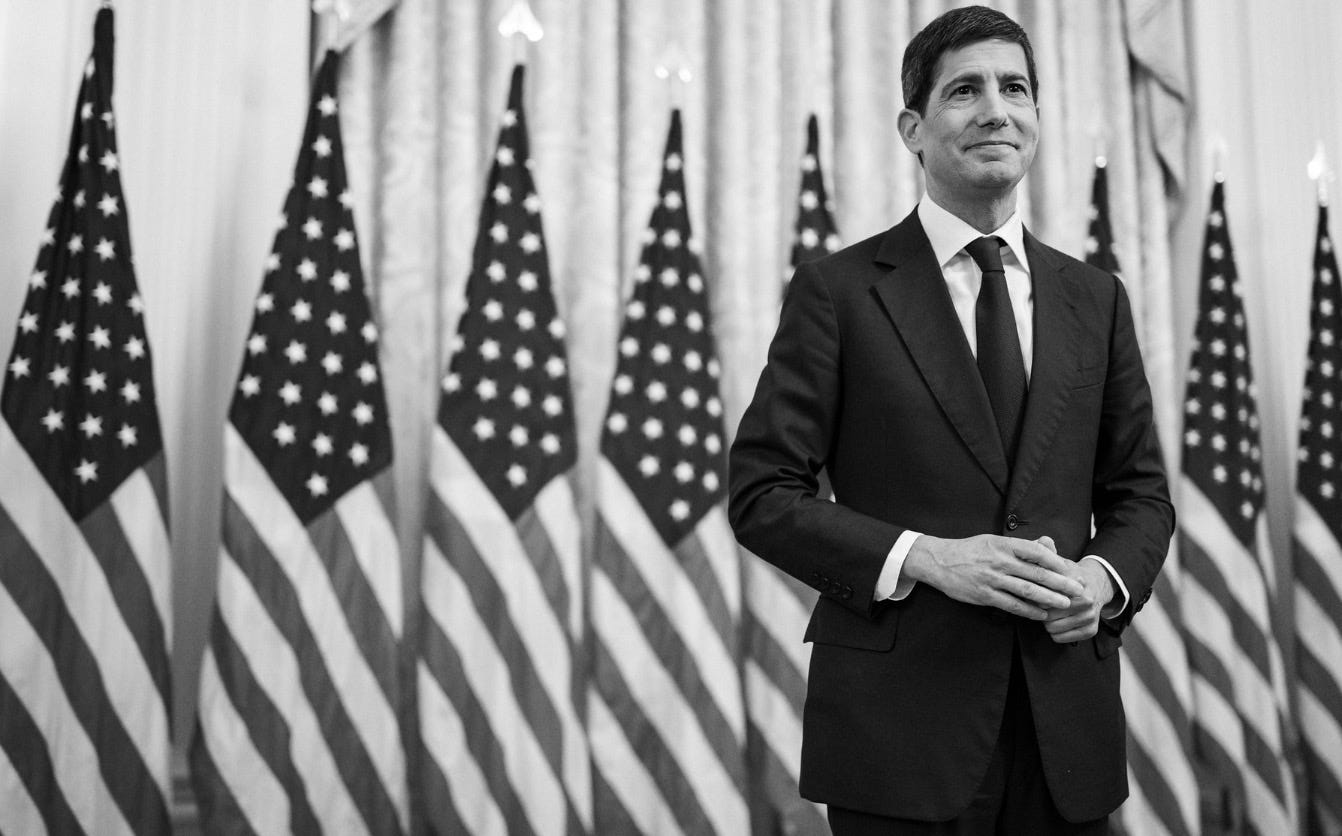
This week’s meeting marks a shift to a new regime at the Fed, as Kevin Warsh takes over as chair. Warsh appears to have won President Trump’s backing in part by arguing that interest rates can fall as AI-driven productivity gains lower prices and strengthen the economy. Whatever room there may be for that argument in the future, it does not seem to fit the current environment. As a result, the administration’s preferred path of lower rates appears to be on hold.
The transition to new leadership comes at an interesting time, however, as a broader split inside the Fed is becoming more visible: members of the Board of Governors, led by Warsh, appear more reluctant to contemplate tighter policy than regional Federal Reserve bank presidents, whose recent comments align more closely with the monetary rules.

As a group, the governors at the Board in DC have shown little appetite for raising rates in the foreseeable future. Michelle Bowman has said that she still sees the next move in the federal funds rate as more likely to be a cut than a hike, though she has acknowledged that persistently higher oil prices could shift the balance of risks. Christopher Waller has moved away from an outright easing bias, saying that a rate cut is no more likely than a rate increase, but he has also made clear that he does not think rate hikes should be under consideration in the near future. Jerome Powell, who remains on the Board for now, has not publicly commented on the stance of policy since his final press conference as Chair, but his April remarks also leaned toward easing rather than tightening.
Recent actions and comments from the regional bank presidents, on the other hand, have turned increasingly hawkish. At the April FOMC meeting, three of the four rotating presidents dissented, opposing the inclusion of an easing bias in the FOMC statement. Since then, Cleveland Fed president Beth Hammack has warned about the growing risks of persistently elevated inflation and argued that monetary policy may not be sufficiently restrictive to bring inflation back to two percent. Kansas City Fed president Jeffrey Schmid has raised the possibility that the Fed may need to increase rates by a quarter point or two to tamp inflation down. A majority of the regional bank presidents may still be comfortable holding rates steady this week, but they also seem open to hiking sooner rather than later. In that sense, the regional Federal Reserve bank presidents are more closely aligned with the monetary rules than the Board of Governors.
Echoes of 2021?
Coming out of the pandemic, consumer price inflation surpassed four percent for the first time in April 2021. The FOMC statement from that month infamously justified keeping the federal funds rate at zero by noting that the rise in inflation largely reflected “transitory” factors. At the time, the monetary rules recommended that the Fed raise its policy rate to at least one percent. But it would take eleven more months — and inflation surging above eight percent as measured by CPI — before the Fed finally began lifting the federal funds rate above zero.
With inflation in May surpassing four percent for the first time in three years, even as Fed officials speculate about the “temporary” effects of supply disruptions, the parallel with 2021’s is difficult to ignore. While it is unlikely that inflation surges back toward its nine-percent post-pandemic peak, there is a real risk that it remains stuck near its current level for an extended period, if monetary policy stays overly accommodative.
In 2021, policymakers ignored the guidance of monetary rules and placed too much weight on the hope that supply-side disruptions would fade on their own. The regional bank presidents seem more concerned than the Board of Governors about repeating that mistake. The lesson all central bankers should have learned is that attributing rising inflation entirely to supply-side disruptions, while overlooking demand-side pressures, can carry significant costs. At this week’s meeting, Fed officials ought to be asking whether continued patience is still consistent with the data. The monetary rules suggest that patience should be running out.

QTR’s Disclaimer: Please read my full legal disclaimer on my About page here. This post represents my opinions only. In addition, please understand I am an idiot and often get things wrong and lose money. I may own or transact in any names mentioned in this piece at any time without warning. Contributor posts and aggregated posts have been hand selected by me, have not been fact checked and are the opinions of their authors. They are either submitted to QTR by their author, reprinted under a Creative Commons license with my best effort to uphold what the license asks, or with the permission of the author.
This is not a recommendation to buy or sell any stocks or securities, just my opinions. I often lose money on positions I trade/invest in. I may add any name mentioned in this article and sell any name mentioned in this piece at any time, without further warning. None of this is a solicitation to buy or sell securities. I may or may not own names I write about and are watching. Sometimes I’m bullish without owning things, sometimes I’m bearish and do own things. Just assume my positions could be exactly the opposite of what you think they are just in case. If I’m long I could quickly be short and vice versa. I won’t update my positions.
As of May 20, 2026 I personally no longer actively trade (read my story here). My investing/saving is done by recurring contributions mostly to sector ETFs and a few select equities, trusted third parties who oversee my accounts, and advisors. Such advisors or funds, through individual equities, options, index funds, mutual funds, ETFs, or other securities, may have positions in, exposure to, or holdings of names mentioned herein that I know nothing about. Basically, via index funds, ETFs and individual equities it is possible I could own, have exposure to, or not own anything at any point. As of the same date, May 20, 2026, in an attempt to lead a healthier lifestyle, I’ve also excluded myself from fantasy sports, sports betting, online and in-person casinos and prediction markets.
And all positions can change immediately as soon as I publish this, with or without notice and at any point I can be long, short or neutral on any position. You are on your own. Do not make decisions based on my blog. I exist on the fringe. If you see numbers and calculations of any sort, assume they are wrong and double check them. I failed Algebra in 8th grade and topped off my high school math accolades by getting a D- in remedial Calculus my senior year, before becoming an English major in college so I could bullshit my way through things easier.
The publisher does not guarantee the accuracy or completeness of the information provided in this page. These are not the opinions of any of my employers, partners, or associates. I did my best to be honest about my disclosures but can’t guarantee I am right; I write these posts after a couple beers sometimes. I edit after my posts are published because I’m impatient and lazy, so if you see a typo, check back in a half hour. Also, I just straight up get shit wrong a lot. I mention it twice because it’s that important.
quote from traders unplugged "The unresolved question—and the most important one in the whole discussion—is:
Can the U.S. stabilize its debt trajectory before markets force a choice between inflation and financial instability? "
Meanwhile, I won't be holding my breath waiting for "AI-driven productivity gains <to> lower prices and strengthen the economy".