

Yesterday morning, NVIDIA’s board of directors may have thought it was putting out a fire in the best way they could. Instead, I think it may have just dumped a gallon of gasoline on it. And when the smoke clears from yesterday’s shock headline…once people have a moment to think and digest…I think it’ll be as clear to everyone as it is to me today.
Prior to yesterday, NVIDIA’s communications team was actually doing a decent enough job, considering the circumstances.
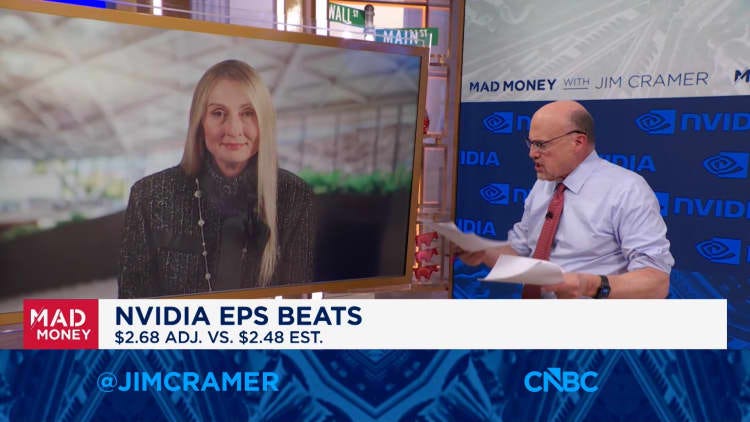
The market was slowly acclimating to the idea of a NVIDIA without Jensen Huang at the helm, the company had an independent investigation underway, and the board had given investors the impression that it understood the gravity of the situation and was prepared to move forward without its founder.
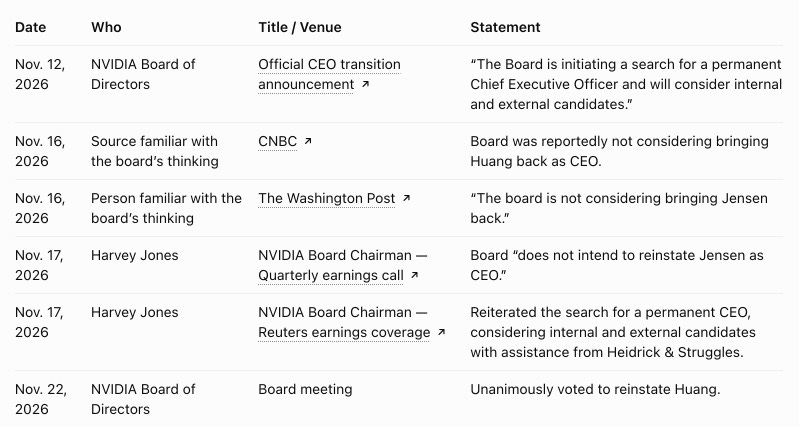
In fact, the board was adamant in a way that makes yesterday’s reinstatement simply bizarre. Remember, it was just last Tuesday, on NVIDIA’s quarterly earnings call, that board chairman Harvey Jones explicitly told investors that the board “does not intend to reinstate Jensen as CEO.”
The day prior, both CNBC and The Washington Post had reported that the board wasn’t even considering bringing Huang back, despite mounting pressure from President Trump and Silicon Valley executives.
Five days later, the board unanimously voted to bring Huang back.
There was, at the very least, some semblance of an orderly process taking place. And had the investigation ultimately vindicated Huang, the board could have brought him back with considerably less controversy.
Instead, we’re essentially back at square one this morning, except now there are a number of additional questions to be answered, additional parties involved, additional potential conflicts of interest to examine, and a political dimension to this story that is going to make it exponentially more difficult for NVIDIA to put the whole thing behind it.
The board may have bought itself a temporary reprieve from the selling in NVIDIA’s stock, but I think it has done so at the expense of subjecting the company to even more scrutiny over the coming months and years.
Oh, and I’m not quite sure the stock is definitely going back to $200 right away, either.
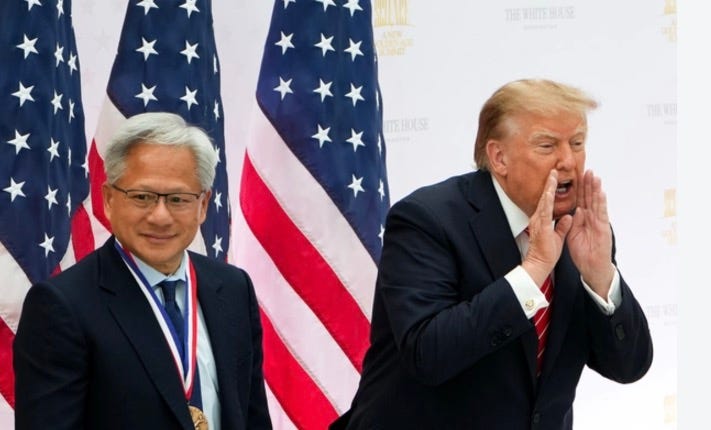
As I told George Gammon yesterday, I still don’t know whether President Trump effectively strong-armed the board into reinstating Huang or whether the board felt as though the assurances it received from the president somehow absolved it of responsibility for bringing him back.
Were the directors reluctant to reinstate Huang and pressured into doing so? Or were they simply looking for someone sufficiently high up in the U.S. government to give them the all-clear so they could justify bringing him back?
Neither possibility gives me much comfort.
For starters, I find it difficult to believe that the national security questions surrounding Huang could have been comprehensively investigated and resolved in the short period of time between his resignation and his reinstatement. Perhaps the intelligence community had been investigating these matters for considerably longer than the public has known about them? Perhaps the government has information that definitively puts some of these allegations to rest?
But what information became available between the middle of last week, when Huang’s return appeared to be out of the question, and Sunday evening, when NVIDIA’s board unanimously decided to bring him back?
And how much of that information had to do with national security versus how much had to do with the several trillion dollars in market capitalization that had evaporated from U.S. equity markets?
As I asked George yesterday:
“What did Trump know today that he didn’t know five days ago other than the stock market crashed?”
And even if we’re willing to give the president the benefit of the doubt on the national security issue, there’s an entirely separate set of questions pertaining to NVIDIA’s business and accounting practices that seem to have been conveniently forgotten about in yesterday’s jubilation.
I’m reasonably certain Donald Trump did not spend his weekend conducting a forensic accounting examination of NVIDIA’s Singapore-related revenue.
Did the president review NVIDIA’s revenue recognition policies? Did he examine correspondence with its distributors? Did he review the company’s customer concentration, the ultimate destinations of its products, its end-user verification procedures, or the nature of the relationships between NVIDIA and the various entities through which its chips have been sold?
Did he examine the extent to which NVIDIA’s investments in other companies may ultimately be facilitating purchases of its own products? Did he speak with the company’s auditors?
Of course, these are different questions than whether or not Jensen Huang personally poses a national security risk. And yet the apparent resolution of one question seems to have been interpreted by the market as the resolution of all of them.
Even if Huang is completely vindicated personally, that tells us next to nothing about whether NVIDIA has adequately accounted for its revenue, complied with export restrictions or maintained appropriate internal controls.
These are questions that require accountants, auditors, attorneys, investigators, documentation and, most importantly, time. NVIDIA’s shares being up 31.5% yesterday does not expedite any of those processes.
Let’s See The 10-Q
One of the things I mentioned in passing during my conversation with George yesterday was that, as of our interview, NVIDIA had yet to file its quarterly 10-Q despite having already reported earnings.
I cannot imagine a more anticipated quarterly filing at this point.