

By Nicolas Cachanosky, American Institute for Economic Research
President Trump’s “One Big Beautiful Bill” (OBBB) is a mixed bag for the Federal Reserve. On the one hand, OBBB’s passage removes the near-term difficulty of conducting monetary policy in the face of huge swings in the Treasury General Account. On the other hand, it may make it more difficult for the Fed to see through its planned balance sheet reduction.
The Federal Reserve’s $7 trillion balancing act just got easier — and more complicated — thanks to President Trump’s historic $5 trillion debt ceiling increase. While this “One Big Beautiful Bill” resolved an unprecedented collision between fiscal brinksmanship and monetary policy, it created new challenges that could complicate Fed operations down the road.
Let’s start with the Fed’s massive balance sheet. During the 2008 financial crisis and COVID-19 pandemic, the Fed expanded its asset holdings from around $800 billion to nearly $9 trillion — that is, $9,000 billion. Then, in 2022, the Fed began slowly shrinking its balance sheet. It is not actively selling assets. Rather, it is not replacing a portion of its maturing bonds. The Fed intends to use this “balance sheet runoff” approach to transition from an abundant reserves to an ample reserves regime.
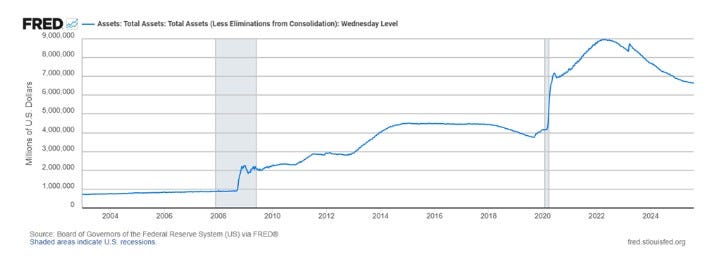
The Fed’s balance sheet runoff approach was designed to run in the background, on autopilot, while interest rates did the heavy lifting of monetary policy. So far, it has reduced the balance sheet by approximately $1.7 trillion.
Before the passage of OBBB, debt ceiling politics created a roadblock for the Fed’s balance sheet runoff plans.
The Treasury has an account at the Fed known as the Treasury General Account (TGA), which is essentially the government’s checking account. Typically, the government will maintain a large balance in the TGA, in order to ensure it can make payments over the next few weeks. It will draw down this balance gradually, and replenish it as it sells bonds and receives tax payments throughout the year.
When the debt ceiling becomes binding, however, the TGA can increase reserve volatility. Unable to issue new debt, the Treasury must rapidly drain the TGA to keep the government funded. When the government spends this money, it flows into the banking system, causing bank reserves to spike. Then, when Congress raises the debt ceiling, the Treasury rebuilds its TGA balance by issuing new debt. That results in a sudden drain of reserves from the banking system. For example, after the debt ceiling was raised in June 2023, the TGA “increased by $600 billion over the short period of three to four months.”
Huge swings in the TGA balance create a dangerous scenario for the Fed. If bank reserves fall too quickly, financial markets might become volatile. This is especially difficult if the Fed is engaged in balance sheet runoff, since that also removes reserves from the system. Indeed, when the Fed faced this risk in March 2025, it slowed its balance sheet runoff. In other words, the Fed took its balance sheet runoff approach off autopilot to prevent a potential reserves shortage.
The OBBB raised the debt ceiling by $5 trillion — the largest increase in US history. This massive increase in the debt ceiling likely provides sufficient borrowing authority for the next five years, allowing the Treasury to operate normally without the dramatic swings in the TGA that complicated Fed policy. Correspondingly, the Fed can resume normal balance sheet runoff operations.
But solving one problem created another. The Congressional Budget Office projects that the OBBB will add $3.4 trillion to the national debt over the next decade — equivalent to roughly $340 billion in additional Treasury issuance each year. That creates a challenging market dynamic. Private markets must absorb both normal Treasury financing needs (approximately $3 trillion in maturing debt this year) plus the additional $340 billion annually. Assuming this increase in the supply of Treasurys outpaces demand, interest rates will be pushed up.
Presumably, the White House will not be happy about the prospect of paying higher interest rates on its debt. It may pressure the Fed to step back in as a buyer of national debt to help reduce the financial cost to the Treasury. Congress could even require the Fed to purchase more government debt, effectively ending the Fed-Treasury accord.
Even if the Fed is neither required nor pressured to buy more government debt, it will have to decide how to react to the corresponding interest rate movements. That, on its own, may push the Fed to reduce the pace of the balance sheet runoff or become a buyer once again.
Thomas Sowell famously quipped that there are no solutions, only tradeoffs. Fed officials can surely appreciate the sentiment. By raising the debt ceiling, OBBB takes them out of the reserve-volatility frying pan. It may also put them into the debt-monetization fire.
Dr. Cachanosky is Associate Professor of Economics and Director of the Center for Free Enterprise at The University of Texas at El Paso Woody L. Hunt College of Business. He is also Fellow of the UCEMA Friedman-Hayek Center for the Study of a Free Society. He served as President of the Association of Private Enterprise Education (APEE, 2021-2022) and in the Board of Directors at the Mont Pelerin Society (MPS, 2018-2022).
He earned a Licentiate in Economics from the Pontificia Universidad Católica Argentina, a M.A. in Economics and Political Sciences from the Escuela Superior de Economía y Administración de Empresas (ESEADE), and his Ph.D. in Economics from Suffolk University, Boston, MA.
Dr. Cachanosky is author of Reflexiones Sobre la Economía Argentina (Instituto Acton Argentina, 2017), Monetary Equilibrium and Nominal Income Targeting (Routledge, 2019), and co-author of Austrian Capital Theory: A Modern Survey of the Essentials (Cambridge University Press, 2019), Capital and Finance: Theory and History (Routledge, 2020), and Dolarización: Una Solución para la Argentina (Editorial Claridad, 2022).
Dr. Cachanosky’s research has been published in outlets such as Journal of Economic Behavior & Organization, Public Choice, Journal of Institutional Economics, Quarterly Review of Economics and Finance, and Journal of the History of Economic Thought among other outlets.

QTR’s Disclaimer: Please read my full legal disclaimer on my About page here. This post represents my opinions only. In addition, please understand I am an idiot and often get things wrong and lose money. I may own or transact in any names mentioned in this piece at any time without warning. Contributor posts and aggregated posts have been hand selected by me, have not been fact checked and are the opinions of their authors. They are either submitted to QTR by their author, reprinted under a Creative Commons license with my best effort to uphold what the license asks, or with the permission of the author.
This is not a recommendation to buy or sell any stocks or securities, just my opinions. I often lose money on positions I trade/invest in. I may add any name mentioned in this article and sell any name mentioned in this piece at any time, without further warning. None of this is a solicitation to buy or sell securities. I may or may not own names I write about and are watching. Sometimes I’m bullish without owning things, sometimes I’m bearish and do own things. Just assume my positions could be exactly the opposite of what you think they are just in case. If I’m long I could quickly be short and vice versa. I won’t update my positions. All positions can change immediately as soon as I publish this, with or without notice and at any point I can be long, short or neutral on any position. You are on your own. Do not make decisions based on my blog. I exist on the fringe. If you see numbers and calculations of any sort, assume they are wrong and double check them. I failed Algebra in 8th grade and topped off my high school math accolades by getting a D- in remedial Calculus my senior year, before becoming an English major in college so I could bullshit my way through things easier.
The publisher does not guarantee the accuracy or completeness of the information provided in this page. These are not the opinions of any of my employers, partners, or associates. I did my best to be honest about my disclosures but can’t guarantee I am right; I write these posts after a couple beers sometimes. I edit after my posts are published because I’m impatient and lazy, so if you see a typo, check back in a half hour. Also, I just straight up get shit wrong a lot. I mention it twice because it’s that important.
The trade off we get from all of this is higher inflation. It is also my opinion that QE has never stopped. The banks who are members of the Fed, have been buying the Treasury issues and they carry the risk if yields go up. Silicon Valley Bank will not be the last one to have problems if yields remain high or go higher. Lower yields will benefit the Treasury, but they will also help the banks who hold a massive amount of higher priced Treasury issues right now. But the trade off will result in higher inflation. It's getting harder to figure out who is winning this game, but it's easy to see who is losing, the consumer.
The economy is imploding from unacknowledged increases in costs and the OBBB provides debt ceiling leeway for MAYBE 18 - 24 months.