

Society’s linear march forward is used to justify numerous seemingly innocuous lifestyle choices. The assumption that the way things have been is the way they will continue to be is the unquestionable tenet at the root of a carefree ideology that can lead to horrid unintended consequences when it all goes down.
People in developed western countries, particularly in the past 80 years, have experienced a level of stability and growth that has rarely been seen. This extremely small sample size of history has led many to bank on the success of their country as a grounding point for all other predictions of the future. A small dive into the past could show that most nations fail or have changes of ownership fairly often. Nothing in this world is certain, but governments are particularly frail.
While governments in general should not be given our blind faith, we should be particularly wary of governments that seem to fit into historical patterns of pre-failure. The classic arc of strength to moral laxity and decadence to destruction is one to be particularly wary of, because of how many times it has occurred. Americans and western Europeans with eyes to see could have very easily noticed how many boxes we check off when it comes to this particular type of societal degradation. We seem to mirror the fall of Rome in particular with great accuracy.
The general carefree spirit of the enlightened “world citizen” causes little reflection when choosing investments. The only question that is asked is, “in the circumstances of the recent past, which investments and type of investments have gained the most value?“ Stocks typically do quite well when individuals ask such a question. The gains of all stocks lose some luster when they are multiplied by the probability of societal collapse. The punishment for seeking the highest return possible will be meted out on the judgment day when returns become meaningless in comparison to food and water.
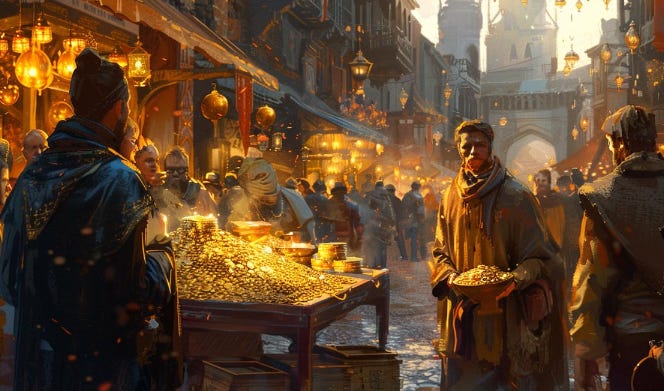
If society were to fall apart, most lucrative investments would be quick to disappear. Our society’s progression of wealth is primarily based on the fact that we have an incredible degree of specialization. The amount of communication and shipping needed to sustain this is not durable to the problems presented by any sort of collapse. The systems of commerce that we currently know are finely tuned and designed around governmental regulations. Even significant changes in regulations have proven problematic for many industries. Imagine how much more powerfully they would be impacted if they had neither the protection of the government, nor the ability to curry favor and limit competition. Some industries would be completely destroyed, such as subsidy-driven soy farming (not to mention that the demand for their crop is nearly fully based on the processing possible through intense specialization). The benefits of rapid gains in the stock market should be tempered with the knowledge that it is fundamentally a gamble on the success of our current institutions.
When the world rearranges based upon some huge shock to government or industry, few parts of our society will be recognizable. Churches and social clubs seem to be the most durable historically, because their existence is not predicated on any one type of government or industry. There’s no guarantee that any specific state will still treat a neighboring state as an ally. Shipping from farms in the central valley to the southwest could be restricted and millions would be forced to migrate or die. Depending on how much of state government remained intact, some necessary treaties could be made. City and town governments would have to step up into the sort of role the founders intended them to play. The only thing that is certain is that commerce would be much more local and specialization would be limited. More durable industry like small sustainable farms or local arts and crafts could arise in cities where property rights were enforced. All hell could break loose in cities that failed to fulfill their role as the safeguards of civilization.
In any of these scenarios, gold would provide a durable store of value. People who question its value in time of crisis have clearly never been to an unstable country. Gold is valued particularly highly when all other investments have hit the floor. It does have use value in a way most investments don’t, yet it also is so universally accepted that it could allow for migration to other more stable countries if need be. While some other investments may have flashy short term gains, gold can help protect against the overnight devaluation nightmares of so many assets when the world as we know it rearranges.
Note from QTR: As I stated in my latest market review, I still think owning gold, silver and bitcoin is the ticket heading into 2H 2024. Gold and silver are performing well and are hedges against everything from inflation to war.
In an article I posted last week, Larry Lepard noted that allocations to gold in the Western World are still “very low” in his opinion, although that is different elsewhere in the world where places like China have seen explosions in gold buying.
And finally as a reminder, I still think gold may wind up pulling back with the broader market in the midst of a deleveraging, should the market keep coming in.
It’s this spot that would likely be my max buy area, as QE is sure to follow in the days and weeks after. Gold was so unloved back in September 2022 when I wrote this article, it was trading at $1,620/oz. We have come a long way, almost 50% since then, and have a long way to go, in my opinion.
Read more:


QTR’s Disclaimer: Please read my full legal disclaimer on my About page here. This post represents my opinions only. In addition, please understand I am an idiot and often get things wrong and lose money. I may own or transact in any names mentioned in this piece at any time without warning. Contributor posts and aggregated posts have been hand selected by me, have not been fact checked and are the opinions of their authors. They are either submitted to QTR by their author, reprinted under a Creative Commons license with my best effort to uphold what the license asks, or with the permission of the author. This is not a recommendation to buy or sell any stocks or securities, just my opinions. I often lose money on positions I trade/invest in. I may add any name mentioned in this article and sell any name mentioned in this piece at any time, without further warning. None of this is a solicitation to buy or sell securities. These positions can change immediately as soon as I publish this, with or without notice and at any point I can be long, short or neutral on any position. You are on your own. Do not make decisions based on my blog. I exist on the fringe. The publisher does not guarantee the accuracy or completeness of the information provided in this page. These are not the opinions of any of my employers, partners, or associates. I did my best to be honest about my disclosures but can’t guarantee I am right; I write these posts after a couple beers sometimes. I edit after my posts are published because I’m impatient and lazy, so if you see a typo, check back in a half hour. Also, I just straight up get shit wrong a lot. I mention it twice because it’s that important.
I’m reading a book about the economic collapse in Argentina. Although I am a big precious metals fan, the author focuses almost exclusively on the survival aspect including the need to carry weapons and learn how the fight. Economic collapses are no fun.
not trying to sound like William Jennings Bryan but what about silver. I heard a lot about gold and a little about lead, but what about silver. Are u still basically a pauper if you don't own gold?