

For years I’ve been warning my subscribers to stay away from regional bank stocks.
My concerns have consistently centered around two areas of their balance sheets: commercial real estate and consumer credit, particularly auto loans.
It hasn’t always been a popular position, especially as regional bank stocks have rallied and the market has seemingly moved on from the banking crisis of 2023.
But my contention has always been that many of the underlying problems that threatened the banking system several years ago were never actually solved. They were simply given more time.
Weeks ago, I reminded readers that all was not well in commercial real estate, pointing out Brookfield walking away from a 95% occupried $600 million luxury skyscraper as evidence.
On October 29, I wrote a piece called The Commercial Real Estate Crisis Is Far From Over, arguing that the disappearance of commercial real estate from the financial headlines didn’t mean the losses had disappeared from the balance sheets.
And I wrote back in July that regional banking stocks were a risk due to ugly marks in commercial real estate. I also warned about commercial real estate and the banks that remain exposed to it in my 10 Areas Of The Market I’d Avoid Right Now, published in October 2025.
And this week, we got a reminder of regional banking’s ties to commercial real estate.
Federal regulators shut down Indiana-based United Fidelity Bank on Friday, marking the largest U.S. bank failure since April 2024. United Fidelity had $5.9 billion in assets, $5.4 billion in deposits and 22 branches.
First Citizens stepped in to acquire substantially all of the bank’s assets at a staggering $2.6 billion discount. The FDIC estimates the failure will cost its Deposit Insurance Fund approximately $1.83 billion.
And what was at the center of the bank’s problems? Commercial real estate.
United Fidelity’s third-quarter regulatory filings showed approximately $2.16 billion in loans on nonaccrual status, of which roughly $2.14 billion were secured by multifamily residential properties.
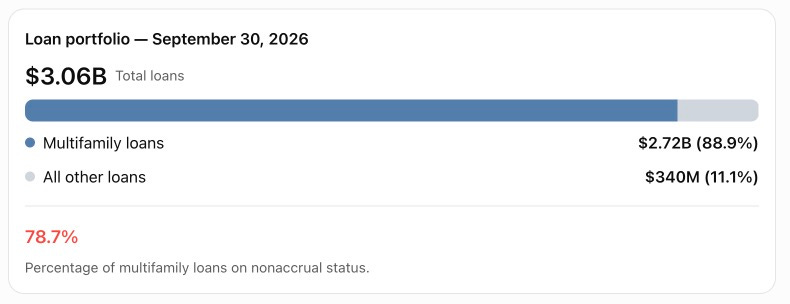
Perhaps even more astonishing is that the bank’s nonperforming loan ratio went from just 0.47% at the end of June to more than 70% at the end of September. In three months.
While we don’t yet know exactly what transpired behind the scenes at United Fidelity, those numbers are worth remembering the next time somebody points to relatively benign bank delinquency statistics as evidence that the commercial real estate crisis is behind us. They say: shit can get real…quickly.
Look at the latest multifamily delinquency rate data: