

Friend of Fringe Finance Lawrence Lepard released his most recent investor letter this week, wrapping up Q1 of 2026. Larry’s fund was up more than 170% last year and has started 2026 down -2.5%. In his letter he writes about the war, valuations, gold, silver, bitcoin, the Fed and more.
Larry gets little coverage in the mainstream media, which, in my opinion, makes him someone worth listening to twice as closely. He is part of a small cohort that has been deadass right on gold and silver over the last few years and was able to see this stratospheric move in metals ahead of time.
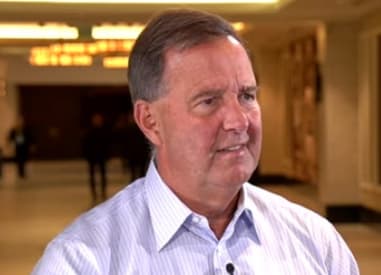
Larry was kind enough to allow me to share his thoughts. His letter has been edited slightly for brevity and for visuals.
THE WAR
The war began on February 28th. After a seven-week roller coaster ride, we now have a two-week tentative cease fire with ongoing back and forth negotiations (likely influenced by China). It remains to be seen if an agreement can be made on Iran’s 10-point peace plan by April 21. There are elements of that plan that the US will not agree to, such as: the withdrawal of US military bases from the Mid East; allowing Iran to enrich Uranium; or allowing Iran to control the Strait. It’s very likely that it will take the planned Trump / Xi Summit in Mid-May to broker a more lasting peace. Time will tell.
Economically though there is a serious disruption in global commodity flows. Iran is adjacent to the Strait of Hormuz and between 20 and 30% of the critical commodities that supply the world economy move by ship through that strait every day. Before the war started roughly 130 container ships were moving through the strait. Since the war began, ship movements have dwindled down to between 0-5 ships per day, with occasional spikes to 9 ships per day.
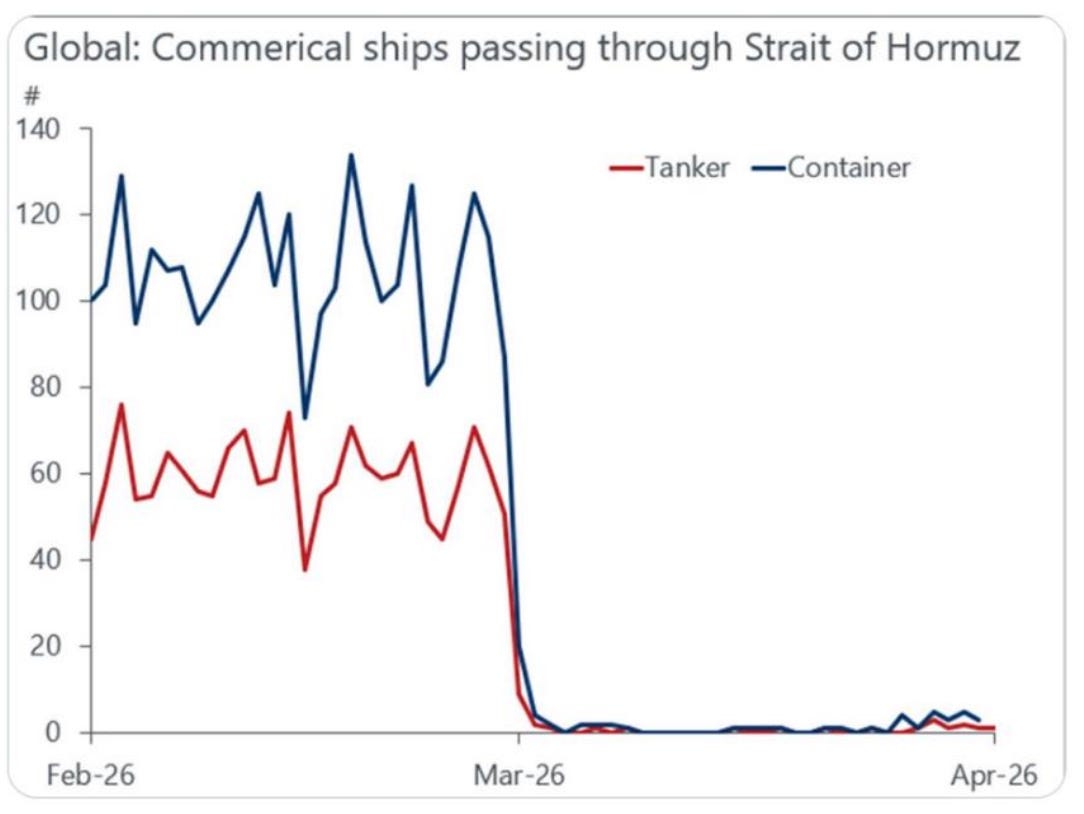
The strait is the Iranians’ biggest bargaining chip in negotiations. The lack of movement of commodities through the strait has a large impact on Asia as China, Japan, Korea, Australia the Philippines, Indonesia and others source a large portion of their oil thru the strait. Several of these countries have already started to encounter oil shortages and have had to implement rationing measures.
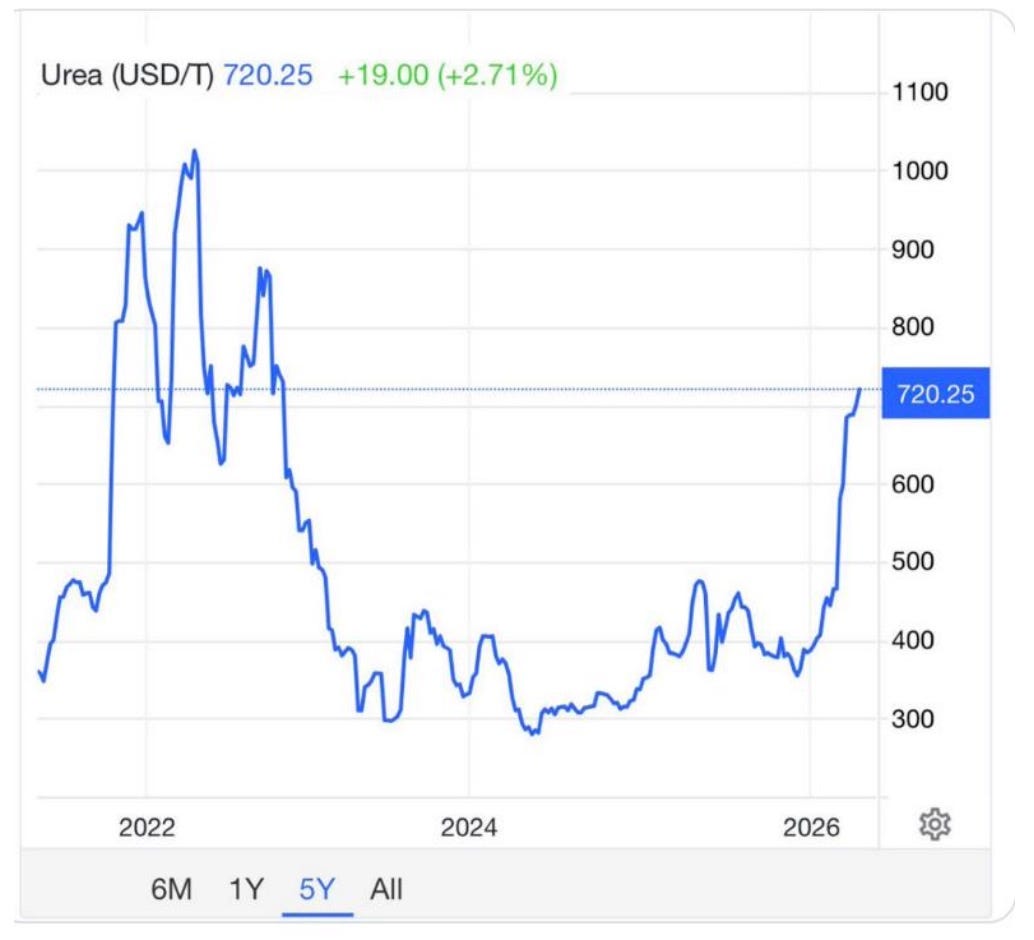
Excellent geopolitical and economic analysts Luke Gromen and Lyn Alden have pointed out that if the strait remains effectively closed for an additional month or more the ripple effects through the world economy will be severe. For example, beyond just oil, 35% of the world’s helium is sourced through the strait and sent to Taiwan for use in semiconductor manufacturing. If Taiwan has to reduce its chip production due to helium shortages the ripple effects in a highly leveraged technically driven world could be meaningful. Another example is sodium phosphate which is the key input to fertilizer production. Roughly 25% of world supply moves through the strait. Curtailment of this has had an immediate impact on fertilizer prices. Urea is the leading form of fertilizer in the world. Note the war’s impact on its price.
As one wag on X/Twitter said, you can’t print food. Food prices are going higher.
China is clearly intervening to get the Iranians to open the strait to prevent a global economic catastrophe. But we do agree that complete strait closure for multiple months will create an economic mess. Even the Iranians will be biting off their nose to spite their face if they croak the global economy since oil is a large source of their government revenue. Thus, we rate the risk of complete strait closure for multiple months leading to a worldwide economic collapse as a 20% tail risk. However, if conditions change and it comes to pass then all world financial markets will undergo enormous stress, and all financial assets would crater, although gold would be left standing as non-counterparty risk money. Also, we cannot see how such a collapse would not lead to an enormous printing operation on the order of WWII, the GFC or COVID. Truly a BIG PRINT.