

The Trade Deficit is one of the two components of the twin deficits; the other being the federal budget deficit which was last reviewed in January. The trade deficit used to be a number that received a ton of attention in the 1980s and 1990s because it was determined to be a strong gauge of the strength and weakness in the US economy. It was last positive in 1975, but big moves in the trade deficit through the 80s and 90s could impact the stock market.
Lately, not many people focus on the trade deficit numbers; however, it is still an excellent metric for identifying how the US is performing. How much more are we consuming than we are producing? It also allows us to export our inflation abroad. If the rest of the world decides to stop making things for us, then it could be an ugly transition.
Current Trends
The February trade deficit came in at -$123B which was the second largest on record only behind the January trade deficit of -$131B. This surge is driven by people trying to get products into the US before tariffs are enacted.
Once the tariffs go into effect, we are likely to see a big contraction in the trade deficit. Not only have we made advance purchases on goods with the recent surge, but the tariffs will make foreign goods more expensive, denting demand.
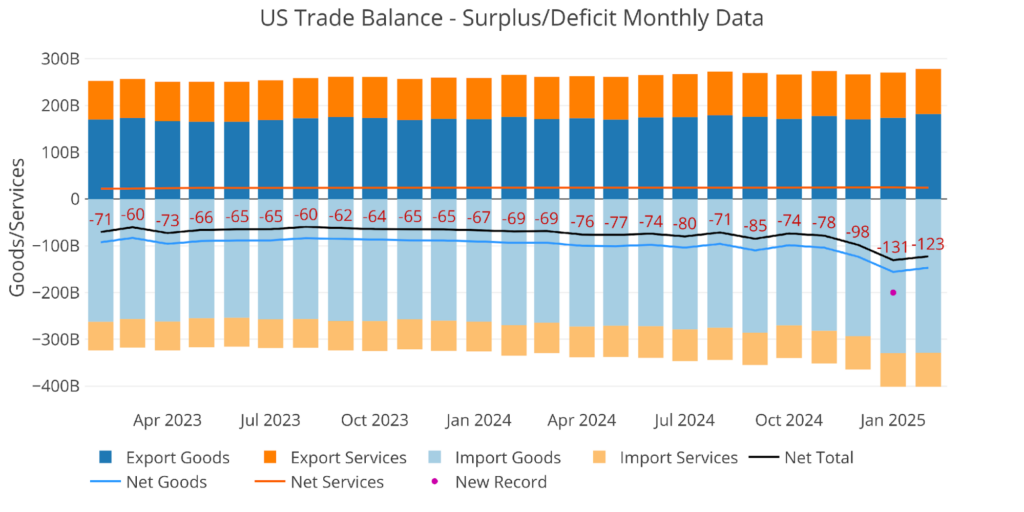
Figure: 1 Monthly Plot Detail
The table below provides detail and shows the massive surge in imports YoY. The TTM total deficit has surged 25%!

Figure: 2 Trade Balance Detail
Historical Perspective
Zooming out and focusing on the net numbers shows the longer-term trend. It really puts the last two months into perspective. It is unlikely this continues and we will probably see a reversal back to the old trend line or even above it as tariffs put a dent in trade.
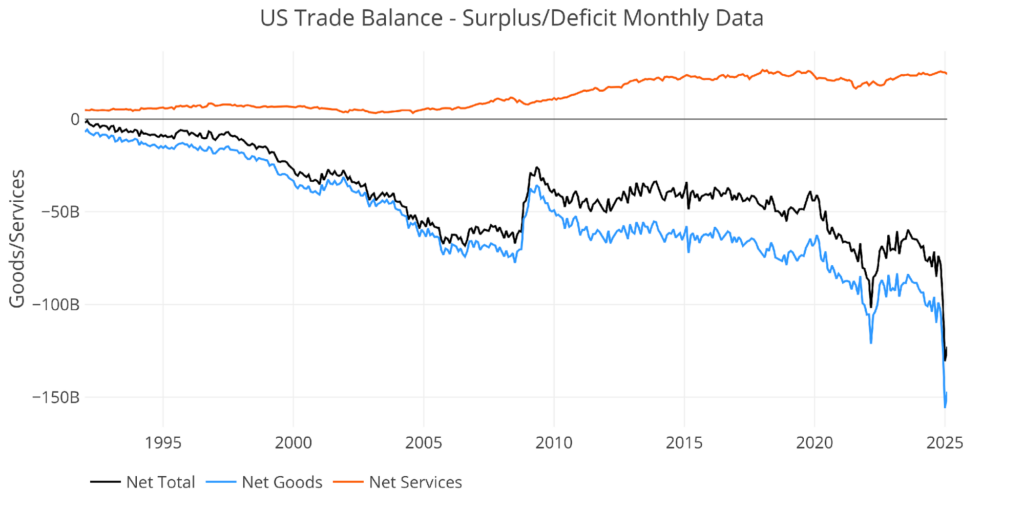
Figure: 3 Historical Net Trade Balance
The Services Surplus has been drifting lower ever since the election as well.
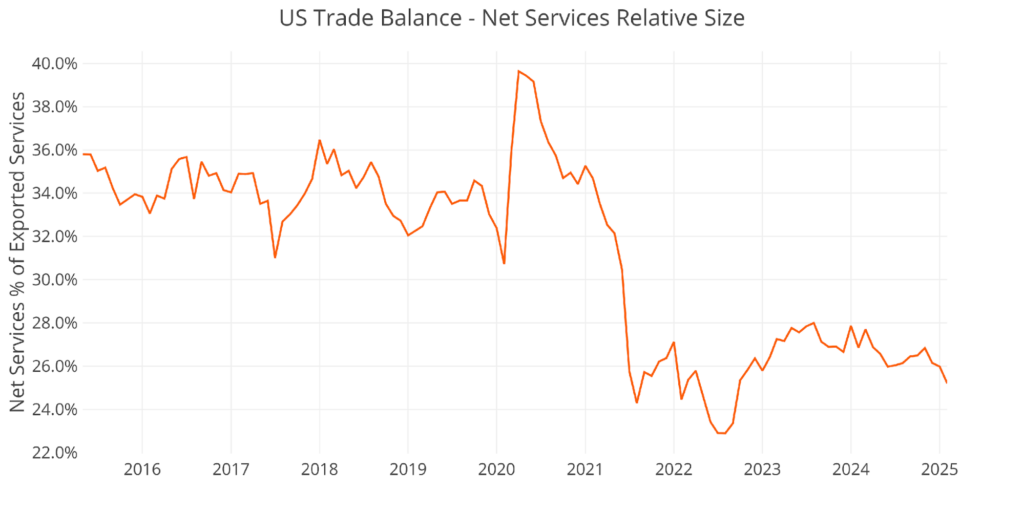
Figure: 4 Historical Services Surplus
To put it all together and remove some of the noise, the next plot below shows the Trailing Twelve Month (TTM) values for each month (i.e., each period represents the summation of the previous 12-months). The dip can be seen from the last two months on the far right.
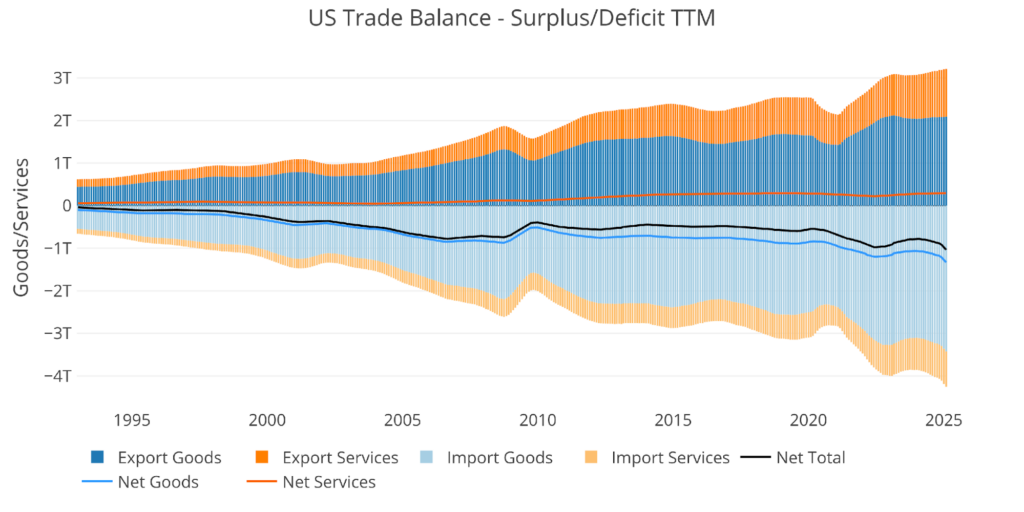
Figure: 5 Trailing 12 Months (TTM)
The TTM Net Trade Deficit surge has brought the deficit as a % of GDP to 3.48%. This is still well below the Covid years and pre-financial crisis.
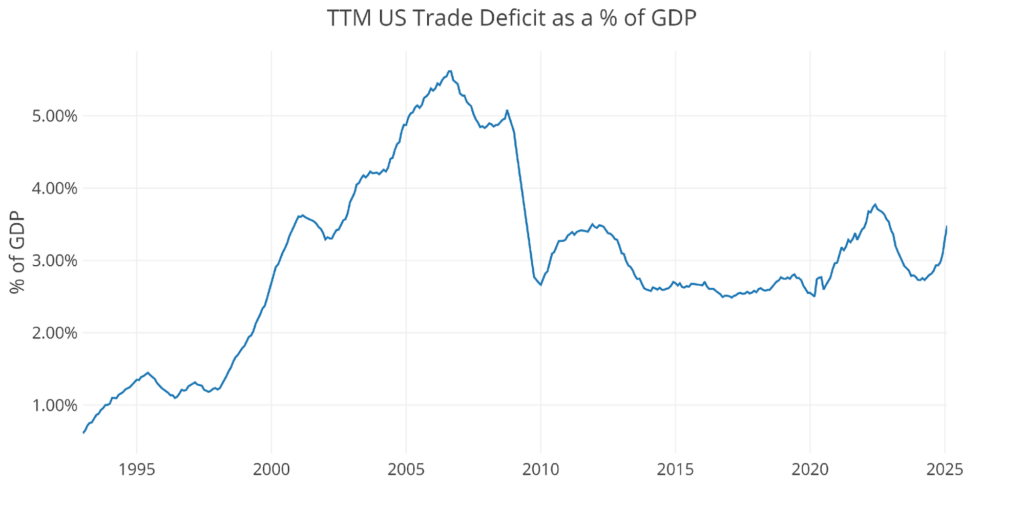
Figure: 6 TTM vs GDP
The chart below shows the YTD values. While Exports are mostly flat, the Imports have seen a big surge.
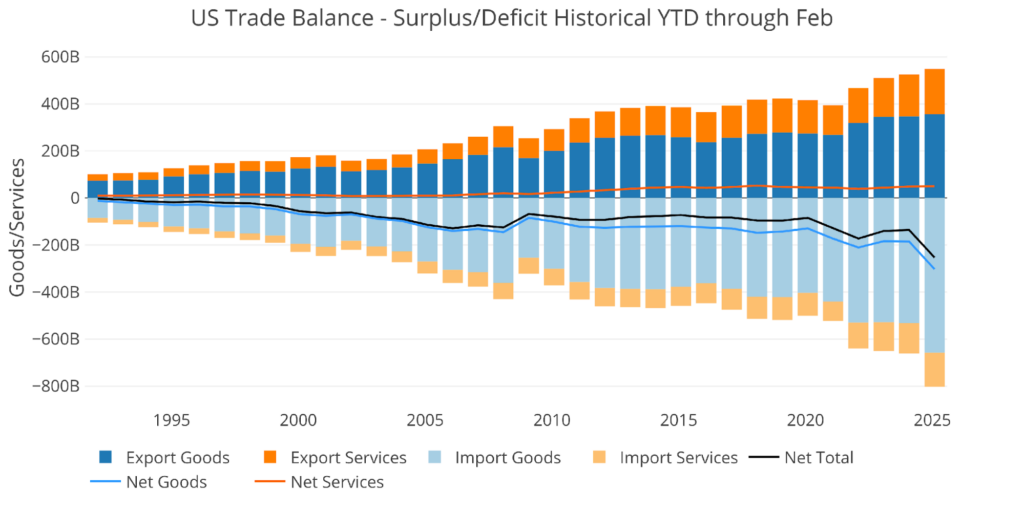
Figure: 7 Year to Date
Wrapping Up
The Trade Deficit still gets very little attention, but it serves as a huge windfall and potential risk for the US. Currently, foreign countries are willing to provide goods and services in exchange for USD that far exceeds what they are buying with the USD they earn.
Trump is playing with fire by targeting our trade partners. If we see Imports start to slow dramatically in the months ahead, it could result in a big spike in prices. The huge deficit surges these last two months are anomalies.

QTR’s Disclaimer: Please read my full legal disclaimer on my About page here. This post represents my opinions only. In addition, please understand I am an idiot and often get things wrong and lose money. I may own or transact in any names mentioned in this piece at any time without warning. Contributor posts and aggregated posts have been hand selected by me, have not been fact checked and are the opinions of their authors. They are either submitted to QTR by their author, reprinted under a Creative Commons license with my best effort to uphold what the license asks, or with the permission of the author.
This is not a recommendation to buy or sell any stocks or securities, just my opinions. I often lose money on positions I trade/invest in. I may add any name mentioned in this article and sell any name mentioned in this piece at any time, without further warning. None of this is a solicitation to buy or sell securities. I may or may not own names I write about and are watching. Sometimes I’m bullish without owning things, sometimes I’m bearish and do own things. Just assume my positions could be exactly the opposite of what you think they are just in case. If I’m long I could quickly be short and vice versa. I won’t update my positions. All positions can change immediately as soon as I publish this, with or without notice and at any point I can be long, short or neutral on any position. You are on your own. Do not make decisions based on my blog. I exist on the fringe. The publisher does not guarantee the accuracy or completeness of the information provided in this page. These are not the opinions of any of my employers, partners, or associates. I did my best to be honest about my disclosures but can’t guarantee I am right; I write these posts after a couple beers sometimes. I edit after my posts are published because I’m impatient and lazy, so if you see a typo, check back in a half hour. Also, I just straight up get shit wrong a lot. I mention it twice because it’s that important.
Well, who else is Trump going to target with tariffs? There is no point to tariffs on nations we don't trade with.
As pointed out, too much dependency on the goods of other nations, especially ones with which we have a semi-adversarial relationship, is problematic. In both my personal and professional life, I have sought to never be so dependent on any one person/source that I could not function without them. You can't have the rug pulled out from under you, if you're not standing on their rug.
Trump is doing things like they have never been done before. Is he screwing it all up? That remains to be seen. But doing it how we've been doing it for the last few decades is leading us to disaster. Few presidents/politicians have been so sharp that I can't keep up with them intellectually. Far from it. But I don't entirely understand Trump's methods. That may be because I don't have enough background to be able to entirely comprehend his methods. Or it may be that his methods are incomprehensible. But the more I know this guy, the more I trust his judgment. I sure as hell don't trust anybody else's in DC.
One wonders if the trade deficits are all that bad or if tariffs will change much other than cause prices for various goods to spike and hurt consumers. Everybody is a consumer and nobody wants to see the cost of goods rise. Lowering barriers for entry into markets by reducing regulations and taxes on businesses and consumers would serve better than raising tariffs, especially tariffs on nations otherwise friendly to us.