

Today I’m passing along something interesting from my friend Whitney Tilson over at Stansberry Research. Whitney was one of the first people I met on Wall Street and I stay in touch with him to this day. He’s got great investing acumen and I always read through his emails and postings when I see them.
Whitney is the Editor of Stansberry’s Investment Advisory, Stansberry Research’s flagship newsletter, The N.E.W. System, and Whitney Tilson’s Daily. He is also Editor of Commodity Supercycles and a member of the Stansberry Portfolio Solutions Investment Committee.
Whitney spent nearly 20 years on Wall Street. During that time, he founded and ran Kase Capital Management, which managed three value-oriented hedge funds and two mutual funds. Starting out of his bedroom with $1 million, Whitney grew assets under management to a peak of $200 million
This week, by way of another great follow, Charlie Bilello, he reviewed a few of the 30 worst-performing stocks so far this year, which I thought might be of interest to my readers looking to scope out potential new opportunities.
One of the more interesting observations in Charlie Bilello's latest market update is that 17 of the 30 worst-performing stocks in the S&P 500 this year are software and related services companies. His conclusion is that investors are increasingly betting artificial intelligence poses an existential threat to many traditional software businesses. The market appears to believe AI will compress pricing power, reduce competitive moats, and make many legacy software products easier and cheaper to replicate, forcing a sharp reassessment of valuations across the sector.
That theme fits neatly into the broader message of Bilello's report. Throughout the piece, he argues investors are becoming far more disciplined, rewarding companies that generate strong free cash flow while punishing those either spending aggressively on AI without clear returns or facing disruption from it.
Google and Tesla were sold after free cash flow turned negative due to soaring AI-related capital expenditures, Oracle continues to lag while Apple is rewarded for financial discipline, and SpaceX serves as another reminder that even great companies can become poor investments when expectations and valuations get too far ahead of reality.
Reviewing the 30 worst-performing stocks so far this year // Major IPOs have seen big drawdowns one year later…
As a bargain-hunting value investor, I regularly look for babies thrown out with the bathwater: good companies encountering temporary (not terminal) problems, whose stocks are experiencing a sell-off that's wildly overdone.
So it was with great interest that I reviewed this list of the 30 worst-performing stocks in the S&P 500 Index year to date (through July 24), published by Charlie Bilello in his latest Week in Charts.
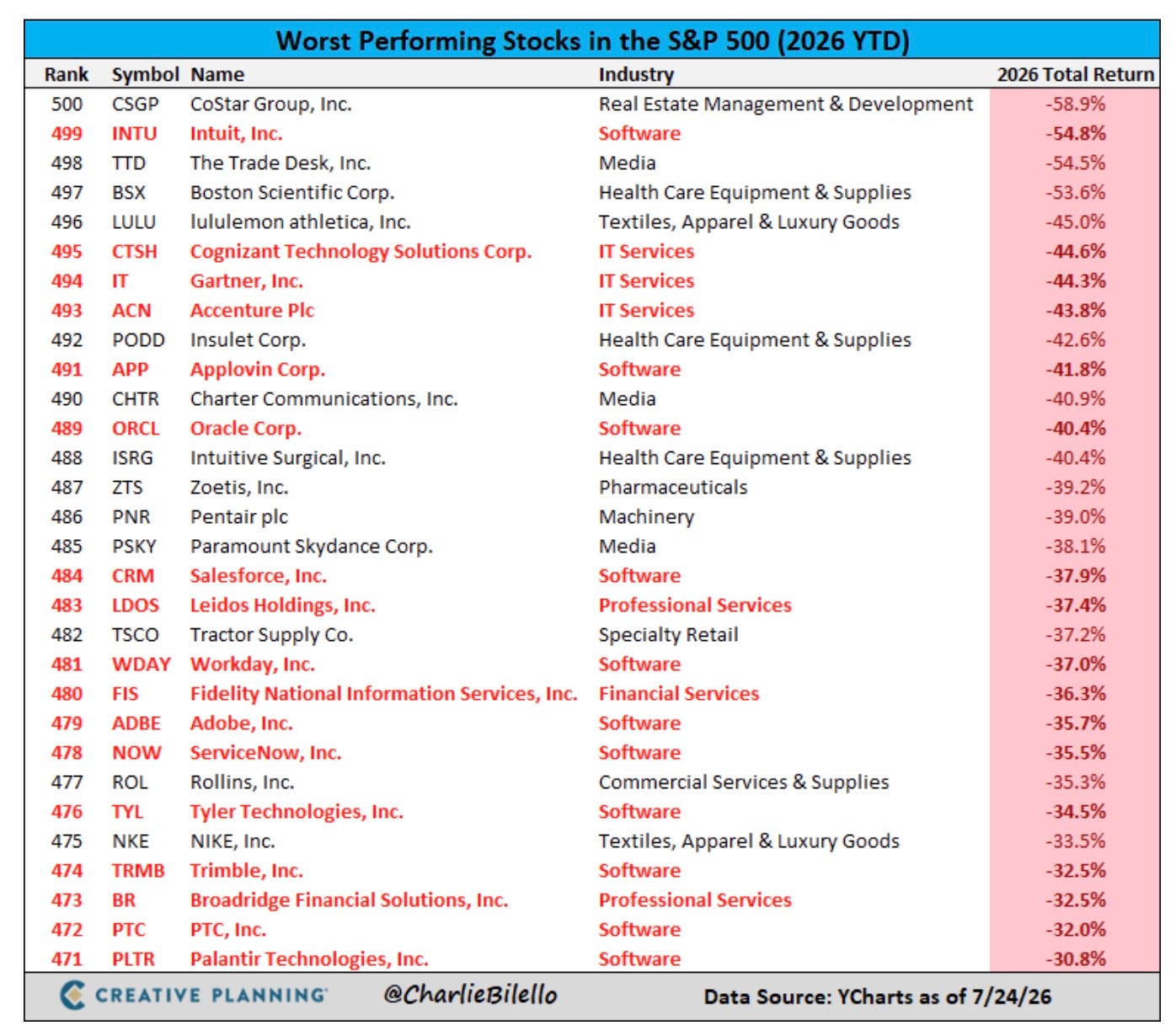
The names in red are software and related services companies, which have been suffering due to investor fears around AI.
Regular readers will recognize many of the stocks on this list, as I’ve written about them several times. So today, I’d like to share my latest thoughts on them...
499, 496, 484, 479, 478, and 475 – Intuit (INTU), Lululemon Athletica (LULU), Salesforce (CRM), Adobe (ADBE), ServiceNow (NOW), and Nike (NKE): In my June 12 e-mail, I named these six as part of my “Discarded Dozen” list of stocks that I predict will outperform SpaceX (SPCX) over the next year. Here’s how they’ve performed since then:
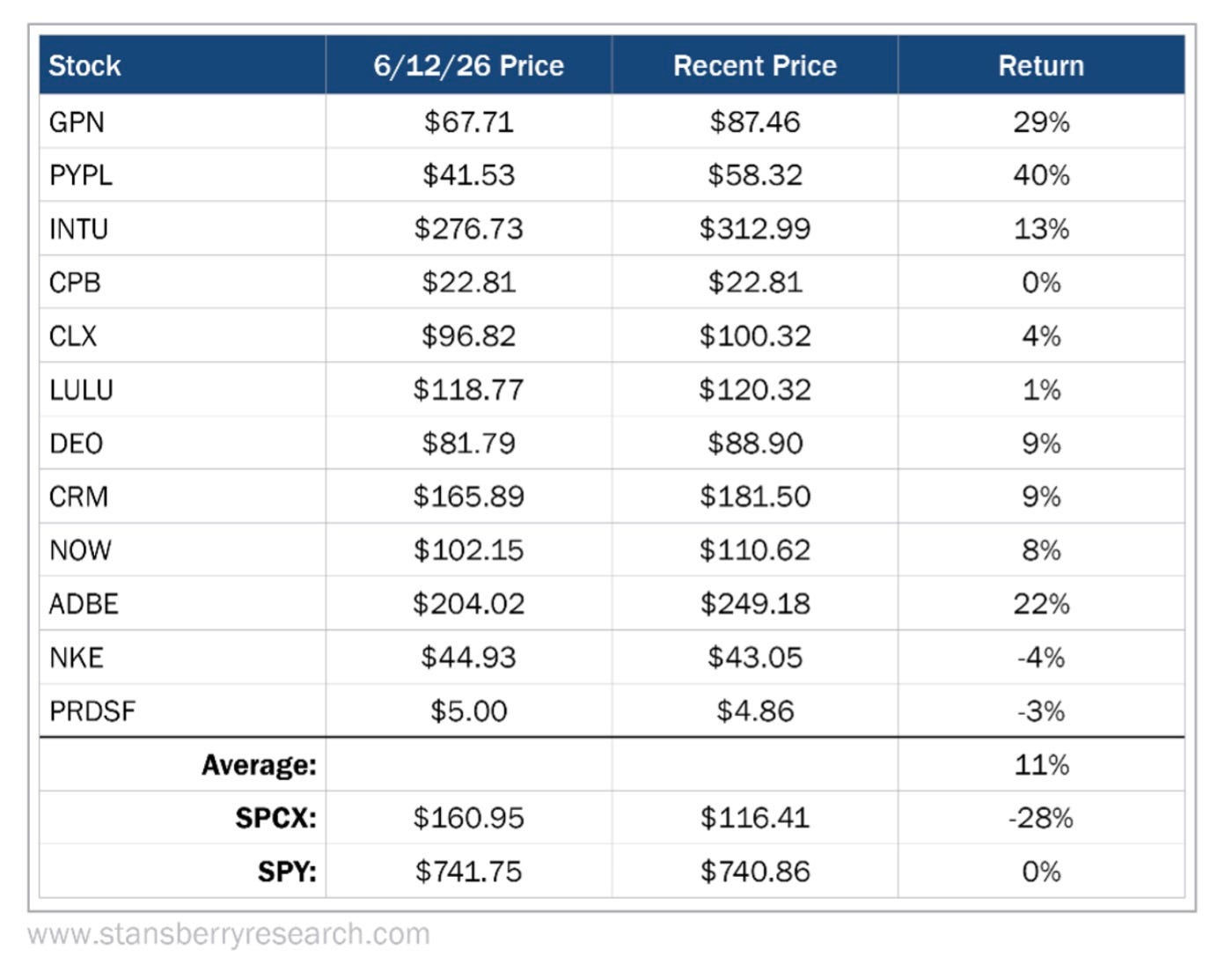
Five of the six are up over the past six and a half weeks, and the group is up 11% on average. Meanwhile, the S&P 500 is flat, and SPCX is down a whopping 28%.
497 – Boston Scientific (BSX): I analyzed the company’s financials and valuation on July 1, then reviewed a bull case for the stock on July 2. I continue to think it’s very interesting.
493 – Accenture (ACN): I took a quick glance at the stock on June 22, after it had crashed to around $125. It’s now up to around $165, but I’m still planning to take a closer look at the company when I get a chance.
491 and 471 – Applovin (APP) and Palantir Technologies (PLTR): I’ve warned my readers to stay away from these stocks many times. They remain on my “Filthy Five” list of stocks to avoid, which I last updated on July 24. [QTR: I second this.]
490 – Charter Communications (CHTR): Along with Accenture, I took a quick glance at Charter on June 22 when the stock had hit a 13-year low. I’m planning to take a closer look at the company when I get a chance.
489 – Oracle (ORCL): I took a first look at the company on June 17, 2025 and concluded, “I think other tech giants have better growth prospects yet trade at a lower valuation, so I’m not tempted to buy ORCL at these levels...” Since then, the stock is down 42% – and I’m still not interested.
488 – Intuitive Surgical (ISRG): I’ve been following the company for decades because my cousin was one of the first employees after the company was founded in 1995. I (stupidly) never bought the stock as it rose more than 250 times. But with it down 40% from its 52-week high, I’ve added it to my list of stocks to take a closer look at.
487 – Zoetis (ZTS): Along with Accenture and Charter, I took a quick glance at Zoetis on June 22 when it was at an eight-year low. It’s essentially flat since then, and I’m planning to take a closer look when I get a chance.
485 – Paramount Skydance (PSKY): On March 30, I analyzed the company and concluded to avoid the stock at all costs. Since then, it’s down 10%, as its acquisition of Warner Bros. Discovery (WBD) has – at least temporarily – been blocked by a court. If the deal goes through, I think the stock will quickly go to zero. If it doesn’t, it’ll just take a little longer to get there.
As for the rest on the list, I’ve yet to take a look. But if any of these stocks are of particular interest to you, please e-mail me by clicking here. I’ll take a closer look at ones that are of greatest interest to my readers.
Another list on Bilello’s Week in Charts caught my eye...
It shows 27 major IPOs in the past 15 years, measured by stock price performance a year after the first-day close and the maximum drawdown from that point in the first year:
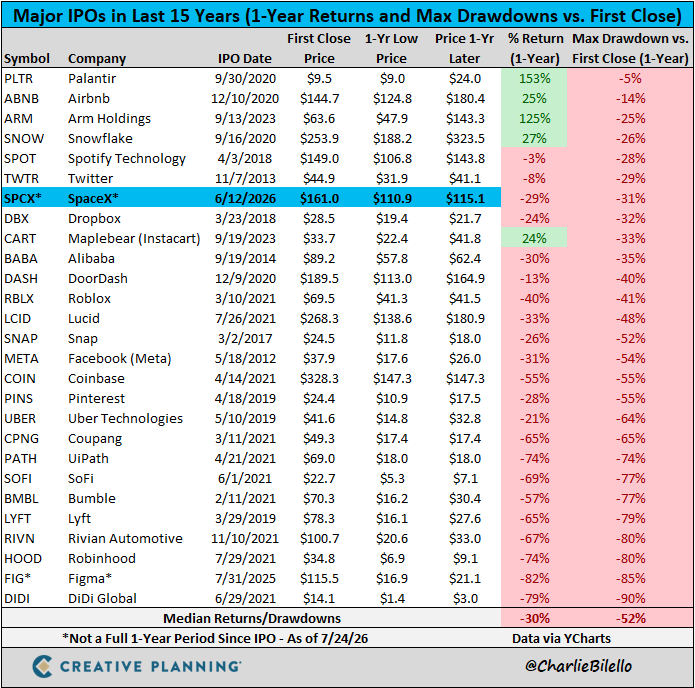
I’m familiar with the research that buying IPOs after their typical first-day pop is a bad idea. But I was still shocked to see how badly some of the biggest IPOs have performed...
Only five of the 27 were up a year later, and the overall median return was a 30% loss – during a long bull market! If you had invested in all 27, you would have endured a median maximum drawdown of 52%.
This underscores what I’ve long said: Do not invest in IPOs. [QTR: I wholeheartedly agree.]

QTR’s Disclaimer: Please read my full legal disclaimer on my About page here. This post represents my opinions only. In addition, please understand I am an idiot and often get things wrong and lose money. I may own or transact in any names mentioned in this piece at any time without warning. Contributor posts and aggregated posts have been hand selected by me, have not been fact checked and are the opinions of their authors. They are either submitted to QTR by their author, reprinted under a Creative Commons license with my best effort to uphold what the license asks, or with the permission of the author. I cannot guarantee the accuracy of all facts and figures included in this article though I made my best effort to get them right. I have been wrong before and will be wrong again, and encourage you to always double check, do your own research and speak to a licensed financial professional.
This is not a recommendation to buy or sell any stocks or securities, just my opinions. I often lose money on positions I trade/invest in. I may add any name mentioned in this article and sell any name mentioned in this piece at any time, without further warning. None of this is a solicitation to buy or sell securities. I may or may not own names I write about and are watching. Sometimes I’m bullish without owning things, sometimes I’m bearish and do own things. Just assume my positions could be exactly the opposite of what you think they are just in case. If I’m long I could quickly be short and vice versa. I won’t update my positions.
As of May 20, 2026 I am attempting to no longer actively trade (read my story here). My investing/saving is mostly done by recurring contributions mostly to sector ETFs and a few select equities, trusted third parties who oversee my accounts, and advisors. Such advisors or funds, through individual equities, options, index funds, mutual funds, ETFs, or other securities, may have positions in, exposure to, or holdings of names mentioned herein that I know nothing about. Basically, via index funds, ETFs and individual equities it is possible I could own, have exposure to, or not own anything at any point. As of the same date, May 20, 2026, in an attempt to lead a healthier lifestyle, I’ve also excluded myself from fantasy sports, sports betting, online and in-person casinos and prediction markets.
And all positions can change immediately as soon as I publish this, with or without notice and at any point I can be long, short or neutral on any position. You are on your own. Do not make decisions based on my blog. I exist on the fringe. If you see numbers and calculations of any sort, assume they are wrong and double check them. I failed Algebra in 8th grade and topped off my high school math accolades by getting a D- in remedial Calculus my senior year, before becoming an English major in college so I could bullshit my way through things easier.
The publisher does not guarantee the accuracy or completeness of the information provided in this page. These are not the opinions of any of my employers, partners, or associates. I did my best to be honest about my disclosures but can’t guarantee I am right; I write these posts after a couple beers sometimes. I edit after my posts are published because I’m impatient and lazy, so if you see a typo, check back in a half hour. Also, I just straight up get shit wrong a lot. I mention it twice because it’s that important.
IPOs are a bit like buying a car at the dealer. When you are sitting across from the salesman or sales manager negotiating your deal, ask yourself who knows more about the car market and the actual value of this car, you or the guy across from you?
Let others take the ride as investors while the market susses out the actual value of future cash flows.
How about INTC? It's down about 37% from its highs. I know, you recommended it in the 20's or 30's. Performance is a matter of when a security is purchased verses when it is sold. Few people buy at the start of the year and sell at the end of the year.
In this case, INTC was a good buy since it had been beaten down to a pulp. Low risk given its long history. Buying stocks that have risen to the moon is high risk. Buying beaten down quality is far more appealing than chasing overvalued quality. IMHO.
I would still buy long term puts on NVDA...something that expires in later 2027. The data center barn burner is going to flame out eventually and A/i stocks will fall from Jupiter back to the moon.