

Phil Hellmuth is an asshole. He’s also one of the greatest poker players of all time.
Hellmuth currently holds the all-time record for World Series of Poker bracelets with 17, ahead of Phil Ivey's 11 and Doyle Brunson, Johnny Chan, and Erik Seidel at 10 each. The WSOP itself lists Hellmuth as the all-time bracelet leader.
His poker playing resume is beyond debate. He has spent decades competing at the highest levels of the game. He has made millions of dollars in an environment where tiny edges determine who wins and who goes broke. Nobody can seriously question whether he knows what he’s doing at a poker table.
Yet despite all of that success, most casual fans know him less for the trophies and more for the meltdowns. His nickname, “The Poker Brat,” wasn’t created by marketers. He earned it honestly. For decades, Hellmuth has been famous for exploding after bad beats, berating opponents, lecturing amateurs, blaming luck, questioning decisions and generally behaving like a petulant, bitchy child whenever the universe failed to recognize his genius.
After getting eliminated by an amateur at the 2008 WSOP Main Event, Hellmuth delivered one of the most famous lines in poker history: “If there weren’t luck involved, I guess I’d win every one.” The quote was ridiculed endlessly because of its arrogance.
As a former poker player who prided myself on being respectful whether I won or lost, I couldn’t stand Hellmuth.
Every time ESPN aired a tournament, there was a decent chance Hellmuth would end up in some kind of confrontation. He would lose a hand and immediately start explaining why his opponent played it incorrectly. He’d get outdrawn and launch into a dissertation about how terrible the other player was. The cameras would cut to him shaking his head, rolling his eyes or muttering under his breath. I always rooted against him. I cheered for whoever happened to be sitting across the table. I wanted to see the little guy knock him out. I enjoyed watching him lose because I thought he was the asshole in the story.
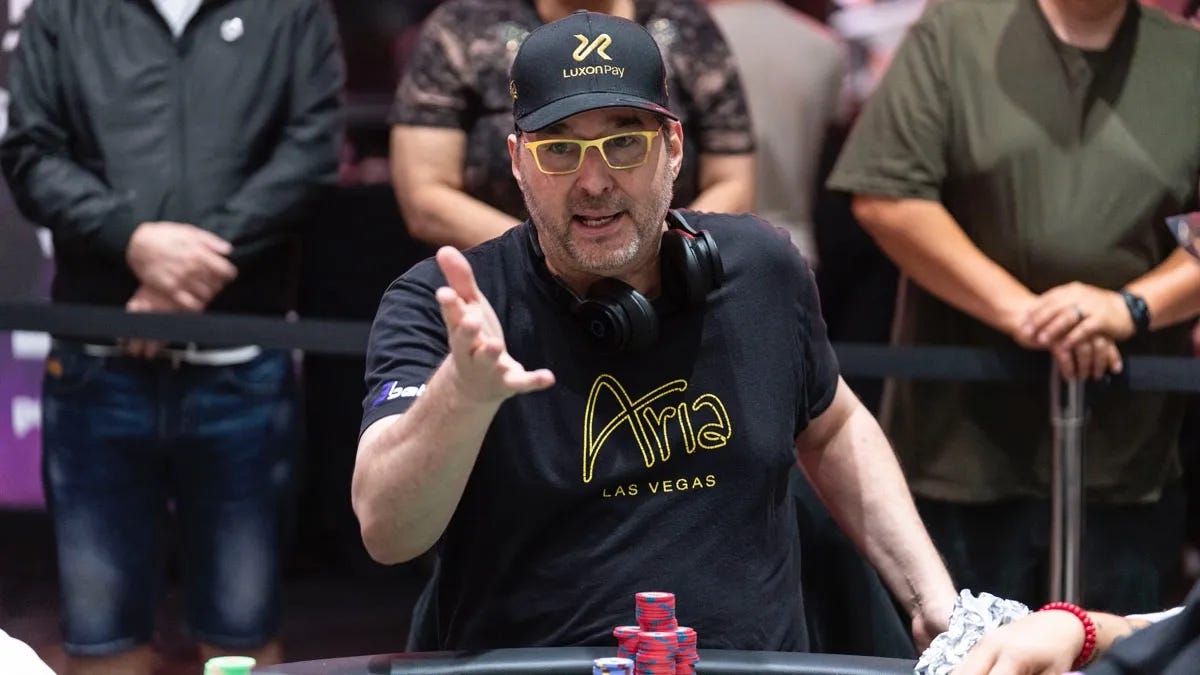
But underneath the arrogance was the frustration of a professional watching someone make objectively terrible decisions and still get rewarded. Hellmuth wasn’t complaining about losing all the time. He was complaining about losing to people he believed didn’t understand the game.
What I didn’t appreciate at the time was that Hellmuth came from a different era of poker. To him, the game meant something. Poker was populated by professionals and serious grinders who understood etiquette, odds, probabilities and a whole set of unwritten rules. There was a culture to the game. There was a hierarchy. There were standards. Players spent years developing discipline and learning how to avoid mistakes. Whether those standards were always reasonable is another debate, but they existed. Hellmuth grew up in a poker ecosystem where the people sitting around him generally understood what they were doing.
Then Chris Moneymaker won the World Series of Poker.
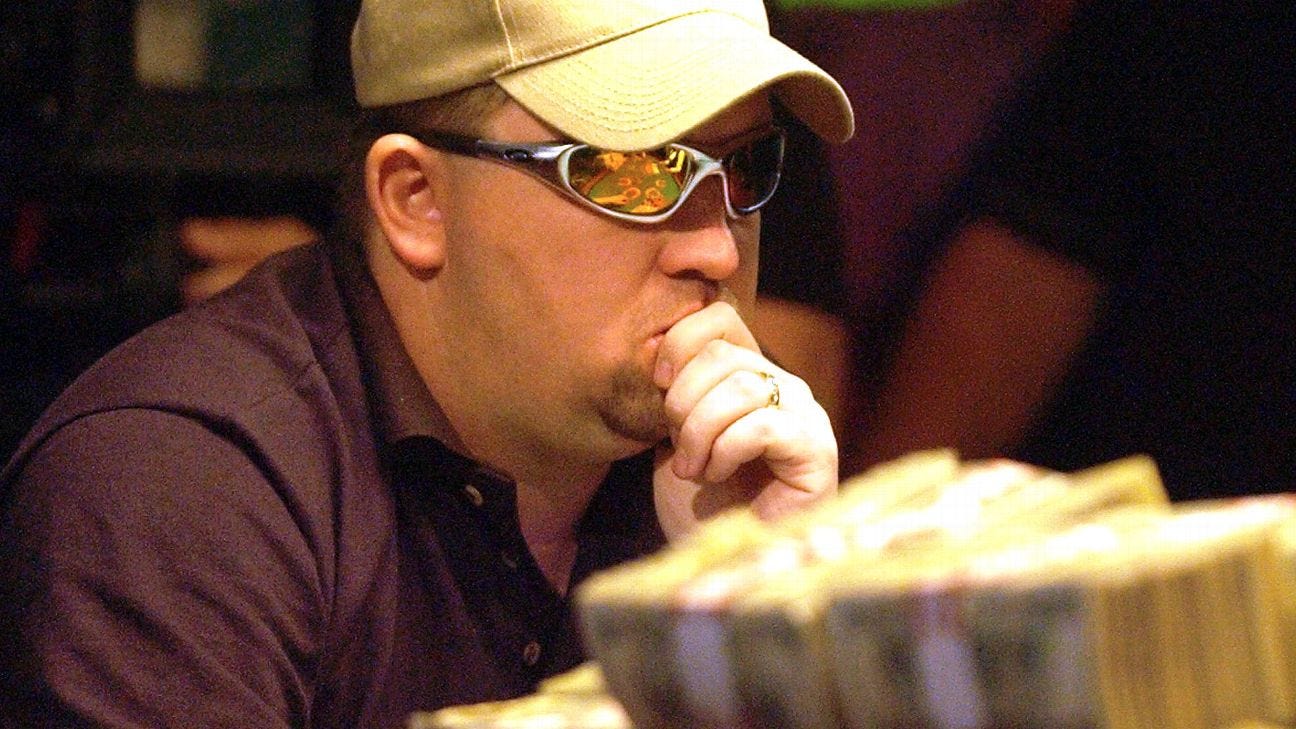
That one tournament in 2003 changed gambling forever. An amateur accountant qualified online and won the biggest poker event in the world. Overnight, every guy sitting on his couch thought he could become a professional poker player. The poker boom that followed flooded the game with newcomers. Tournament fields exploded in size. Online poker exploded. Every casino suddenly had tables packed with people who had little experience and even less discipline. The barriers to entry disappeared. The game that had once been dominated by professionals suddenly became accessible to everyone.
For the average poker fan, this was fantastic. For Phil Hellmuth, it was probably a nightmare. Instead of facing professionals every day, he was now sitting across from amateurs. Guys calling raises with 7-2 offsuit because they thought it would be funny. Players opening pots with Q-9 offsuit because they liked the cards. People accidentally slow-rolling because they didn’t even know what a slow roll was. Opponents who didn’t understand pot odds, position sizing or tournament dynamics.
These new players weren’t following basic strategy. They weren’t following convention. They weren’t following any established framework at all. Sometimes they were simply hoping they’d get lucky and seeing what happened.
And every once in a while, they won.
This is where many of Hellmuth’s greatest outbursts originated. It wasn’t losing to elite players that bothered him. It was losing to people he believed had absolutely no idea what they were doing. He would spend hours making disciplined decisions only to get stacked by somebody who wandered into a pot with garbage and caught lightning in a bottle. To Hellmuth, that wasn’t just frustrating. It was offensive. His entire worldview was built around the idea that skill should ultimately prevail. Then some guy who could barely explain the rules would eliminate him from a tournament and collect the chips.
One of Hellmuth’s most famous complaints was after losing a pot in 2008:
“F****** internet player. Idiot player. He called a raise with Q-10! How are these players still in this tournament…this kid probably won’t last another hour! It’s so sick. They have no concept of poker. F****** idiot. They don’t even know how to spell poker.”
For years, I laughed at that rant. Then it happened to me.
I don’t know why, given my newfound nirvana and balance in life, but I found myself arguing with a young investor on Twitter last night for some reason. Normally I don’t engage. Life is too short and Twitter is too stupid. But this one got under my skin.
The discussion started when, unprovoked, this investor “Luis” claimed PayPal was on its way to bankruptcy. Yes, PayPal. The company generating roughly $4 billion a year in free cash. The company sitting on approximately $22 billion in cash. The company with relatively modest net debt and a single-digit earnings multiple. That PayPal.
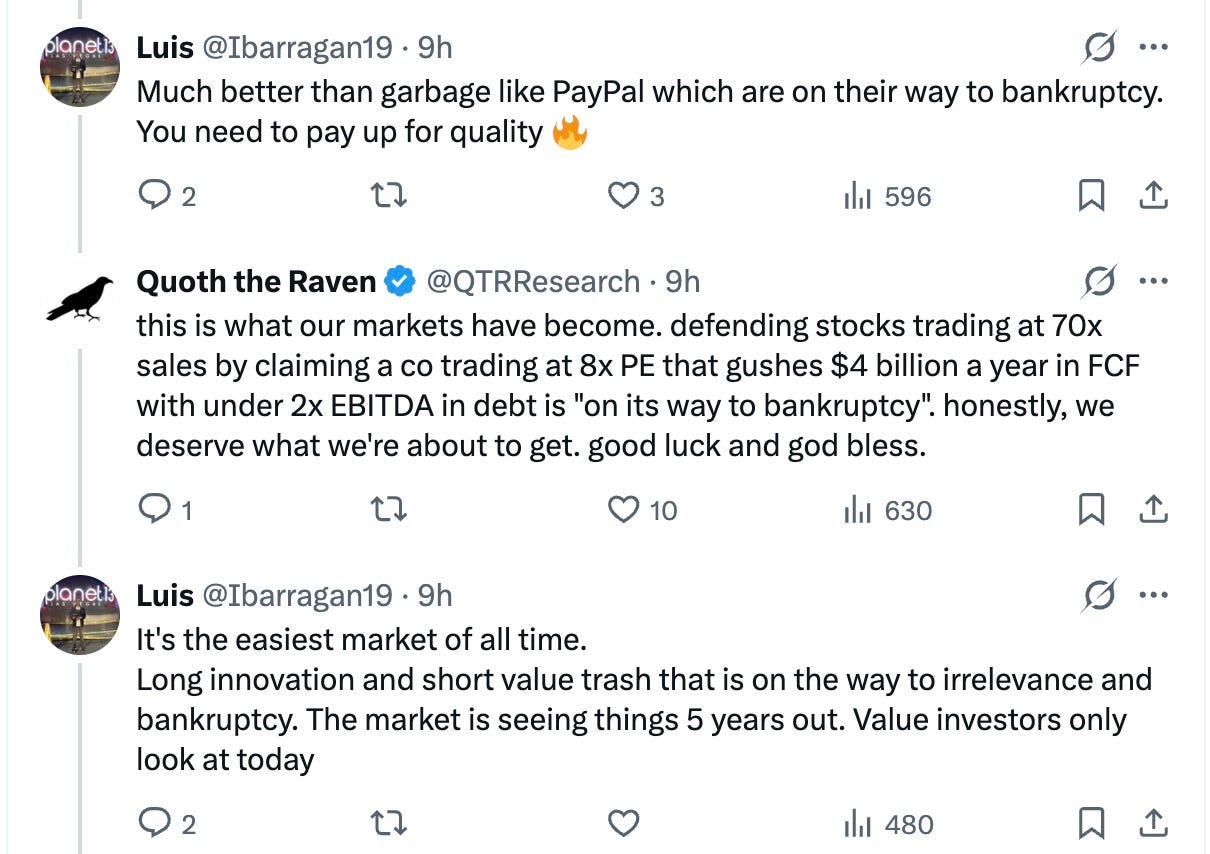
As the conversation continued, the reasoning became even more absurd. I was informed that “the AI trade is in the early innings.” I was told the market is looking five (yes, with a P/E of 35x, five) years ahead. I was told innovation beats value. I was told investors who focus on cash flow are missing the future. I was told that despite the Nasdaq roughly tripling over the last four years and sitting just a few percentage points from all-time highs, “everyone is extremely bearish.”
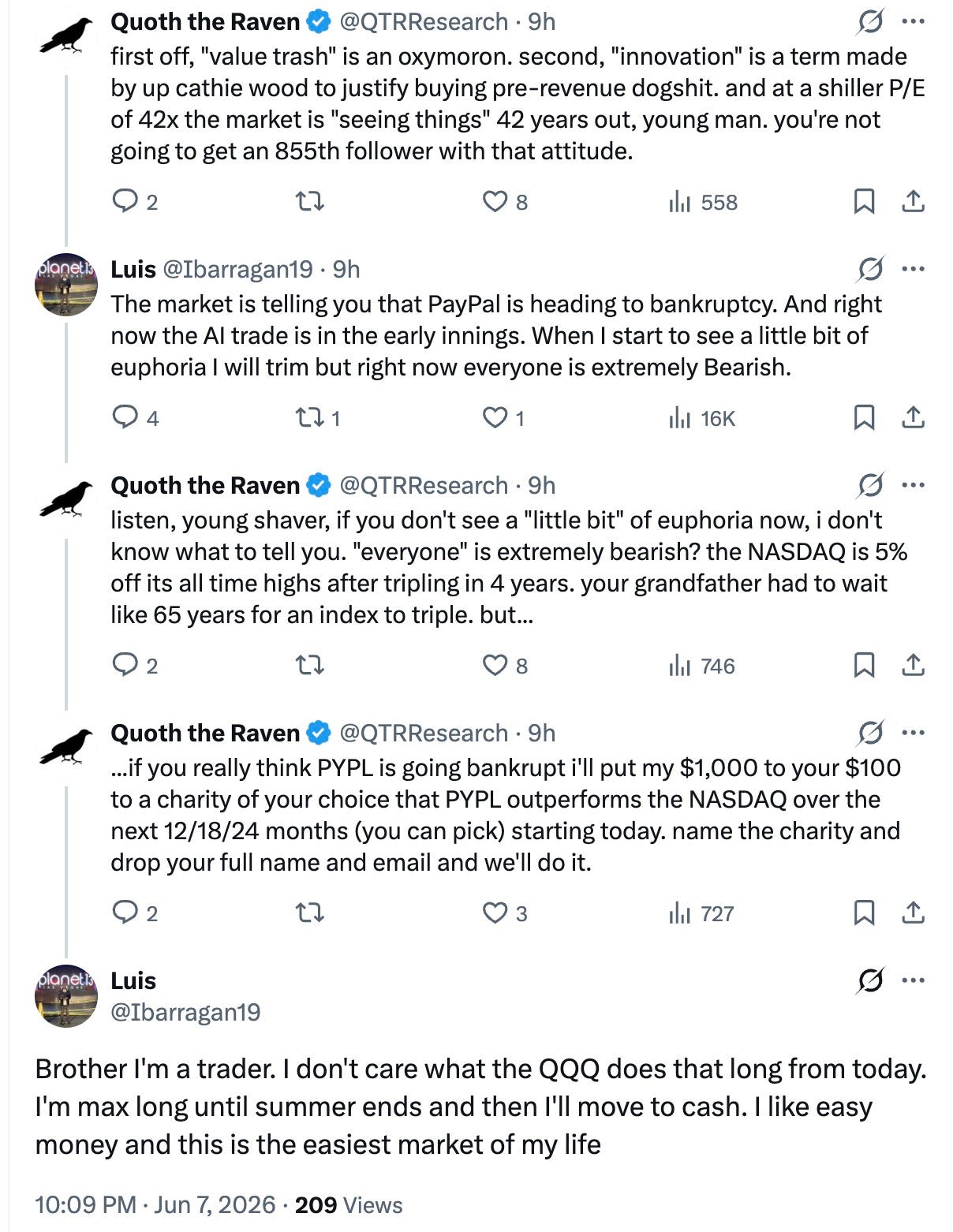
Naturally, I was also informed that he was “feasting on call options.”
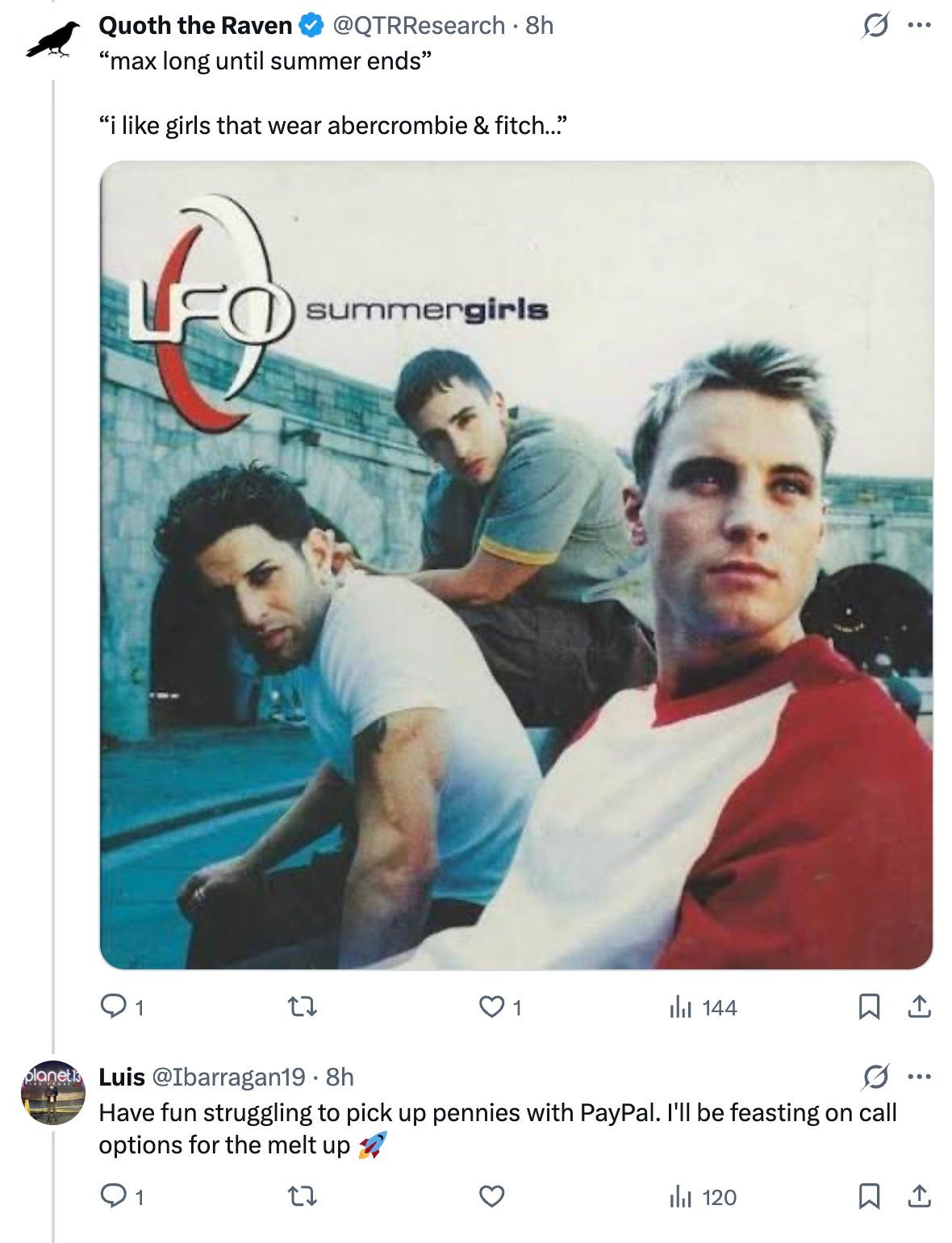
At some point during the exchange, I had a flashback to every Phil Hellmuth meltdown I had ever watched.
This investor is the winner in this bull market cycle? The guy telling me a company generating billions in cash is going bankrupt?
For the first time, I understood the emotion. Not because I think I’m always right. Not because I think younger investors are always wrong. But because I suddenly understood what it feels like to watch someone arrive at conclusions with complete confidence despite ignoring the most basic facts sitting directly in front of them.
For years I’ve argued that the current environment is being driven less by traditional investment analysis and more by speculation, momentum and options activity. The market’s biggest stories are increasingly disconnected from cash flows, balance sheets and valuation.
The participants driving many of these moves aren’t carefully underwriting businesses. They’re chasing narratives. They’re chasing themes. They’re chasing whatever stock is currently being discussed by the algorithm. Most importantly, they’re chasing call options.
“Friday was the second largest option volume session of all time (107 million options changed hands),” writes X user @Jheretohelp1, citing Goldman.
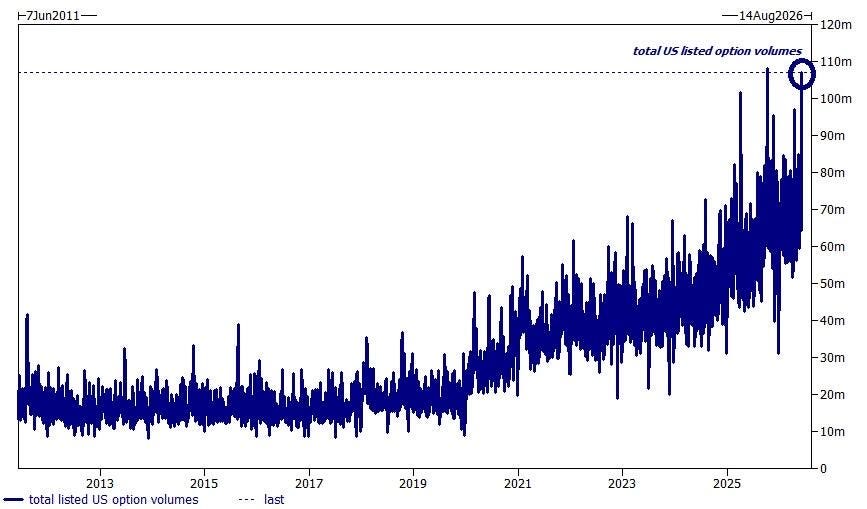
The rise of options speculation (or “feasting” on options as our friend calls it) has created a reflexive dynamic that many people still underestimate. Call buying creates dealer hedging. Dealer hedging creates buying pressure. Rising prices attract additional call buyers. More call buyers create additional hedging demand. The cycle feeds itself. The result can look exactly like genuine investment demand even when much of the activity is being driven by short-term speculation.
That process works beautifully on the way up. The problem is that the same crowd buying weekly calls because they believe every dip is temporary tends to disappear the moment conditions change. Professional capital is usually slower and more patient. Retail speculation is not. The investor who believes every stock will recover eventually is often the same investor panic-selling after a 20% drawdown. The crowd that rushes into momentum trades can rush out even faster.
Which brings me back to Phil Hellmuth.
Maybe the reason I’ve softened on him isn’t because I’ve become more sympathetic. I mean, he’s still a man-child. Maybe it’s because I’ve become more familiar with the feeling. After years of watching him lose his mind at opponents who appeared to have no clue what they were doing, I finally found myself having the same reaction while scrolling Twitter last night. The details were different, but the emotion was identical. Somewhere in the back of my mind, I heard Hellmuth’s voice.
“This guy can’t even spell markets,” I thought to myself.
I still think Phil Hellmuth is an asshole. But after spending an evening being lectured about PayPal’s impending bankruptcy by someone “feasting on call options” while declaring that everyone is bearish five percent below all-time highs, I have to admit something…I appreciate his blowups a little more now.

QTR’s Disclaimer: Please read my full legal disclaimer on my About page here. This post represents my opinions only. In addition, please understand I am an idiot and often get things wrong and lose money. I may own or transact in any names mentioned in this piece at any time without warning. Contributor posts and aggregated posts have been hand selected by me, have not been fact checked and are the opinions of their authors. They are either submitted to QTR by their author, reprinted under a Creative Commons license with my best effort to uphold what the license asks, or with the permission of the author.
This is not a recommendation to buy or sell any stocks or securities, just my opinions. I often lose money on positions I trade/invest in. I may add any name mentioned in this article and sell any name mentioned in this piece at any time, without further warning. None of this is a solicitation to buy or sell securities. I may or may not own names I write about and are watching. Sometimes I’m bullish without owning things, sometimes I’m bearish and do own things. Just assume my positions could be exactly the opposite of what you think they are just in case. If I’m long I could quickly be short and vice versa. I won’t update my positions.
As of May 20, 2026 I personally no longer actively trade (read my story here). My investing/saving is done by recurring contributions mostly to sector ETFs and a few select equities, trusted third parties who oversee my accounts, and advisors. Such advisors or funds, through individual equities, options, index funds, mutual funds, ETFs, or other securities, may have positions in, exposure to, or holdings of names mentioned herein that I know nothing about. Basically, via index funds, ETFs and individual equities it is possible I could own, have exposure to, or not own anything at any point. As of the same date, May 20, 2026, in an attempt to lead a healthier lifestyle, I’ve also excluded myself from fantasy sports, sports betting, online and in-person casinos and prediction markets.
And all positions can change immediately as soon as I publish this, with or without notice and at any point I can be long, short or neutral on any position. You are on your own. Do not make decisions based on my blog. I exist on the fringe. If you see numbers and calculations of any sort, assume they are wrong and double check them. I failed Algebra in 8th grade and topped off my high school math accolades by getting a D- in remedial Calculus my senior year, before becoming an English major in college so I could bullshit my way through things easier.
The publisher does not guarantee the accuracy or completeness of the information provided in this page. These are not the opinions of any of my employers, partners, or associates. I did my best to be honest about my disclosures but can’t guarantee I am right; I write these posts after a couple beers sometimes. I edit after my posts are published because I’m impatient and lazy, so if you see a typo, check back in a half hour. Also, I just straight up get shit wrong a lot. I mention it twice because it’s that important.
I've been running into this in real estate investing the last several years. With 40 years of experience under my belt. I decided to step aside and let the nuevo genius' run and wish them the best. I'm going to go cut the grass.
Another aspect of this sub I am drawn to. I dont know why.....But it forces me to look inward on occssion. I for one sure can be one arrogant MFer. But im recognizing it more and more and addressing it. It seems to be a trait of the highly motivated and intense. But that doesn't excuse not learning how to temper it and try a different approach. 🍻 as always captain.