

By Jorge Munoz, Mises Institute
This month is the 100th anniversary of the birth of one of the most important and prolific authors of the Austrian School. This author wrote about practically every possible topic: economics, history, philosophy, etc.
Rothbard is known for his radical defense of liberty without any kind of compromise. From his youth, he was a brilliant boy and, thanks to his parents—especially David—he developed his anarchism. He published more than 20 books throughout his life and thousands of articles; it is said that he wrote more than 20 pages a day without breaking a sweat, using a typewriter that was already outdated for the time.
Robert Higgs—author of Crisis and Leviathan—recounts that, in a review of said book, Rothbard went far beyond what was expected: he praised the work and detailed in 26 pages how it could be improved, providing numerous references that, according to Higgs, would have been impossible for him to incorporate even if he had dedicated an entire decade solely to reading.
His controversy with Ayn Rand’s circle is well known. Rothbard published “The Ayn Rand Cult,” a fierce critique of that circle of Objectivists whom he accused of being a cult. He knew them firsthand, as upon reading Atlas Shrugged, he wrote a letter to Rand praising the book with enthusiasm and stating it was one of the best he had ever read. However, after some time and several controversies—including the circle’s attempt to get him to separate from his wife, Joann, because she was Catholic—Rothbard decided to walk away for good.
Perhaps the most complete biography of Rothbard is the one published by Justin Raimondo, titled An Enemy of the State: The Life of Murray N. Rothbard (2000). David Gordon also wrote a book called The Essential Rothbard, but it focuses more on his technical work. Raimondo’s book is fascinating because it brings you closer to Rothbard the person: his intellectual trajectory, his struggles, his ambitions, and his environment. It shows that he didn’t just dedicate himself to writing masterful treatises, but combined his intellect with a strong commitment to practical change, getting involved in parties and publishing in any magazine that gave a voice to the ideas of liberty.
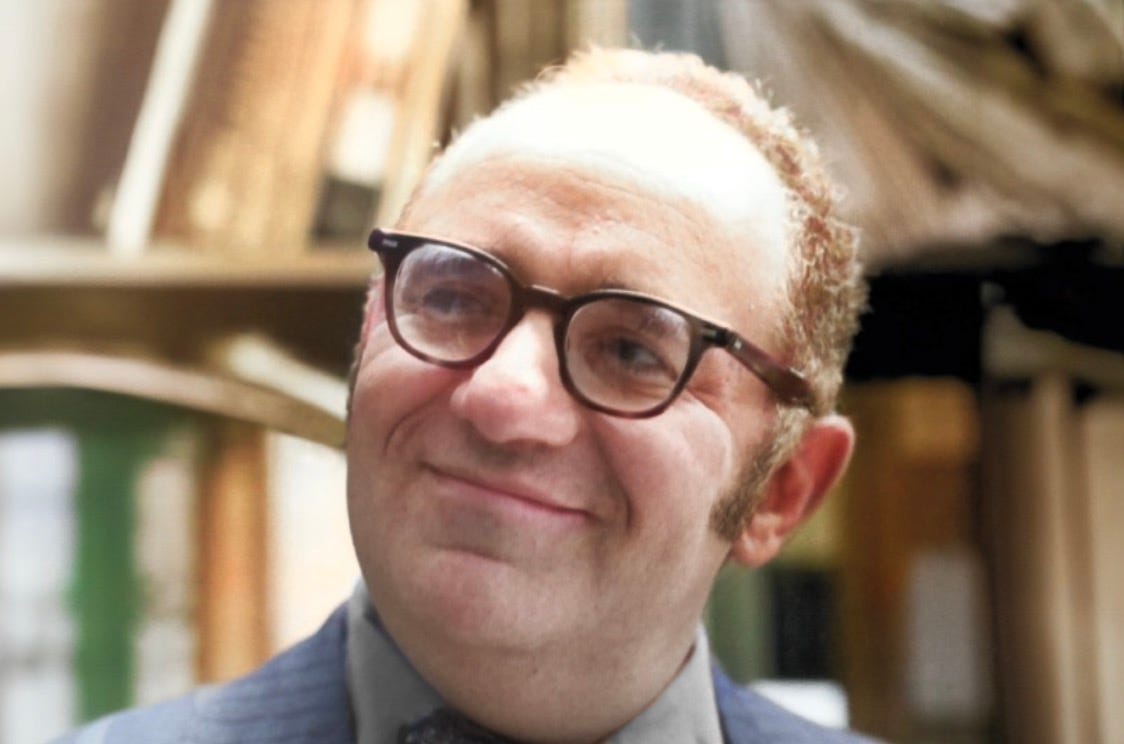
Furthermore, Rothbard did not hesitate to ally himself with the left or the right depending on which position better suited the libertarian ideal at any given moment. After the New Deal, the right began abandoning its roots and adopting more interventionist and warmongering stances, led by William Buckley. For this reason, Rothbard reclaimed the “Old Right,” pointing out that it was the place to return to, citing authors like Mencken, Albert Jay Nock, or Howard Buffett (Warren Buffett’s father, a senator for Nebraska and friend of Rothbard). Because of this, during the anti-war movement of the Vietnam War, Rothbard did not hesitate to ally with the left, as he saw it as much closer to libertarian positions than the “New Right.”
At Columbia University, Rothbard studied mathematics and later earned a PhD in economics. He was never fully convinced by any previous economic school: he knew Keynesianism was wrong and always advocated for freedom, but felt he lacked the tools to defend it in the economic sphere. Everything changed when he received some news: a professor named Ludwig von Mises—who had recently arrived in New York fleeing Nazi Germany—had published an economics treatise. When Rothbard asked what the book would include, the answer was everything. That book was Human Action, published in 1949.
From then on, he would definitively convert to the Austrian School and leave classical liberalism behind to become a steadfast anarcho-capitalist. But, unlike Mises, Rothbard defended anarcho-capitalism based primarily on ethics and morality, and not just economic efficiency and utilitarianism.
Rothbard says it was shortly after reading Human Action that he moved from classical liberalism to anarcho-capitalism, thanks to a conversation with some friends:
Friends: “Why are you in favor of the government providing police force and justice? What is your justification?”
Rothbard: “Well, people come together and decide that you can have this monopoly on the judicial and police system.”
Friends: “If people can come together and say that, why can’t they come together and build a steel plant, a dam, and everything else? Why can’t they also set up other government industries?”
Rothbard: “Reflecting on it the next day, I thought: My God, they’re right. I concluded that ‘laissez-faire’ was inconsistent: I either had to move to anarchism and eliminate government entirely or I had to become a liberal [in the American sense, meaning socialist].
Rothbard is an author who stands out not only for his brilliance in dealing with practically any subject but also for writing in a way that often makes you read him as if it were a novel, using irony and sarcasm even in his most elaborate treatises. His clarity in writing was exceptional, although from a strategic point of view, it might not have been the best choice; obscure, abstruse, and hard-to-understand authors tend to spark more interest among intellectuals—plus, that way, disciples can make a good living interpreting the master’s work, which can only be deciphered by those initiated in such high matters.
Rothbard always spoke clearly, perhaps too clearly, and for that, he has been heavily criticized. But that never mattered to him; he could have made a good living and enjoyed a comfortable existence if he hadn’t tackled many of the topics he did. But he didn’t care, taking Mises as an example—his mentor in a New York seminar who had a part-time, poorly paid job as an economist. Despite everything, Mises never lost his smile and never complained about his situation. Rothbard would follow in his master’s footsteps.
He taught engineering students who had taken economics as an elective at the Brooklyn Polytechnic Institute. Rothbard didn’t even cite himself, even when writing about the topics being discussed; the students didn’t really know who they had in front of them. Hoppe recounts that, when he went to study with Rothbard, he discovered his student scholarship was larger than Rothbard’s salary. Despite everything, he was able to make a living thanks to institutions like the Volker Fund, which supported him in writing Man, Economy, and State, with Mises’s approval.
Rothbard never believed the official history written by the victors and court intellectuals. This is evident throughout his work, especially in his books Wall Street, Banks and American Foreign Policy, The Case Against the Fed, The Great Depression, and many more. As Hoppe tells us:
But above all, it was Murray who taught me never to trust official history, invariably written by the victors, but to conduct all historical research like a detective investigating a crime. Always, first and foremost and as a first approximation, one must follow the money trail in search of a motive. Who benefits? Whether in terms of money, real estate, or pure power, from this or that measure.
Tom Woods also shares a curious anecdote. It turns out Woods needed a recommendation on a topic he was studying:
Woods: “I’d love to have a history of money in the U.S. written from a pro-gold standard perspective. Do you know of anything?”
Rothbard: “Well, there’s good material on this in the Minority Report of the U.S. Gold Commission of 1983.”
Woods: “When I read it, I saw there was a lot of historical material, from the colonial period to the 20th century, covering the various crises of the 19th century. All the information you could want. It turns out Rothbard had written that material, but he didn’t tell me.”
Now that report can be found in A History of Money and Banking in the United States.
I could cite every book and paper that talks about Rothbard, but space does not permit it. I think the videos are enough to capture his essence. Today, we are lucky to have all his material available for free on the internet, just a click away. And not just his books—he also has lectures and classes uploaded to YouTube.
Much remains to be said, and I’ve tried to focus more on his persona than his work, because space does not permit a full biography in this article. In short, if you’re interested in economics, read Rothbard. If you’re interested in politics, read Rothbard. If you’re interested in philosophy, read Rothbard. If you’re interested in sociology, read Rothbard. And above all, if you’re interested in liberty, read Rothbard.
If—living in an era without the internet and using a typewriter—he was able to accomplish such a feat, how much more can we do with all the tools at our disposal? I believe that if Rothbard were living in the age of the internet and AI, we would already be in Ancapistan by now.

QTR’s Disclaimer: Please read my full legal disclaimer on my About page here. This post represents my opinions only. In addition, please understand I am an idiot and often get things wrong and lose money. I may own or transact in any names mentioned in this piece at any time without warning. Contributor posts and aggregated posts have been hand selected by me, have not been fact checked and are the opinions of their authors. They are either submitted to QTR by their author, reprinted under a Creative Commons license with my best effort to uphold what the license asks, or with the permission of the author.
This is not a recommendation to buy or sell any stocks or securities, just my opinions. I often lose money on positions I trade/invest in. I may add any name mentioned in this article and sell any name mentioned in this piece at any time, without further warning. None of this is a solicitation to buy or sell securities. I may or may not own names I write about and are watching. Sometimes I’m bullish without owning things, sometimes I’m bearish and do own things. Just assume my positions could be exactly the opposite of what you think they are just in case. If I’m long I could quickly be short and vice versa. I won’t update my positions. All positions can change immediately as soon as I publish this, with or without notice and at any point I can be long, short or neutral on any position. You are on your own. Do not make decisions based on my blog. I exist on the fringe. If you see numbers and calculations of any sort, assume they are wrong and double check them. I failed Algebra in 8th grade and topped off my high school math accolades by getting a D- in remedial Calculus my senior year, before becoming an English major in college so I could bullshit my way through things easier.
The publisher does not guarantee the accuracy or completeness of the information provided in this page. These are not the opinions of any of my employers, partners, or associates. I did my best to be honest about my disclosures but can’t guarantee I am right; I write these posts after a couple beers sometimes. I edit after my posts are published because I’m impatient and lazy, so if you see a typo, check back in a half hour. Also, I just straight up get shit wrong a lot. I mention it twice because it’s that important.
I began my interest in economics and philosophy with 'Atlas Shrugged' and Ayn Rand. I concurred on many, but not all, ideas laid out with objectivism. That lead to the Mises Institute and to what I now consider my core beliefs. Rothbard, of course, was a grand, guiding influence. I don't know what economic discipline our "esteemed" institutions of higher learning teach, but judging from the actions of the graduates, it's clearly not aligned with anything close to a libertarian, or in my case an AnCap philosophy. It's a shame.
It's always been about the oil. My old man gave up his career in the military after Korea because he knew they would send him to the middle east. He got out, his squadron went to Saudi Arabia to defend the oil.