

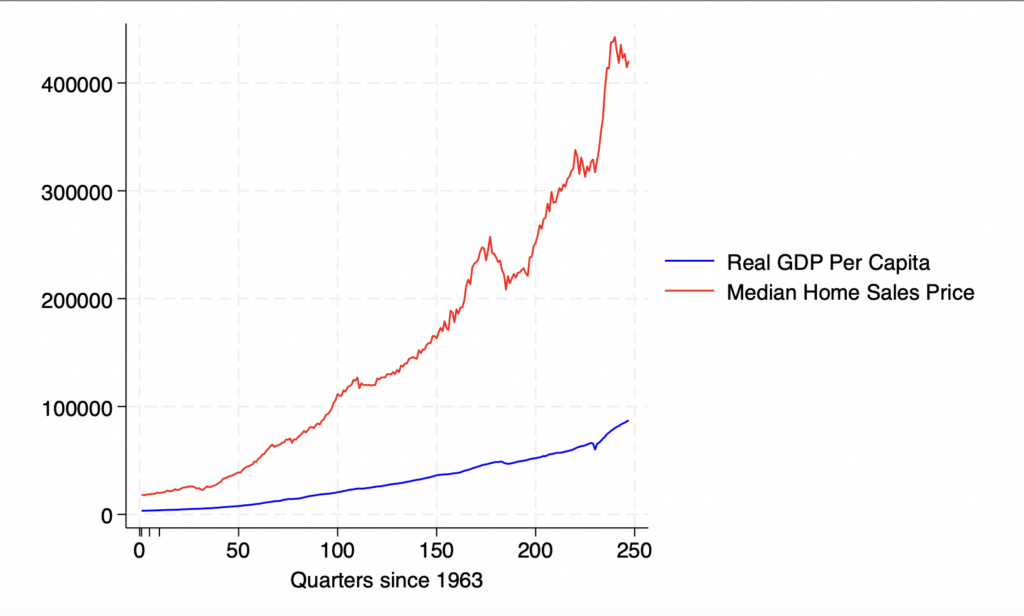
While home prices increase in price exponentially, many worry as to whether they will one day own a home. For years the American dream consisted of home ownership and financial independence. The increasing price of homes makes it seem as though only a select group of elites can afford them. The graph below shows median price of home sales exponentially outpacing real GDP per capita, not even taking into account that individual purchasing power trails far behind real GDP.
The urgency of desire for a homeownership creates perverse, long-term incentives for both home buyers and builders. Rather than building homes that are intended to last, construction companies, lured by high present demand, will build homes from cheap materials and use techniques that prioritize speed. The drastic decrease in the size of a 2×4 since the 1920s paints a vivid picture of the decline in home quality.
The material quality as well as the design quality of homes has shot through the floor because homebuyers are not able to see the full risks of their investment. Because homes include the limited resource of land as well as a traditional durable structure, they have historically been a solid investment. Houses that were built over 100 years ago are often still hot commodities and they seem to constantly appreciate. Homes used to be built with the idea that they would last a long period of time and be repaired as they needed it. While each house is different, the public still mentally places them into one asset category when they are deciding whether to buy a home or not. Specific companies earn trust through years of repeated performance, and it would be easy to think that homes as an asset function the same way. Fundamental differences in durability will stratify houses into different categories of investment as buyers see how newly built homes disintegrate.
Just as companies utilize different profit maximizing strategies, so also do home builders try unique approaches. Some builders plan for long-term success by creating homes that will bolster their reputation far into the future, but many home builders in recent years have planned for their investment to peak shortly after they build it, counting on housing shortage and buyer indifference to keep home prices in general high. While this is a good strategy for maximizing profit in the current market, people will slowly start to become more critical of new builds as they see their young homes disintegrate.
Two limiting factors for homebuilders of the past were more scrutinizing buyers and a smaller selection of materials. With lower demand for homes, sellers did not have the same negotiating power that they have been given since the housing shortage after World War II. Homebuyers were also more likely to have had experience in construction, or at least some knowledge of craftsmanship. Their more trained minds would let them see signs of fast and cheap construction more easily than the modern eye. Homes were often bought with the idea of keeping them in the family for an extended period of time, so they were more carefully examined for quality. The second limitation to the wiles of builders in the past was that they did not have access to the same cheap materials that are currently available. While homebuilding materials are by no means cheap, they are far cheaper than the logs and stone used to fashion homes of the past. Cheaper transportation costs along with cheaper methods of production have allowed the building materials of all types to decrease in price. While some would have thought that this could have made high-quality houses more accessible, it seems to have only stirred up exponential cravings for bargains among homebuilders. They try to use far less framing and ever smaller 2x4s to make up for a lack of more stable and durable materials.
Additionally, modern conveniences have shifted many costs away from building companies and towards residents. Homes in hot places that would have been built with thick, cooling walls are now fully reliant on air conditioning. Pre-fabricated parts also reduce producer cost and ultimately shift costs to long-term homeowners. pre-built units are much more difficult to repair and they are much more likely to fall apart if a single weak link is broken. Houses that are simple can be repaired simply, and that often pays off the higher cost of more substantial natural materials. While quickly built houses solve the housing problem for now, they will just exacerbate the problem 30 years from now when builders who could’ve been building new houses must waste time rebuilding where their old ones were demolished.
While their work may be questionable, builders cannot bear the blame for responding to the self-centered nature of their target market. The American consumer does not think about their children as they used to. A house becoming worthless in 50 years doesn’t weigh heavily in their mind of one who cares only for deals today. Building a house that can last is objectively more expensive, but it used to be expected, and it pays off in the long run.
…And Trump Won’t Fix The Economy: Schiff
Last Friday, Peter joined Artur Kalbarczyk for a wide-ranging conversation about the Federal Reserve’s next moves, the “time bomb” of U.S. government debt, and why he believes inflation will keep surging in 2025. Despite market expectations that the Fed will leave rates unchanged at its upcoming meeting, Peter sees plenty of monetary danger on the horizon—especially with budget deficits ballooning and no real plans for meaningful spending cuts.
Turning first to the Federal Reserve, Peter emphasizes that, although rising inflation would ordinarily prompt more rate hikes, the central bank appears hesitant to take action:
The fact that the Fed is not going to raise rates, even as inflation is rising, is a significant development because that means real rates are going to be plunging. And that’s going to be negative for the dollar. It’s going to be bullish for commodities. It’s going to be bullish for gold. And so those are the trends, I think, that are going to be important.
While the Fed projects 2% as its inflation target, Peter argues that it may soon shift the goalposts. Rather than tightening policy and risking a recession, officials may decide to tolerate 3% inflation or higher. This reluctance to bite the bullet stems from decades of poor fiscal and monetary policy:
It’s really unfixable in that it’s not just about cutting spending. We’ve got to repair the structural damage to the economy. That’s the result of decades of bad monetary and fiscal policy, where we have an economy that runs on consumer credit and people living beyond their means… And so we have massive trade deficits and budget deficits. So we have an entire economy that’s predicated on those deficits continuing.
On the subject of government spending, Peter’s outlook is grim, as annual budget deficits could reach three or four trillion dollars soon. He points to mounting interest costs on federal debt—potentially hitting two trillion dollars a year by 2026—as the most urgent red flag:
The national debt is probably going to hit 40 trillion within a year. We’re going to be adding three to four trillion a year in debt. So this is a time bomb here. In fact, it’s already, I think, going off when the interest on the debt is 1.2 trillion or so. Sometime next year, it’s going to hit 2 trillion. And by 2026, we’ll be spending 2 trillion a year just paying the interest on the debt. And it’s going to keep rising from there.
Moreover, Peter doubts that President Trump’s proposed policies—ranging from renewed tax cuts to the threat of tariffs—will address the real problem. Even if new tariffs generated revenue in theory, he says, the bigger challenge is that the United States simply no longer has the domestic capacity to replace imported goods:
The tariffs are taxes and the government needs more taxes, right? Because we have a huge deficit. So the tariffs will help reduce the deficit somewhat. But, you know, they’ll be more than offset by other tax cuts. So the deficit is going to go up. The problem is we’re not likely to get the tariffs for that reason. But, you know, Trump misrepresented the tariffs to the voters– as if we’re going to get government, and we’re going to have Canada pay for it. … It’s not going to happen. That’s not how it works.
Peter remains resolute in his bullishness on gold, which he believes is poised to set record highs in U.S. dollar terms (as it already has in many other currencies). Meanwhile, he laments the ongoing hype around Bitcoin and “meme coins,” arguing that they siphon potential investors away from more traditional and reliable hedges:
Crypto has taken the retail investor out of the precious metals market. Gold is being driven by central banks and more sophisticated buyers, but silver is considered ‘poor man’s gold.’ Well, the poor men are gambling on crypto. Silver is just not on anybody’s radar, but there are more and more uses for silver discovered all the time.

QTR’s Disclaimer: Please read my full legal disclaimer on my About page here. This post represents my opinions only. In addition, please understand I am an idiot and often get things wrong and lose money. I may own or transact in any names mentioned in this piece at any time without warning. Contributor posts and aggregated posts have been hand selected by me, have not been fact checked and are the opinions of their authors. They are either submitted to QTR by their author, reprinted under a Creative Commons license with my best effort to uphold what the license asks, or with the permission of the author.
This is not a recommendation to buy or sell any stocks or securities, just my opinions. I often lose money on positions I trade/invest in. I may add any name mentioned in this article and sell any name mentioned in this piece at any time, without further warning. None of this is a solicitation to buy or sell securities. I may or may not own names I write about and are watching. Sometimes I’m bullish without owning things, sometimes I’m bearish and do own things. Just assume my positions could be exactly the opposite of what you think they are just in case. If I’m long I could quickly be short and vice versa. I won’t update my positions. All positions can change immediately as soon as I publish this, with or without notice and at any point I can be long, short or neutral on any position. You are on your own. Do not make decisions based on my blog. I exist on the fringe. The publisher does not guarantee the accuracy or completeness of the information provided in this page. These are not the opinions of any of my employers, partners, or associates. I did my best to be honest about my disclosures but can’t guarantee I am right; I write these posts after a couple beers sometimes. I edit after my posts are published because I’m impatient and lazy, so if you see a typo, check back in a half hour. Also, I just straight up get shit wrong a lot. I mention it twice because it’s that important.
Completely disagree with thesis on quality of homes being built. Regulations have tightened up the industry over last 50 years. I've built a dozen homes over last 5 years; I have 2 building inspectors on speed dial. you don't just "phone it in". R-values have increase markedly. My 50 year old home has R-14 in the walls, new homes in same area are required to have R-29 now. We do a blower door test (by law) too check energy efficiency of the home. Respectfully, I'm just not sure where Mr. Schiff gets his information. I'd trade my 50 year old house for the one I built last year in a heartbeat.
Schiff gets it right when he says silver is undervalued, but stubbornly holds onto his anti crypto stance and denigration of digital assets. Almost everything is electronic nowadays. In some ways reminds me of a man discouraging investment in the fledgling auto industry in 1890 and instead insisting on continued investments in hay and metals for horse shoe construction and blacksmithing equipment. After all, how are automobiles supposed to operate without roads, or gasoline, or places along a road, even if built, where one can purchase gasoline. Plus it is highly combustible and dangerous, storage costs will make the automobile impractical for the average person. Buyer beware.