

By Jeffrey A. Tucker, Brownstone Institute
The year was 2001 and the dot-com bust was in the rearview mirror. New ideas were in circulation among young and visionary entrepreneurs. Sure, pets.com failed and so many others but that was a temporary boom-bust.
The Internet will change everything eventually, we were told. Technology, decentralization, crowd sourcing, and digital spontaneity will create an information landscape without gatekeepers. Everything will have to adapt. The experts of the old world will be replaced by a people’s revolution. Whereas legacy elites waved credentials, a new class of revolutionaries will raise armies of servers and digits to move the center of civilization to the cloud.
Wikipedia was a headline feature, an experiment in crowd sourcing knowledge in a way that was decentralized, able to scale in ways the old model was not, and drawing from the knowledge and passions of people the world over. The platform seemed to embody the principle of freedom itself. Everyone has a voice. The truth will emerge from the seeming chaos of competing points of view.
At long last, the anti-authoritarian outlook would be tested on a medium that had intrigued scholars since the ancient world: books containing all knowledge. Reading through Aristotle’s vast corpus, you find this passion and drive at work. He wanted to document everything he could about the world around him. Centuries later following the fall of Rome, St. Isidor, archbishop of Seville, embarked upon a similar path. With the help of countless scribes, he spent his life writing Etymologiae, a massive treatise on all that was known, compiled from 615–630AD.
As publishing with movable type took hold in the 15th and 16th centuries, the first similar work appeared in 1630: Johann Heinrich Alsted’s Encyclopaedia Septem Tomis Distincta. When by the late 19th century, book publishing and distribution was democratized by markets and technology, and middle-class households could obtain real libraries, the encyclopedia set became a huge commercial success. Many companies were involved in making and selling them.
After the Second World War, it became common for every household to have a set on the shelf, or several. They provided endless fascination for everyone, a reference tool for learning for all ages. One of the more salient memories of my own childhood was opening them randomly and reading as much as I could, on pretty much any imaginable topic. I spent countless hours with these magical books.
Encyclopedias drew from the best experts but always with gatekeepers to decide what was and was not credible information. The top editorial position at World Book, Britannica, or Funk & Wagnalls was a powerful place to be professionally. He could decide what was and was not true, who was and was not an expert, what people did and did not need to know.
When Murray Rothbard had finished his graduate studies at Columbia University and before he had a teaching position, he was looking for ways to bring in income. As a trained economic historian, he attempted to send in three entries to an encyclopedia company. The essays were promptly rejected simply because his take was different from the mainstream consensus, never mind that what he wrote was true.
This is the problem with gatekeepers. So long as printing remained the main means by which knowledge was preserved and distributed, they would be necessary.
The founding of Wikipedia in 2001 was about a vision to change that. The initial reaction was widespread and justifiable incredulity. It could never work for anyone to be able to change anything, so they said. It’s not possible simply to wipe away the gatekeepers and for truth to emerge. For years, this perception dominated, as teachers and experts of all sorts spoke of Wikipedia only with disdain.
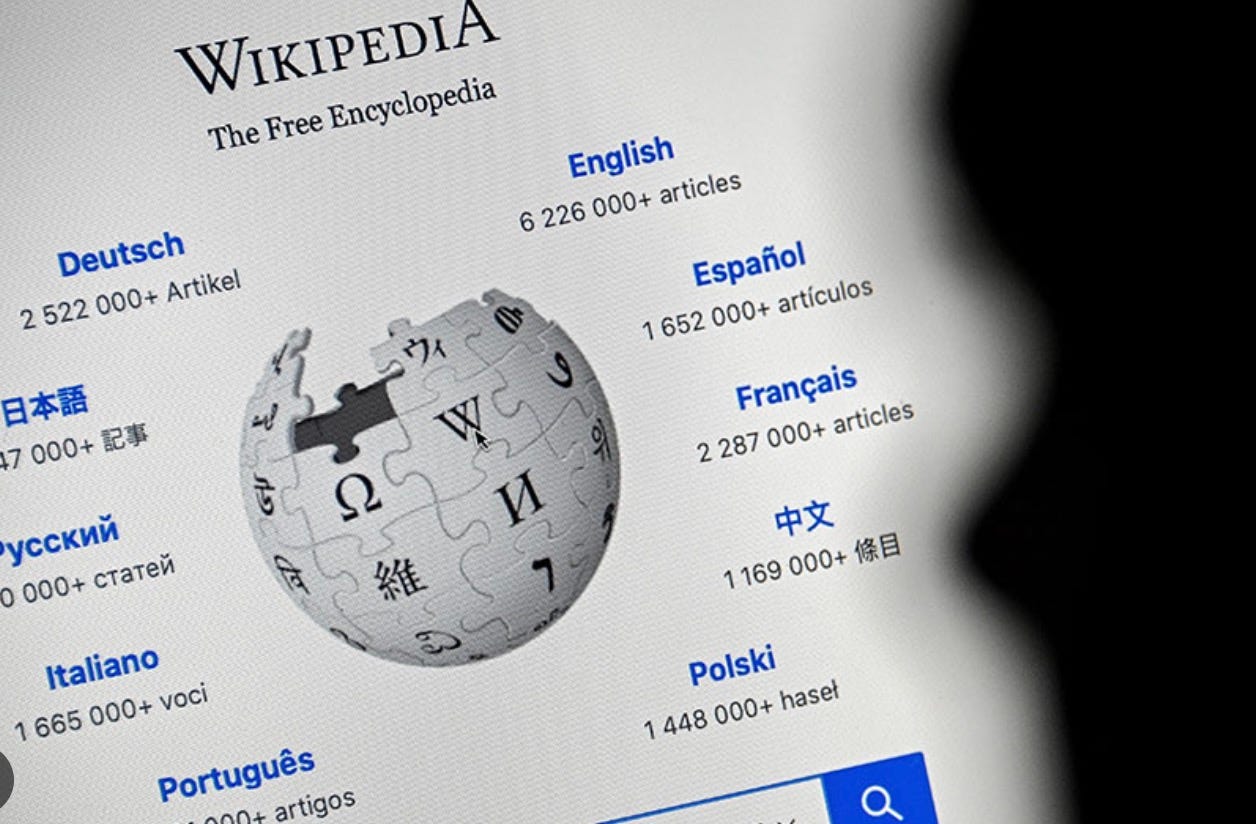
But gradually, something interesting began to happen. It actually seemed to be working. The entries became ever more voluminous and detailed. The rules of the road became more embedded, so that citations and documentation were required, and interest groups rallied around particular entries to guard them against corruption. Sure anyone can edit but your edits will be reversed immediately if you are not in compliance. For many entries, it became essentially impossible to change them without first going to the discussion pages and asking permission.
Already early on, new gatekeepers emerged on the platform. How did they become that way? Through persistence, skill at Wiki code, deep knowledge of the platform, and a native ability to understand the culture of the platform. For a time, this only increased the credibility of the platform. As the proof of concept became ever more visible and obvious, it began to rank ever higher in search results. At some uncertain point, the critics quieted down and Wikipedia triumphed.
Were its earliest champions correct? Did the model of spontaneous evolution actually generate a better product than the old top-down system? In many ways, it did. In other ways, it did not. Wikipedia brandished crowd-source credibility – this is what the community has decided to be true – while giving rise to a new opinion oligarchy that was as bad or worse than what it replaced.
The targeting of the platform started right away. The topic was science, and global warming in particular. One of the founders, Larry Sanger, noted that this was happening early on. Some sources were deemed inadmissible while others were valorized as excellent for citation. The topic in particular was fraught with the problem of epistemological capture. The grants flowed to those pushing conventional narratives who were in turn published in the major journals, while dissidents were shoved aside and even tossed out of professional societies. Wikipedia perfectly manifested the same problem.
The whole point of Wikipedia was to permit crowdsourcing to break down traditional information cartels. In this case, and ever more as the years went on, the cartels had reassembled themselves.
At least with old-style encyclopedias, readers knew the names of both the authors of entries and the editors. They signed what they wrote. With Wikipedia, 85 percent of the most powerful editors remained entirely anonymous. This turned out to be a grave problem. It permitted powerful industries, foreign governments, deep-state agents, and anyone with the highest stake in a topic to control the messaging while banishing contrary points of view.
As politics became ever more contentious, Wikipedia in general went the way of mainstream media with a consistently mainline center-left bias on any topic that impacted on political outlook. After Trump won in 2016, the entire platform was swept up in the hate that followed. Editors made lists of credible and not credible sources, thus banning any right-of-center media from being cited in the interest of balance. Indeed, balance disappeared entirely.
The Covid period proved that it was too far gone to be saved. Every entry echoed CDC and WHO propaganda, and even the entry on masks advanced the most preposterous claims. The material on the Covid vaccines might as well have been written by industry (and probably was). If you were looking for something objective – perhaps some common sense on dealing with a respiratory infection – the search was hopeless.
The platform had been fully captured during the greatest crisis of our lives. It was far worse than an older encyclopedia which would at least preserve known information on natural immunity or therapeutics or strategies used in pandemics in the past. Wikipedia was so agile that it would be edited in real time to delete settled knowledge and replace it with whatever hullabaloo was being whipped up by industrial bureaucrats that morning. This was not digital utopia; this was Orwell come to life.
The rise of Wikipedia was spectacular, implausible, and glorious. Its fall is equally disappointing, predictable, and inglorious. It’s also paradigmatic. Every major venue failed in its emancipationist promise and instead became handmaidens of the propagandists and censors: Microsoft, Google, Facebook, and even Amazon. The information revolution turned gradually into a tool for shoring up the corporatist/state system.
The betrayal here serves as a tragic reminder that no technology is uncorrupted, no method not subject to abuse, no platform permanently inoculated against capture. Indeed, the more credibility an institution earns, the more confidence it inspires, the more likely it is to attract bad actors who will flip its purposes on their head and push an agenda.
What I’ve reported above is no longer unknown. Most people today are aware of Wikipedia’s biases. Regular people long ago gave up trying to save it from itself. You can spend a half-day on a small edit and see it reversed by the nameless editorial oligarchs who guard every entry that is even slightly controversial. Instead of broadening and including voices, it has narrowed and excluded them.
Fortunately, the wheels of technology have kept turning. Artificial intelligence dropped in the late Covid period and at least one company, xAI, has devoted itself to providing the best tools to keep the dream of democratized information alive. Grokipedia, even in its first iteration, is already leagues above Wikipedia in balance and range of information sources. As it turns out, machines do a better job than anonymous oligarchs at getting us close to the truth.
Welcome to the post-Wikipedia age. It was fun while it lasted. All hail its deprecation and replacement with something much better.

QTR’s Disclaimer: Please read my full legal disclaimer on my About page here. This post represents my opinions only. In addition, please understand I am an idiot and often get things wrong and lose money. I may own or transact in any names mentioned in this piece at any time without warning. Contributor posts and aggregated posts have been hand selected by me, have not been fact checked and are the opinions of their authors. They are either submitted to QTR by their author, reprinted under a Creative Commons license with my best effort to uphold what the license asks, or with the permission of the author.
This is not a recommendation to buy or sell any stocks or securities, just my opinions. I often lose money on positions I trade/invest in. I may add any name mentioned in this article and sell any name mentioned in this piece at any time, without further warning. None of this is a solicitation to buy or sell securities. I may or may not own names I write about and are watching. Sometimes I’m bullish without owning things, sometimes I’m bearish and do own things. Just assume my positions could be exactly the opposite of what you think they are just in case. If I’m long I could quickly be short and vice versa. I won’t update my positions. All positions can change immediately as soon as I publish this, with or without notice and at any point I can be long, short or neutral on any position. You are on your own. Do not make decisions based on my blog. I exist on the fringe. If you see numbers and calculations of any sort, assume they are wrong and double check them. I failed Algebra in 8th grade and topped off my high school math accolades by getting a D- in remedial Calculus my senior year, before becoming an English major in college so I could bullshit my way through things easier.
The publisher does not guarantee the accuracy or completeness of the information provided in this page. These are not the opinions of any of my employers, partners, or associates. I did my best to be honest about my disclosures but can’t guarantee I am right; I write these posts after a couple beers sometimes. I edit after my posts are published because I’m impatient and lazy, so if you see a typo, check back in a half hour. Also, I just straight up get shit wrong a lot. I mention it twice because it’s that important.
The year was 1980-something. It was a Saturday because I was watching cartoons in the morning and not at school. Something those from the ancient times call “Saturday morning cartoons.”
There was a ring at the door. A stranger. My mother let him in and called for my father. I curiously followed in, tucked behind.
This man stood tall, carrying upon a dolly a large crate full of wonder. It was the 80s so (1) people would legitimately have jobs as traveling salesman and (2) as a kid I loved it.
“Have you ever seen an encyclopedia?” He asked, looking straight at me.
“No, what is it?!” I inquisitively replied.
The man looked to my parents and asked “May I?” And my father responded sternly in his barely perceptible accent “Shore.”
The man deftly slid the crate off the dolly, unhooked some latches and showed us magnificence we had never before witnessed. It was a row of large books. 22 or so Volumes. Categorized alphabetically. Bound in leather with the pages in gold leaf.
I looked at my mom. She was gone. Entranced. All she could see was gold. Beautiful gold.
Where we immigrated from, we didn’t have books this intricate and beautiful.
My dad snapped, “What is this? A dictionary? We have a dictionary. And he pointed to the giant 40 pound tome sitting atop its podium.”
The man responded, “oh no no, sir. In fact, encyclopedias work in conjunction with a dictionary. A dictionary might give you a brief description of something, but an encyclopedia will tell its story! Go on over and pick a word, maybe an animal?”
My dad headed to the podium and flipped the pages of the dictionary mumbled something and looked up and said “Geeraf.”
Quick as he could the salesman grabbed one of the volumes towards the center and pulled it out. We all gathered around. Silent.
“Giraffe.” He exclaimed as he flipped to the page.
The silence was broken with gasps. My mom may have cried. Upon the page for the giraffe were words, yes, but full color pictures too. Many pages of pictures. A mother giraffe with her baby. Diagrams. Sketches. It was truly a wonder.
I didn’t even have to ask. My dad was a physician and an academic. He hurriedly wrote the man a check and several months later we received the shipment.
The full set of leather bound, gold leaf encyclopedia Britannica.
Over the next year I went through every page of every volume.
It was there, in the Encyclopedia Britannica, where I received confirmation of what I had always suspected: a woman cannot have a penis and men cannot get pregnant.
My love for reading started with World Book when a was young. Pops fell for a door to door sale. Brown and black leather bound. Loved them.
Id grab a letter and read myslef to sleep about random knowledge topics that interested me. Would wake up with it on my chest in the morning.
I can connect a lot of dots back to that early practice.