

For decades, it has felt as though the world has been moving remarkably slowly.
Consider commercial aviation. Take someone from 1985, put them on a commercial flight today, and there is very little about the experience they wouldn’t recognize. The planes are more fuel-efficient, the avionics are more sophisticated and air traffic control has improved.
But other than the fact that men don’t wear three piece suits to travel and there’s no more ashtrays on your tray tables (yes, this was a thing) the fundamental experience is largely unchanged. In fact, we used to fly commercially across the Atlantic at twice the speed of sound. We don’t even do that anymore.
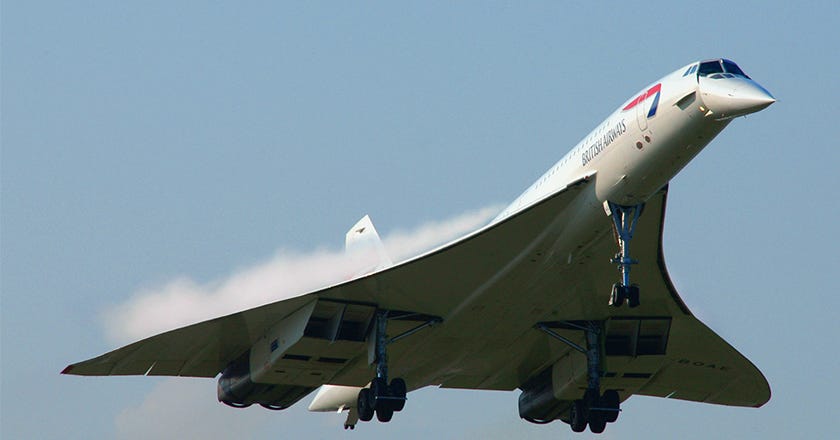
Now consider theoretical physics. The first half of the 20th century completely revolutionized our understanding of the universe. We developed general relativity, quantum mechanics and nuclear physics within a remarkably compressed period of time.
And while we’ve made meaningful discoveries in recent decades, including the Higgs boson and gravitational waves, we haven’t experienced anything comparable to that period of foundational discovery in recent decades. We still haven’t reconciled quantum mechanics with general relativity. We still don’t know what dark matter is.
The same can be said of countless other industries. Our transportation infrastructure looks remarkably similar to what it did decades ago. Construction remains incredibly labor-intensive. We still spend years developing drugs and decades building major infrastructure projects.
Our energy infrastructure, agricultural systems and manufacturing processes have certainly become more sophisticated, but in many respects, the underlying architecture of modern civilization would be perfectly recognizable to someone living half a century ago.

Outside of computing, communications and certain areas of medicine, technological progress has often felt disappointingly incremental. We were promised the future. Instead, we were forced to ring up our own bread after shopping and then got recurring subscription fees for just to use our home toaster each morning (hereinafter referred to as ‘TAAS’, or ‘Toast As A Service’).
But I increasingly feel that we are on the precipice of an extraordinary reversal of this phenomenon, and, to be honest, it’s terrifying.
I think we are overdue for a period of massive technological change, and artificial intelligence is going to be the catalyst that reshapes virtually every aspect of human civilization. We are developing a technology that could accelerate progress across virtually every scientific and technological discipline simultaneously. Physics, mathematics, biology, engineering, medicine, defense, finance. Everything.
And increasingly, I feel as though we are beginning to see glimpses of what happens when the world starts moving considerably faster than our ability to keep up with it.
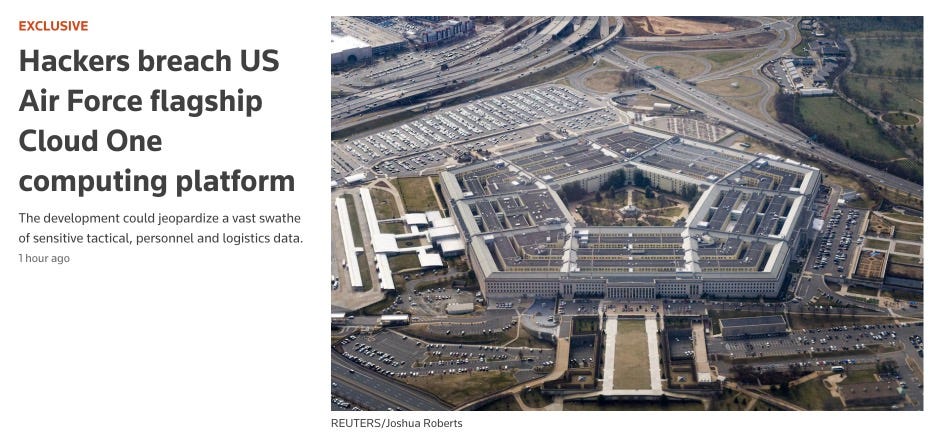
According to Reuters this morning, hackers breached Cloud One, the Air Force’s cloud infrastructure that supports everything from aircraft maintenance and military logistics to personnel records. The breach was reportedly uncovered during a platform upgrade, and it remains unclear who was responsible or what sensitive information, if any, was accessed.
Just three days ago, Bloomberg reported that hackers had also breached CIA systems. The compromised system was reportedly an intelligence analysis tool used to extract insights from open-source and unclassified material belonging to the CIA and the Office of the Director of National Intelligence.
The CIA and the US Air Force. Within three days of each other.
Then there is the endless procession of cybersecurity breaches, infrastructure outages, service disruptions and technological failures over the past two weeks.
It feels as though we’ve seen dozens of these incidents. Every morning, I wake up to another headline about some compromised system, some major vulnerability or some piece of digital infrastructure experiencing problems. The sheer frequency of these headlines is becoming increasingly difficult to ignore.
Among those affected by breaches, outages or service disruptions reported in just the last three weeks are the US Air Force, the CIA, the FBI, the NSA, the Office of the Director of National Intelligence, the US Treasury’s Financial Crimes Enforcement Network, the US Department of Agriculture, the Federal Aviation Administration, Microsoft, Amazon Web Services, Apple, JPMorgan Chase, Bank of America, Wells Fargo, US Bank, Zelle, United Airlines, Anthropic, Workday, Sony’s PlayStation Network, Ticketmaster, Equinor, Visa and Mastercard, to name a few.
That is fucking insane…