

By Frank Shostak, Mises Institute
Some commentators are of the view that an important driver in consumer price inflation is the business drive for higher profits. According to the Ground Work Collaborative think tank report,
Prices are simply the sum of costs and corporate profits. While rising costs of inputs can drive up what Americans pay at the gas pump or the grocery store, corporate profits can just as easily.
The report found corporate profits accounted for about 53 percent of inflation during the second and the third quarter of 2023. But does it make any sense that profits cause price inflation? Businesses cannot raise prices to secure higher profits without the buyers’ agreement. A price is a point at which a voluntary exchange will take place between two individuals. The exchange is based on their valuations of the goods they want relative to what they offer in exchange. This is true whether money is involved or not, though prices are often denominated in terms of money in a money economy.
How Are Prices Established?
As a rule, a supplier sets the price. After all, it is the supplier who offers the goods to the buyers. So it is the supplier who must set the price of a good before he presents the good to the buyers. In order to secure a price that will improve his lot, the price that the supplier sets must at least cover his direct and indirect costs. By setting the price, the supplier must make as good an estimate as possible whether he will be able to sell his entire supply at that price. The process of making the estimate involves the assessment of the possible responses of the buyers and the possible responses of his competitors—other suppliers. If his estimates are accurate then he makes a profit.
Notwithstanding that the supplier sets the price, the final decision-maker of the price of goods is not the supplier, but the buyer. It is the buyer—by accepting the price that is set by the supplier—that determines the good’s price. The supplier in the market is at the mercy of the consumer (i.e., the buyer). This means that the supplier cannot raise prices in order to raise his profit without the consumer’s agreement. Entrepreneurs and producers are essentially servants of the consumers, as their success depends on their ability to anticipate and satisfy consumer needs.
In a free market, consumers “vote with their dollars.” With every purchase, they are signaling to producers what goods they want and in what quantities, ultimately directing the entire structure of production. According to Ludwig von Mises,
The state of the market at any instant is the price structure, i.e., the totality of the exchange ratios as established by the interaction of those eager to buy and those eager to sell. There is nothing inhuman or mystical with regard to the market. The market process is entirely a resultant of human actions. Every market phenomenon can be traced back to definite choices of the members of the market society.
The market process is the adjustment of the individual actions of the various members of the market society to the requirements of mutual cooperation. The market prices tell the producers what to produce, how to produce, and in what quantity.
While the costs of production might appear to be the main factor in price determination, this is not so. Ultimately, it is the evaluation of the buyer that dictates whether the price set by the supplier is going to be realized. Every buyer decides, in his own context, whether the good that he bought at a particular price betters his life and well-being. If the cost of production were the driving factor behind the setting of the market prices, then how would we explain the prices of goods that have no cost because they are not produced—goods that are simply there, like undeveloped land? Likewise, the cost-of-production theory cannot explain the reason for the high prices of famous paintings. According to Rothbard,
Similarly, immaterial consumer services such as the prices of entertainment, concerts, physicians, domestic servants, etc., can scarcely be accounted for by costs embodied in a product.
It follows then that businesses striving to make profits cannot increase the prices of goods without the agreement of consumers.
Defining a Price
A monetary price of a good is the amount of money paid for the good, such as the number of dollars per loaf of bread or the number of dollars per shirt. The key driving factors here are the amount of dollars, the quantity of goods, and the subjective consumer demand for goods relative to dollars. All other things being equal, an increase in demand and/or decrease in supply of goods implies that the price of these goods will increase. If a business raises the price of its goods and consumers agree to this increase, then consumers will have less money to spend on other goods, all other things being equal. Hence, there will be a specific price increase, not a general price increase.
The Money Supply and What Inflation Really Is
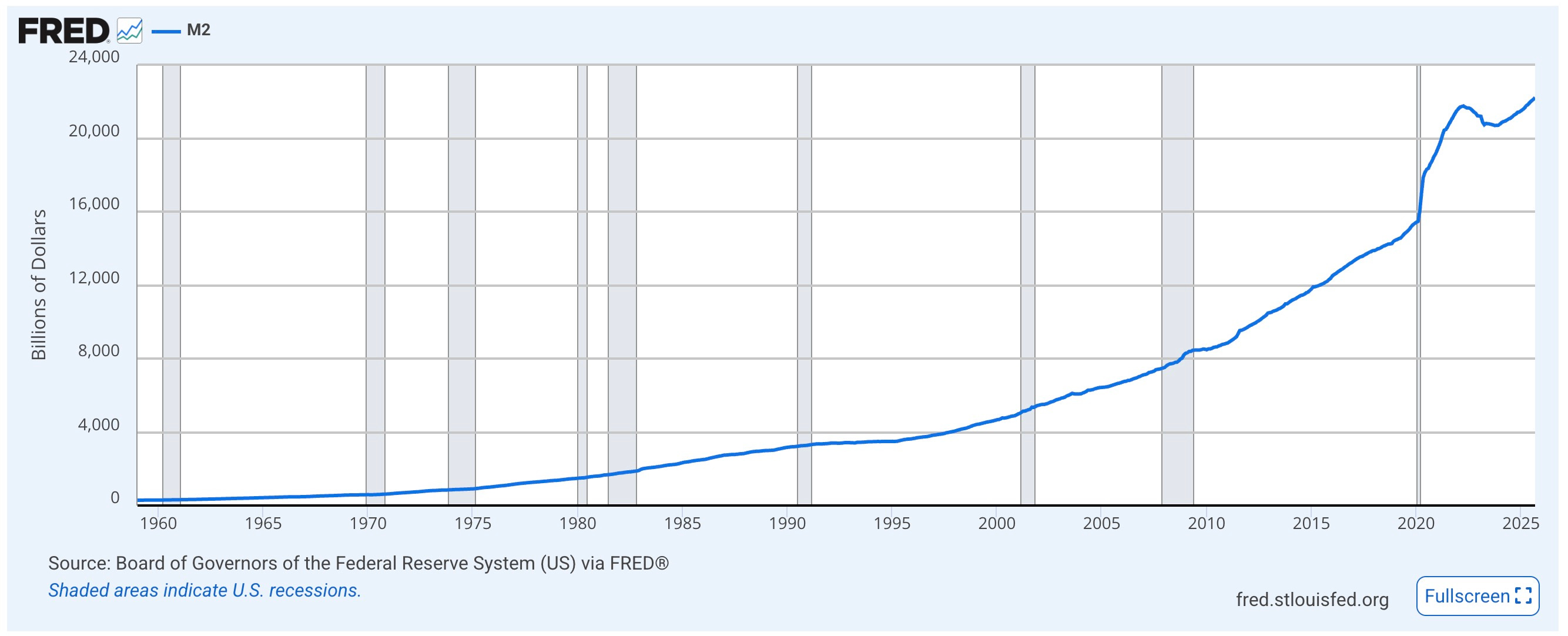
Many believe that it is the role of the central bank to guide the economy onto the path of economic and price stability. If central bank officials believe that the economy is likely to fall to below the path of economic and price stability, then officials are expected to prevent this decline through an expansionary monetary policy. However, expansionary monetary policy cannot generate economic stability. Expansionary monetary policy actually sets the foundation for an exchange of nothing for something or the diversion of wealth from wealth-generators to the early recipients of the newly-increased money and credit. As a result, this undermines the process of wealth generation and weakens the prospects for economic growth.
As a rule, because of the inflationary increases in the money supply from central bank monetary policy, certain individuals will have more money in their pockets, which they are likely to spend on consumer goods. Hence, we will now have more money relative to goods (i.e., the prices of goods will increase, all other things being equal).
As a result of the increase in money supply, producers’ costs follow suit. This, however, does not imply that the cost of production determines the prices of goods. Prices are still determined by the buyers. As a result of the increase in the costs of production, suppliers can attempt to raise prices, but are more likely to produce less. If demand remains the same, prices will increase. Hence, price increases are not because of the increase in the production costs but because of the artificial expansion of money and credit.
Could Price Controls Resolve the Issue of General Price Increases?
Many believe that the government should introduce price controls in order to prevent increases in the prices of some key consumer goods. However, a policy of restricting price adjustments will weaken various marginal producers and lead to shortages. Consequently, some producers are likely to move to other activities which are not subject to government price controls.
Conclusion
Some commentators blame businesses for pushing overall prices higher in order to boost their profits. While businesses set prices, it is the consumers that ultimately determine whether the price set will be accepted. The suggestion by some that there is a need to impose price controls on some essential consumer goods overlooks how such policies stifle the production process and lead to shortages, if implemented. This leads to a decline in the living standards of the very people it is intended to help. The major cause behind such price increases is not corporate greed and profits but the expansionary monetary policy of the central bank or inflation.

QTR’s Disclaimer: Please read my full legal disclaimer on my About page here. This post represents my opinions only. In addition, please understand I am an idiot and often get things wrong and lose money. I may own or transact in any names mentioned in this piece at any time without warning. Contributor posts and aggregated posts have been hand selected by me, have not been fact checked and are the opinions of their authors. They are either submitted to QTR by their author, reprinted under a Creative Commons license with my best effort to uphold what the license asks, or with the permission of the author.
This is not a recommendation to buy or sell any stocks or securities, just my opinions. I often lose money on positions I trade/invest in. I may add any name mentioned in this article and sell any name mentioned in this piece at any time, without further warning. None of this is a solicitation to buy or sell securities. I may or may not own names I write about and are watching. Sometimes I’m bullish without owning things, sometimes I’m bearish and do own things. Just assume my positions could be exactly the opposite of what you think they are just in case. If I’m long I could quickly be short and vice versa. I won’t update my positions. All positions can change immediately as soon as I publish this, with or without notice and at any point I can be long, short or neutral on any position. You are on your own. Do not make decisions based on my blog. I exist on the fringe. If you see numbers and calculations of any sort, assume they are wrong and double check them. I failed Algebra in 8th grade and topped off my high school math accolades by getting a D- in remedial Calculus my senior year, before becoming an English major in college so I could bullshit my way through things easier.
The publisher does not guarantee the accuracy or completeness of the information provided in this page. These are not the opinions of any of my employers, partners, or associates. I did my best to be honest about my disclosures but can’t guarantee I am right; I write these posts after a couple beers sometimes. I edit after my posts are published because I’m impatient and lazy, so if you see a typo, check back in a half hour. Also, I just straight up get shit wrong a lot. I mention it twice because it’s that important.
These analyses never take seriously the failure to enforce anti monopoly law or the degree to which the ownership of classes of so many goods is so concentrated- like processed food and medical care and telecom and utilities and network effects in tech. We’re at the point, right, that 50% of consumer spending is spent by the top 10% -or is it more than that? This Mises analysis focuses too much on consumer “power” and not enough on how much most can be squeezed as quality of life deteriorates.
None of us here need this explained, surely this is more for children and Mamdani voters?