

By Mises Wire, Lennart Wagemans
Many claim the problem with fractional reserve banking is that it loans money into existence. It does, but under normal circumstances the money created by commercial banks disappears when loans are repaid or defaulted on, which therefore doesn’t create a permanent inflation of the money supply. Government intervention, however, converts temporary money into permanent money through bailouts like the Troubled Asset Relief Program. They purchase loans that would have been defaulted on, preventing the evaporation of credit. When banks hold loans that are at risk of default, they face having to write them off, which would remove this part of the money supply. Bailouts turn such disappearing credit into permanent money, in effect giving banks free money.
Without government bailouts, banks would be unwilling to make loans that are unlikely to be repaid, thus limiting their willingness to loan large amounts of money into existence. This would keep the money supply more stable. At any time, some part of the money in existence would still be destined for removal through repayment. This proportion would somewhat fluctuate with economic conditions, and the temporary money would be indistinguishable from other money until a loan is repaid, but new money would not continually get loaned into existence.
When high-risk loans inevitably fail, the state steps in to purchase them to prevent banks from having to write off so many loans that they have net negative assets on their books. However, seeing the creation of toxic loans as just excessive risk-taking in reaction to having a safety net misses the larger dynamic. Praxeologically, the production of toxic loans is the rational supply of a good in high demand. These financial assets can be sold for a higher value than it costs to make them, thus their production is economically rational.
Banks, praxeologically speaking, perform the function of government contractors, producing the product “toxic financial asset.” Similar to how defense contractors produce fighter jets or fish farms produce caviar for state banquets, banks create failing loans knowing the government will purchase them. This demand ensures that banks continue to produce high-risk financial instruments. The financial sector profits from creating these products despite knowing they may become worthless. Ironically, it is their worthlessness that causes them to be valuable since that rationalizes the bailout.
Companies receiving bailout funds have not incurred typical costs, like having to maintain machinery or invest in future production, meaning they operate on much higher margins. Thus, they have much more money to offload before it loses value. They are looking for quick gains, not stable dividends, which can typically be found in assets like tech stocks and real estate, causing an unnatural inflow of funds into these sectors. This explains why tech giants grow disproportionately large; they happen to attract the interest of people with fresh money. Productivity and value creation become relatively less valuable as the economy becomes optimized toward capturing inflation investments. This process distorts market signals, misallocates resources, and perpetuates an economic environment where success ties more to financial maneuvering than genuine productive output.
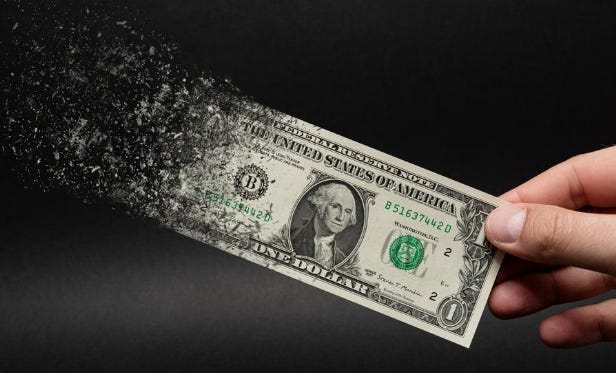
Many businesses today, especially in the tech sector, function more as inflation-capturing devices than traditional profit-generating enterprises. They prioritize attracting investment from the recipients of fresh money. A second layer of these inflation-capturing suppliers grew to capture the trickle of funds from the first layer. This means the economy has geared itself to supply the businesses that get new money, instead of allocating resources to what actual people want to buy.
The closer to the inflation fan a business is, the more profitable it can be. In an economy that rewards inflationary rent-seeking, creating value has become unwise, as it only earns low-profit-margin money from stingy spenders who had to work to earn it. You will be able to confirm that practically anybody you know either receives money from an inflation source or supplies those who do. The economy has grown toward the money source, like a fungus toward a nutrient, rather than meeting real people’s needs. This means economic decisions are effectively made by what elites in palaces decide to finance, rather than the market. This is like a fascist economy where businesses were nominally private, but state planners in the capital made the production decisions.
Many superwealthy today were simply lucky initial owners of popular assets that got bid up by this unnatural inflow of new money. Attracting the money flow toward assets you own has become a more important means of wealth generation than profitable operation. And that is what all the top companies do these days, trying to dazzle investors. It is like starting a cryptocurrency and getting people to buy it so your initial coins grow in value. This explains the propensity for hype cycles. They are not trying to make a profit; they are trying to excite investors to bid up their stocks.
It is not just those who directly receive fresh money who benefit from an increase in the money supply. As everyone else’s purchasing power erodes from inflation, owners of substantial assets, like factories, are lifted relatively. They continually receive a transfer of purchasing power at the expense of everyone else. An 8% annual inflation rate — a realistic estimate considering that economic growth masks the true increase in the money supply — enhances the value of hereditary capital by 2,200 times when compounded over a century, or 220,000%. Conversely, a family without assets had their purchasing power reduced to 0.045% of its original value. This means inflation continually creates inequality. This is the real reason the rich get richer, why the world is so unequal, and why so many bad decisions are made in the internal power struggle for inflation capture.
By continually handing free money to the rich, government facilitates a transfer of purchasing power from the population to the moneyed class. This skews wealth distribution and continually impoverishes the working class. Earned money now makes up a smaller portion of the overall purchasing power available. In a free market, wealth accumulation would rely more on productive enterprise than rent-seeking, resulting in a more equitable distribution of wealth based on productivity. Work would be more highly rewarded, and even modest employment would provide substantial purchasing power, reducing the need for a welfare state. Thus, the current system perpetuates inequality that favors the rich at the expense of the broader population.
Marxists have misdiagnosed the cause of economic inequality. It’s not the extraction of surplus value from workers, as suggested by the labor theory of value, that gives capitalists unfair wealth. Instead, it’s the continuous influx of free money through increases in the money supply. Their analysis inverts the reality of how inequality arises. Karl Marx identified the natural market as the problem and called for state intervention to fix it. Thus, his cure was the disease. Interventionist policy ironically perpetuates the very inequality they decry. A culture steeped in his economic interpretation maintains an interventionist environment that benefits financial elites through inflationary policies and bailouts, perpetuating economic disparity. (Although praxeologically, this may have been his intention.)
The problem is not insufficient regulation of the financial sector. If one type of risky bet is banned, banks will find other ways to speculate or create derivatives of existing bets. You can’t ban all risky bets. Mortgage-backed securities were bets on other’s mortgages, and Enron bet on future energy prices. In a normal market, these risks would be self-correcting. Faced with losses when bets go sour, they would be unwilling to make unsafe bets. The real problem is having a system of involuntary force that transforms temporary credit into real purchasing power.
In a broader perspective, we can see distinct types of financial structures. During the industrial capitalism of the 19th century, power resided with industrial capitalists who created tangible products, driving progress and improving living standards. Today, the financial elite manipulate the allocation mechanism itself, without producing real value, having reduced industrial producers to the role of servants. This structure resembles feudal power systems, where medieval palace elites controlled society, disguised as modern financial theory.

QTR’s Disclaimer: Please read my full legal disclaimer on my About page here. This post represents my opinions only. In addition, please understand I am an idiot and often get things wrong and lose money. I may own or transact in any names mentioned in this piece at any time without warning. Contributor posts and aggregated posts have been hand selected by me, have not been fact checked and are the opinions of their authors. They are either submitted to QTR by their author, reprinted under a Creative Commons license with my best effort to uphold what the license asks, or with the permission of the author. This is not a recommendation to buy or sell any stocks or securities, just my opinions. I often lose money on positions I trade/invest in. I may add any name mentioned in this article and sell any name mentioned in this piece at any time, without further warning. None of this is a solicitation to buy or sell securities. These positions can change immediately as soon as I publish this, with or without notice and at any point I can be long, short or neutral on any position. You are on your own. Do not make decisions based on my blog. I exist on the fringe. The publisher does not guarantee the accuracy or completeness of the information provided in this page. These are not the opinions of any of my employers, partners, or associates. I did my best to be honest about my disclosures but can’t guarantee I am right; I write these posts after a couple beers sometimes. I edit after my posts are published because I’m impatient and lazy, so if you see a typo, check back in a half hour. Also, I just straight up get shit wrong a lot. I mention it twice because it’s that important.
Great article, also some clues as to why the Democrats have so many Champagne Socialists, Limousine Liberals and Bollinger Bolsheviks. Isn't it amazing how they start out poor and whining 'it's not fair' but when in government end up rich, like Nancy Pelosi, Diane Weinstein, Kim Schrier etc. What is Obama worth? And Biden?
There is a thing about inequality. Everyone think its a bad thing. However, if you try to find a statistical definition for it and try to measure it, for instance by looking at differences between average and median income or wealth (Lyn Alden did a very nice analysis of this about 2 years ago), you will find that places like Switzerland or Monaco or Singapore are by far the most unequal places in the world.
However, they also happen to be the best places to live for humans on this planet. GINI coefficient, human development index, people's subjective happines, you name it, unequal countries are almost always in the lead.
The only outlier of this seems to be the US, which is unequal but is getting less and less a good place to live for its citizens. Well, the US however is also a global imperium on the decline, and side-effects of this, like Triffin's dilemma are probably the most reasonable causes for this paradox.
So why are we afraid of inequality? Inequality creates incentives and social mobility. In my home country, Hungary society was a lot more equal from 1948 to 1990 in the years of Soviet style socialism. The income difference in 1980 between the top and the bottom decile was 4x, in 2000, 10 years after the change it was 17x. Was Hungary a better place to live in 1980 than in 2000?
An unequal society is not a problem. A society without social mobility and inequality is a HUGE problem.