

By Robert L. Bradley, Jr., American Institute For Economic Freedom
What US industry is the most subsidized and regulated by the federal government? If you answered nuclear power, you are correct.
As a result, the 70-year “Atoms for Peace” program represents the most expensive failure (malinvestment) in US business with a history of uncompleted projects and massive cost overruns, as well as future decommissioning liabilities.
Still, President Trump is all-in with nuclear, setting a goal of ten new reactors in construction by 2030 and a quadrupling of total US capacity by 2050. Biden was bullish too, and George W. Bush had his turn at a “nuclear renaissance.” Each failed, but in the nuclear space, hope springs eternal.
Commercial fission began in the 1950s amid government and scientific fanfare. The promise was virtually limitless, emission-free, affordable electricity compared to coal-fired generation. But the technology was experimental and encumbered by a fear of radioactive contamination. Electric utilities and municipalities resisted. It would take open-ended (federal) research and development, insurance subsidies, and free enriched uranium, and rate-base returns under state regulation, to birth nuclear power.
Scale economies and learning-by-doing were expected by vendors General Electric, Westinghouse, and others. Their turnkey projects guaranteeing cost and delivery, which produced a “bandwagon effect” of new orders in the 1960s, backfired. Almost half of the plant cost had to be absorbed by vendor stockholders. Cost-plus contracts would ensue with captive ratepayers in tow.
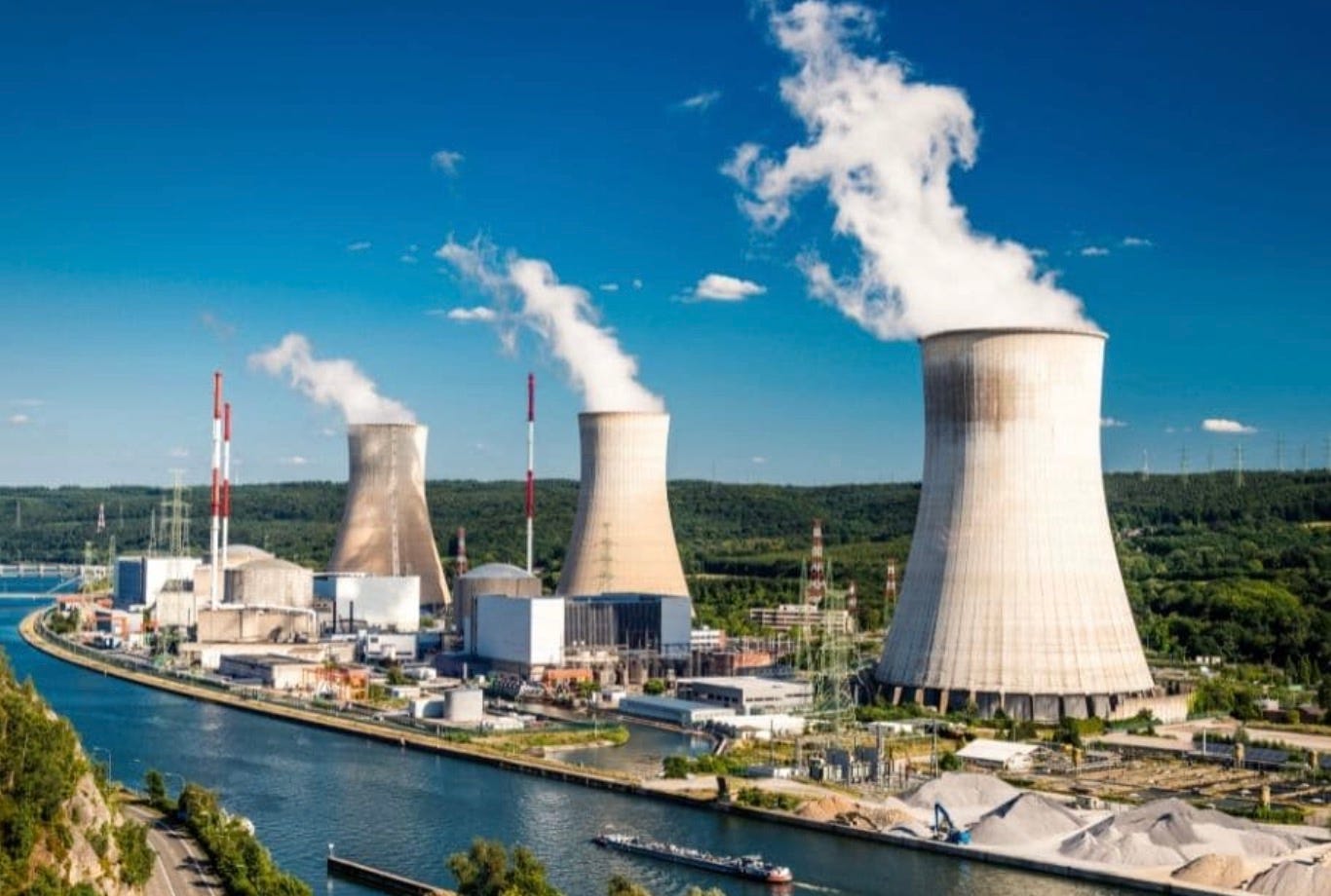
In the 1970s, cost overruns, completion delays, and cancellations marked the end of the nuclear boom. With the Three Mile Island accident in 1979, a regulatory ratchet accelerated. “Federal regulations used to take up two volumes on our shelves,” one participant told Congress. “We now have 20 volumes to explain how to use the first two volumes.” Legalistic, overly prescriptive, retroactive rules now came from adversarial hearings and “the way of the institutions of government.”
At the same time, turbine engines fueled by oil and natural gas took off. Cogeneration and combined cycle plants set a new competitive standard for nuclear, not only coal. Such technology used far fewer parts and was much more serviceable than a fission plant.
Today, 94 active reactors produce dependable power to reinforce a grid weakened by intermittent wind and solar. With high up-front capital expense sunk, marginal-cost economics supports their continued operation. But for new capacity, large necessary government subsidies confirm an enduring reality: nuclear fission is the most complicated, fraught, expensive way to boil water to produce steam to drive electrical turbines.
Hyperbole abounds about new reactor design. Small Modular Reactors (SMRs) are newsworthy, but is a turnkey project being offered to ensure timeliness and performance? Or does the fine print of the contracts offer the buyer “outs”? This question should be asked of those promising to buy or develop gigawatts of new nuclear capacity in the next decade.
What now for nuclear policy to enable affordability and reliability? In a nutshell, the twin evils of overregulation and oversubsidization should give way to a real free market. The Nuclear Regulatory Commission should yield its civilian responsibilities to the best practices established by the Institute for Nuclear Power Operations, an industry collaborative created after Three Mile Island. Federal insurance via the Price-Anderson Act of 1957 (extended seven times to date) should be replaced by private insurance per each “safe” reactor.
Federal grants, loans, and tax preferences for nuclear should end. Antitrust constraints on industry collaboration should cease, and waste storage and decommissioning should be the responsibility of owners.
Nuclear fission today is an essential component of a reliable electric grid. But economics and incentives matter, and US taxpayers and ratepayers should not bear the costs of an uncompetitive technology. Neutral government is best for all competing energy sources, after all, in contrast to the energy designs of both Republicans and Democrats.
Read more from this author in his comprehensive PDF: Nuclear Power: A Free Market Approach

QTR’s Disclaimer: Please read my full legal disclaimer on my About page here. This post represents my opinions only. In addition, please understand I am an idiot and often get things wrong and lose money. I may own or transact in any names mentioned in this piece at any time without warning. Contributor posts and aggregated posts have been hand selected by me, have not been fact checked and are the opinions of their authors. They are either submitted to QTR by their author, reprinted under a Creative Commons license with my best effort to uphold what the license asks, or with the permission of the author.
This is not a recommendation to buy or sell any stocks or securities, just my opinions. I often lose money on positions I trade/invest in. I may add any name mentioned in this article and sell any name mentioned in this piece at any time, without further warning. None of this is a solicitation to buy or sell securities. I may or may not own names I write about and are watching. Sometimes I’m bullish without owning things, sometimes I’m bearish and do own things. Just assume my positions could be exactly the opposite of what you think they are just in case. If I’m long I could quickly be short and vice versa. I won’t update my positions. All positions can change immediately as soon as I publish this, with or without notice and at any point I can be long, short or neutral on any position. You are on your own. Do not make decisions based on my blog. I exist on the fringe. If you see numbers and calculations of any sort, assume they are wrong and double check them. I failed Algebra in 8th grade and topped off my high school math accolades by getting a D- in remedial Calculus my senior year, before becoming an English major in college so I could bullshit my way through things easier.
The publisher does not guarantee the accuracy or completeness of the information provided in this page. These are not the opinions of any of my employers, partners, or associates. I did my best to be honest about my disclosures but can’t guarantee I am right; I write these posts after a couple beers sometimes. I edit after my posts are published because I’m impatient and lazy, so if you see a typo, check back in a half hour. Also, I just straight up get shit wrong a lot. I mention it twice because it’s that important.
I entered the nuclear power industry in 1980 after graduating with a BS in mechanical engineering. My first job was as a startup and commissioning engineer and received my first license in 1982. I've been anticipating the "nuclear renaissance" ever since. In my opinion, given the mix of energy sources, nuclear power is the best use for baseload power generation. Next best would be coal and hydroelectric. Notice all are burdened by difficult (and I think unreasonable) environmental regulations and impossible risk assessments.
If medicine, chemicals and pharmaceuticals were subject to the same scrutiny, most drugs and chemicals would be banned, and as would many medical procedures because the risks, while low for most would result in poor outcomes for some. In the nuclear energy business, that is a huge hurdle. Component upgrades and controls system improvements may take years to recieve approvals, making them costly and risky from a business perspective, therefore logical beneficial improvements aren't even attempted. Regulatory capture isn't a problem; regulatory antagonism is.
Great article, thanks for sharing. I think we all share Robert's opinion.