

[QTR’s Note: I didn’t plan on publishing yet another Mamdani piece. After all, we all know he’s a knob. But I couldn’t help but offer up one last brilliant take I loved reading myself, just to be clear about where I stand heading into the self-immolation of NYC. As you were.]
When Zohran Mamdani ran for mayor of New York City, his platform promised paradise: rent freezes on stabilized apartments, free city buses, universal childcare from six weeks to age five, city-run grocery stores not motivated by profit, and a minimum wage of $30 per hour by 2030, all funded by higher taxes on corporations and top earners.
Many of his promises are untenable, requiring levels of power that a city mayor simply doesn’t have. But even if he did have the power to institute all of his radical policies, they’d bring incredibly grave unintended consequences. Paradoxically, the lower-income New Yorkers, renters, small business employees that he claims to be fighting for would be crushed most of all.
On paper these proposals are politically appealing, especially younger generations who inherited out of control deficits, debt, and inflation making life totally unaffordable. For many, the promises of free buses, rent freezes, universal childcare, and city-run grocery stores with affordable food are too tempting to resist. Low-information, economically illiterate voters fail to understand that they’re impossible to fulfill, and if they were fulfilled, they would cause a ripple effect of destructive consequences.
First, there are the obvious legal and structural constraints. Mamdani cannot unilaterally freeze rents for stabilized apartments without control over the Rent Guidelines Board and possible changes to New York State law. Free buses require cooperation from the Metropolitan Transportation Authority and bond-holders, because fares are pledged revenue. And raising taxes on corporations and top-earners would need to clear resistance from the state legislature and the governor.
Despite the rhetoric, these policies involve complex legal, regulatory, and political processes with many layers and stakeholders. Voters who expect Mamdani to just flip a switch and activate these ideas as a benevolent dictator are in for a disappointment.
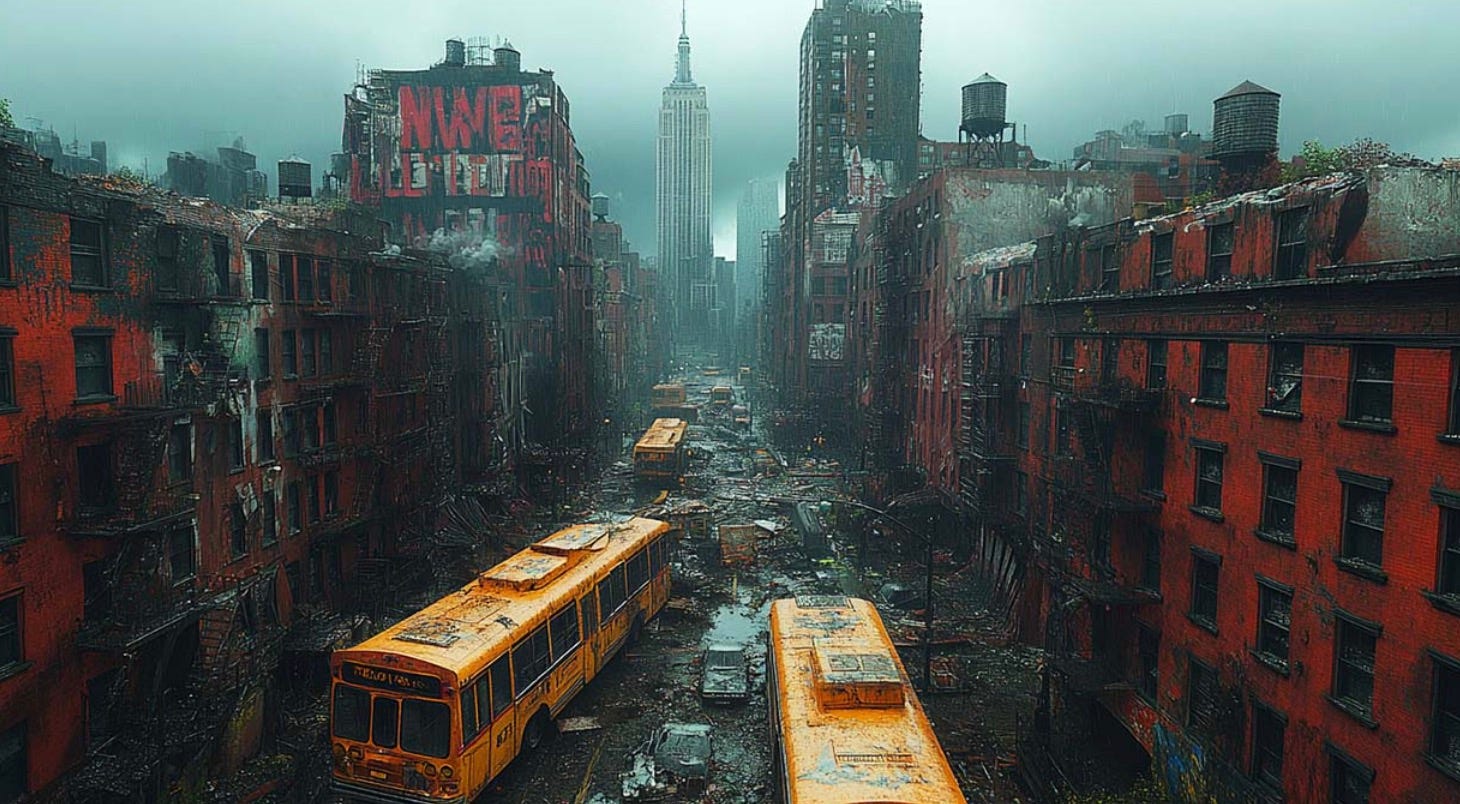
Even if he could flip a switch, the resulting disaster would be a massive wake-up call for the quixotic voters who believe that solving problems like high prices and unaffordable rent is as easy as a unilateral declaration from a government caretaker. Fiscal reality always wins in the end. The cost of universal childcare, free buses, and other proposed programs is enormous relative to the city’s budget and revenue base.
Raising corporate taxes and top-earner surcharges may generate some revenue, but also entail risks of capital and business flight, reduced investment, and tax base erosion. Why would high earners, who are rich enough to go wherever they want and can often do their work from anywhere on a computer, stay somewhere that punishes them for doing so? There are many reasons that oversimplified slogans like “tax the rich” never seem to become policy.
When property owners expect no or minimal ability to increase rent as their own costs rise, they have no incentive to maintain existing units or build new ones. Developers will look elsewhere, reducing housing supply and driving up prices for non-stabilized units. Cockroaches? Broken furnace? Leaky pipe? Landlords with thin margins would have no incentive to fix problems in buildings that they could no longer afford to keep in decent shape. While rent freeze ideas like Mamdani’s are supposed to support the vulnerable, they actually destroy any ability to provide decent housing options for those same people.
Consumer Price Index for All Urban Consumers: Owners’ Equivalent Rent of Residences in New York-Newark-Jersey City
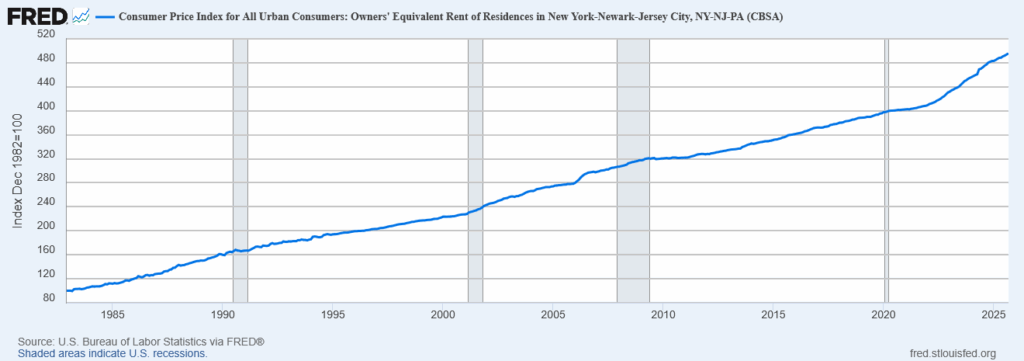
U.S. Bureau of Labor Statistics, Consumer Price Index for All Urban Consumers: Owners’ Equivalent Rent of Residences in New York-Newark-Jersey City, NY-NJ-PA (CBSA) [CUURA101SEHC], retrieved from FRED, Federal Reserve Bank of St. Louis; https://fred.stlouisfed.org/series/CUURA101SEHC, November 10, 2025.
Similarly, a $30 minimum wage in New York City sounds nice, until you realize that instead of a low wage, those companies just reduce hiring and raise prices to levels no one can afford. Instead of a low-wage job, you price yourself out of any job at all. For small businesses and service industries, the ability to absorb labor-cost shocks is paper-thin. Once forced to pay far more than they can afford to pay for basic entry-level jobs like cashiers, attendants, and shelf stockers, companies will fold or go elsewhere. Companies would become increasingly incentivized to invest in automation and strip benefits. Again, every problem Mamdani claims to solve would become massively worse.
Running grocery stores through the city means direct competition with private firms, leading to problems with managerial efficiency, supply chains, and cost control. City-run enterprises have notoriously mixed results. And free transport means the MTA would have to offset already-massive lost fare revenues through taxes or service cuts.
So just collect the revenue from billionaires, of which NYC has plenty, right? Boosting corporate taxes and surcharging the top 1% is a great way to encourage the rich to simply go (or invest) elsewhere, while working-class folks become even more stuck where they are: a city with a shrinking tax base and plummeting growth. The end result is that you’re eliminating the very revenue needed to fund the promised programs.
“Free stuff” platforms like Mamdani’s are childish and exploitative, appealing to a populace that is increasingly desperate and lacks the financial understanding to see how they would take bad problems and make them even worse. Mamdani says he speaks for the working-class New Yorker, the renter, the small-business employee, but they’re the ones who would end up getting screwed. Rent freezes may help existing tenants temporarily, but they worsen housing quality and availability, pushing lower-income people further into competition for fewer units.
The law of unintended economic consequences is always ready to teach its lessons, but unfortunately, New Yorkers would be learning the hard way. The cost is borne by people who rely on a vibrant economy and affordable housing and jobs, not by elites.
Mamdani’s promises appeal to frustrations about the cost of living, the affordability of housing, and stagnating wages as prices skyrocket. But these issues go far beyond New York City, far beyond Mamdani’s jurisdiction. Until we fix the problems caused by more government control and centralization, New York will continue to suffer. Mamdani’s trick, like that of all Socialists, is that more government will solve the problems that were created by central planning to begin with.
As Mamdani said himself:
“There is no problem too large for government to solve, and no concern too small for it to care about.”
In other words, prepare to be micromanaged into economic oblivion.

QTR’s Disclaimer: Please read my full legal disclaimer on my About page here. This post represents my opinions only. In addition, please understand I am an idiot and often get things wrong and lose money. I may own or transact in any names mentioned in this piece at any time without warning. Contributor posts and aggregated posts have been hand selected by me, have not been fact checked and are the opinions of their authors. They are either submitted to QTR by their author, reprinted under a Creative Commons license with my best effort to uphold what the license asks, or with the permission of the author.
This is not a recommendation to buy or sell any stocks or securities, just my opinions. I often lose money on positions I trade/invest in. I may add any name mentioned in this article and sell any name mentioned in this piece at any time, without further warning. None of this is a solicitation to buy or sell securities. I may or may not own names I write about and are watching. Sometimes I’m bullish without owning things, sometimes I’m bearish and do own things. Just assume my positions could be exactly the opposite of what you think they are just in case. If I’m long I could quickly be short and vice versa. I won’t update my positions. All positions can change immediately as soon as I publish this, with or without notice and at any point I can be long, short or neutral on any position. You are on your own. Do not make decisions based on my blog. I exist on the fringe. If you see numbers and calculations of any sort, assume they are wrong and double check them. I failed Algebra in 8th grade and topped off my high school math accolades by getting a D- in remedial Calculus my senior year, before becoming an English major in college so I could bullshit my way through things easier.
The publisher does not guarantee the accuracy or completeness of the information provided in this page. These are not the opinions of any of my employers, partners, or associates. I did my best to be honest about my disclosures but can’t guarantee I am right; I write these posts after a couple beers sometimes. I edit after my posts are published because I’m impatient and lazy, so if you see a typo, check back in a half hour. Also, I just straight up get shit wrong a lot. I mention it twice because it’s that important.
I’m surprised there hasn’t been more widespread and vocal pushback against Mamdani’s Democratic Socialism agenda. This shift runs counter to the principles of our Constitutional Republic—the very system Franklin warned the Convention had given us only “if we can keep it.” Clearly, we have not.
The phrase "economically illiterate voters” jumped out. This is an apt description of, not just the voters of New York City, but a majority of the voters in the whole country. How else to explain the continuous election of politicians from both parties that have no problem adding to the national deficit every single year.