

By Patrick Barron, Mises Institute
In a recent article, I pointed out that the surest path to saving the fiat dollar from destruction was to make it fully redeemable in gold at whatever that price happened to be on a certain day in the near future. Making the dollar “as good as gold” would force the government to pursue spending discipline, knowing that new spending could not be funded by printing money “out of thin air” but by cutting a like amount of current spending, raising taxes, borrowing honestly in the bond market, or some combination of these methods. In order to increase total spending without resorting to one of these methods would require that the government obtain more gold with which to back the increased spending. But what would the exchange rate of gold to dollars look like? In other words, how many dollars would one have to present in order to obtain an ounce of gold or, alternatively, how many dollars would one receive by presenting an ounce of gold?
The short and totally honest answer is “whatever the market determines the price of gold to be in dollars on the day of transition.” But surely we can lay some broad outline of the likely price or its outer limits.
The “Gold Coverage Price”
One way to do this is to calculate what I call the “Gold Coverage Price.” Simply divide the number of ounces of gold held by the Treasury into the monetary base. The monetary base is also called standard money. It is composed of commercial bank dollar reserves held in the banks’ reserve accounts at the Fed plus physical bank notes in the economy (i.e., bank vaults and elsewhere such as business tills, your wallet, cookie jar, etc.). Only the Fed can create or destroy standard money. It does so via what it calls “Open Market Operations.” When the Fed buys an asset, it creates standard money. When it sells an asset, it destroys standard money.
As of October 2025, the date of the most recently released monetary statistics by the Federal Reserve Bank of St. Louis, the monetary base was $5.3019 trillion. The US Treasury has not changed its report of gold holdings for several decades nor has its holdings been audited for several decades, despite valiant efforts by congressmen such as Ron Paul. The reported amount is 261.5 million ounces of gold. There is legitimate debate about whether all of this gold is physically available, whether some has been leased or swapped, and whether official figures are complete. In the absence of definitive contrary evidence, however, we must take the published number at face value that the full 261.5 million ounces are there and can be used to redeem monetary base dollars.
Gold Redeemability at $20,000 Per Ounce?
The math is straightforward: Divide the monetary base’s roughly five trillion dollars by the Treasury’s 261.5 million ounces to get $20,275 as the price to redeem an ounce of gold. Put another way, as the last dollar is presented to the Treasury the last ounce of gold would be handed over. Of course, it would never come to this, because somewhere after redeemability is declared the market would have confidence that such redeemability would indeed be honored or the market would lose confidence and trigger a crisis. Nevertheless, it is very likely that the dollar market price of an ounce of gold would far surpass the roughly five thousand dollar market price today.
An Historical Perspective of the Gold Coverage Price
For the purpose of illustrating the plight of the dollar I offer the following chart which shows the monetary base, Treasury gold holdings, and the resultant “Gold Coverage Price” for representative years since the dollar was linked to gold at $35 per ounce at the 1944 Bretton Woods conference (source: World Gold Council).
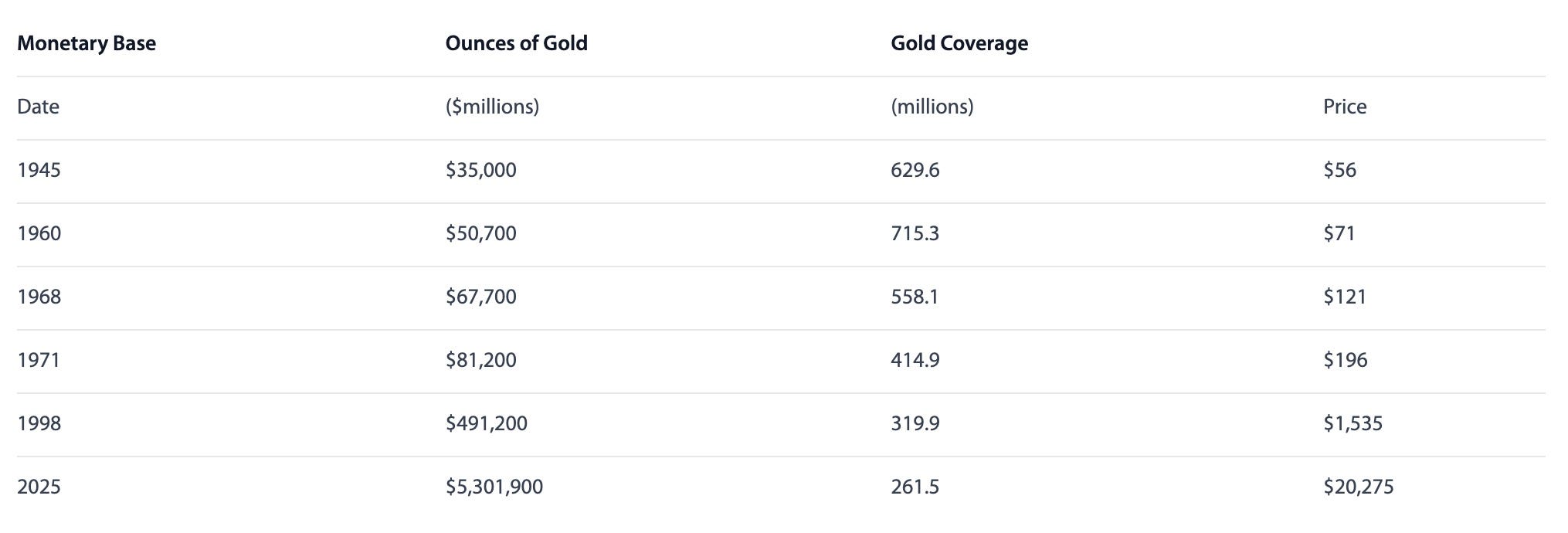
Note that the monetary base has increased every representative year and that, except from 1945 to 1960, the number of ounces of Treasury gold has decreased every year. The result is that the “Gold Coverage Price” has gone up in all representative years. Even in 1945, the “Gold Coverage Price” was higher than the official exchange price of $35 set at Bretton Woods. Also note that, in 1971—the year that President Nixon “temporarily suspended” gold redemption—the “Gold Coverage Price” was a modest (by today’s standard) $196. So devaluing the dollar to gold, instead of suspending redemption, to that amount, or somewhat less, and promising to debase the dollar no further, could have kept the US and the world on a credible gold standard.
But such was not to be. In the next 27 years—1971 to 1998—the monetary base went up by a factor of six times. Then it really took off! From 1998 to the end of 2025, the monetary base went up by almost 11 times while Treasury gold holdings fell by 18 percent. As a result, the “Gold Coverage Price” is 13 times higher over that 27 year period.
An Existential Crisis for the Dollar
It is clear that the government has lost all spending discipline and it would be foolish to believe that it will suddenly regain that discipline absent an external control, namely, gold. This is an existential crisis for the dollar.

QTR’s Disclaimer: Please read my full legal disclaimer on my About page here. This post represents my opinions only. In addition, please understand I am an idiot and often get things wrong and lose money. I may own or transact in any names mentioned in this piece at any time without warning. Contributor posts and aggregated posts have been hand selected by me, have not been fact checked and are the opinions of their authors. They are either submitted to QTR by their author, reprinted under a Creative Commons license with my best effort to uphold what the license asks, or with the permission of the author.
This is not a recommendation to buy or sell any stocks or securities, just my opinions. I often lose money on positions I trade/invest in. I may add any name mentioned in this article and sell any name mentioned in this piece at any time, without further warning. None of this is a solicitation to buy or sell securities. I may or may not own names I write about and are watching. Sometimes I’m bullish without owning things, sometimes I’m bearish and do own things. Just assume my positions could be exactly the opposite of what you think they are just in case. If I’m long I could quickly be short and vice versa. I won’t update my positions. All positions can change immediately as soon as I publish this, with or without notice and at any point I can be long, short or neutral on any position. You are on your own. Do not make decisions based on my blog. I exist on the fringe. If you see numbers and calculations of any sort, assume they are wrong and double check them. I failed Algebra in 8th grade and topped off my high school math accolades by getting a D- in remedial Calculus my senior year, before becoming an English major in college so I could bullshit my way through things easier. I am an investor in Mark’s fund.
The publisher does not guarantee the accuracy or completeness of the information provided in this page. These are not the opinions of any of my employers, partners, or associates. I did my best to be honest about my disclosures but can’t guarantee I am right; I write these posts after a couple beers sometimes. I edit after my posts are published because I’m impatient and lazy, so if you see a typo, check back in a half hour. Also, I just straight up get shit wrong a lot. I mention it twice because it’s that important.
I think I’ll buy some more gold and silver if doing so is a bet on politicians avoiding hard/honorable decisions. Seems like a no lose proposition.
Or you could divide our total debt ($37 trillion) by number of ounces and get $140,000 per ounce.