

By Patrick Barron, Mises Institute
The purchasing power of the US dollar has been debased by over 99 percent since the foundation of the Federal Reserve. (An ounce of gold cost $20.67 in 1913. According to the Wall Street Journal as of Friday, January 16 its price was $4,588.40. That means that the dollar is worth less than one half of one percent of its 1913 purchasing power [$20.67/$4,588.40=.0045]). Its remaining purchasing power may eventually become zero. There is no discipline in US spending and the Fed has become a willing accomplice to this crime.
The current administration is out of control. I need only point out that President Trump wants to increase military spending by a half trillion dollars from his already-bloated one trillion dollar budget, which will add another half trillion dollars to the government’s already-projected $1.9 trillion deficit, funded almost entirely by printing money. He will get it unless it simply becomes impossible. The only way it can become impossible is to end fiat money—which can be created out of thin air in whatever gigantic quantities are desired—and make the dollar “good as gold.”
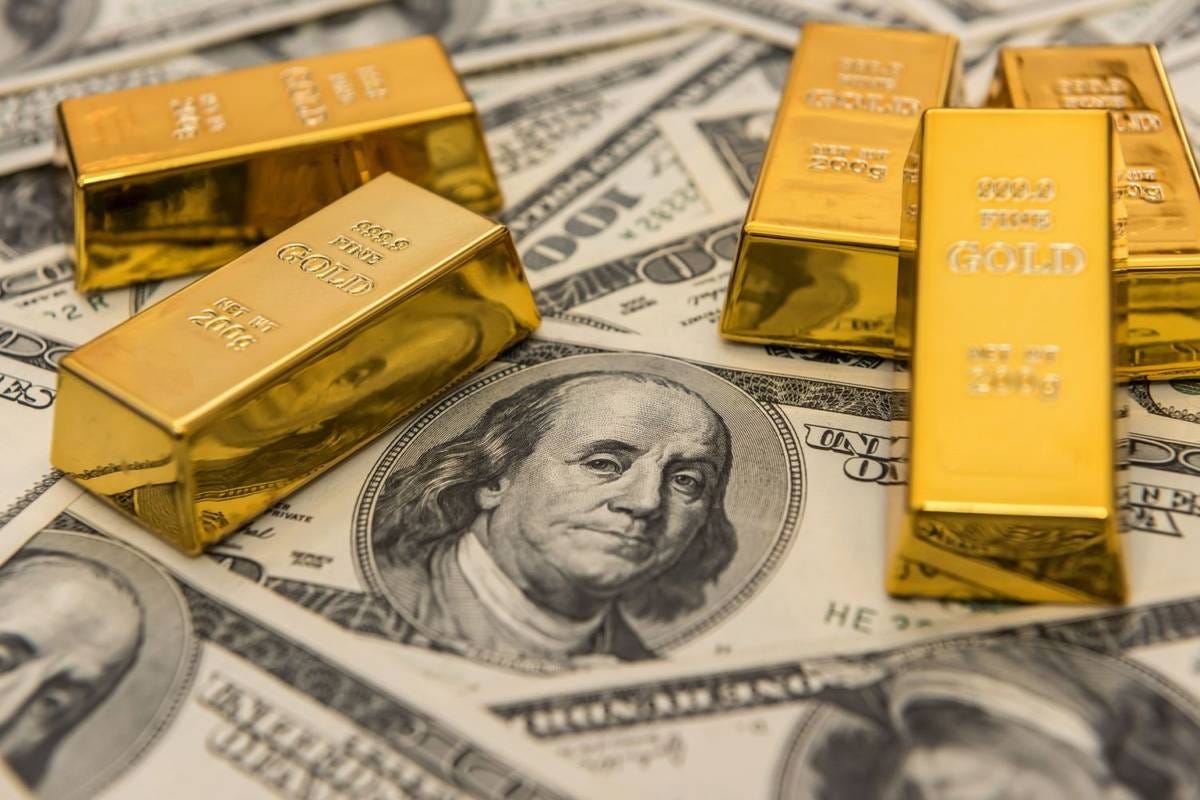
The general outline of how to do it was explained by Ludwig von Mises in his 1952 update to his classic 1912 treatise, The Theory of Money and Credit (specifically, chapter 23). The monetary authorities announce that the dollar will be redeemable in gold at a specific date in the not-too-distant future at whatever the market price is on that date. That’s it. This is the only mechanism that will save the dollar and prevent chaos in the US, and there will be chaos when the dollar collapses.
It is important that there is no way that redeemability can be suspended, not even for war. In fact, strict redeemability is most necessary when the US is considering going to war. The people and their representatives need to know the true cost of war; whereas, currently the cost of war and military spending is hidden behind monetary inflation that erodes the dollar and our prosperity in a stealthy manner. Like any cancer, monetary inflation eventually will kill its host.
It should be clear to all that this is the only sure and lasting path to monetary stability. Yes, we may occasionally get an administration that shows some semblance of budget discipline, but this always is short-lived. Remember the Barron maxim: Any entity that can print money will print money. There is no alternative to lasting monetary discipline other than funding the federal budget with honest money, which for millennia has been gold.

QTR’s Disclaimer: Please read my full legal disclaimer on my About page here. This post represents my opinions only. In addition, please understand I am an idiot and often get things wrong and lose money. I may own or transact in any names mentioned in this piece at any time without warning. Contributor posts and aggregated posts have been hand selected by me, have not been fact checked and are the opinions of their authors. They are either submitted to QTR by their author, reprinted under a Creative Commons license with my best effort to uphold what the license asks, or with the permission of the author.
This is not a recommendation to buy or sell any stocks or securities, just my opinions. I often lose money on positions I trade/invest in. I may add any name mentioned in this article and sell any name mentioned in this piece at any time, without further warning. None of this is a solicitation to buy or sell securities. I may or may not own names I write about and are watching. Sometimes I’m bullish without owning things, sometimes I’m bearish and do own things. Just assume my positions could be exactly the opposite of what you think they are just in case. If I’m long I could quickly be short and vice versa. I won’t update my positions. All positions can change immediately as soon as I publish this, with or without notice and at any point I can be long, short or neutral on any position. You are on your own. Do not make decisions based on my blog. I exist on the fringe. If you see numbers and calculations of any sort, assume they are wrong and double check them. I failed Algebra in 8th grade and topped off my high school math accolades by getting a D- in remedial Calculus my senior year, before becoming an English major in college so I could bullshit my way through things easier.
The publisher does not guarantee the accuracy or completeness of the information provided in this page. These are not the opinions of any of my employers, partners, or associates. I did my best to be honest about my disclosures but can’t guarantee I am right; I write these posts after a couple beers sometimes. I edit after my posts are published because I’m impatient and lazy, so if you see a typo, check back in a half hour. Also, I just straight up get shit wrong a lot. I mention it twice because it’s that important.
I suppose it's a measure of our present predicament that gold's role as a monetary metal was hotly debated during the first years of the Great Depression. From 1931 :
"The delegation has admitted the likelihood of a gold shortage and has proposed means of maintaining an adequate supply of credit expansion in the face of inadequate gold supplies."
https://chicagotribune.newspapers.com/article/chicago-tribune-the-problem-with-gold-as/122119688/
Economies grow. The transaction demand for money always increases. The supply of gold is fixed and inelastic. Debasement is inevitable.
Unless we're all up for deflation, which is worse.
Gold is a scorecard for how well we are allocating scarce resources to productive ends.
When we sent 600,000 soldiers to a land war in Asia and flew to the moon at the same time, gold noticed. When we swamped the nation in subsidies to weather a non-existent
plague while handing untold billions to chronically unproductive third worlders who are in the country illegally, gold noticed that, too.
But what gold is not is money, not in the practical sense that we need money.
Public policy should aim at ameliorating the inevitable. That is, if we accept that we are stuck with a fiat system that is inherently inflationary, then :
1) The Fed should abandon a dual mandate and target a 2% inflation rate only.
2) Recognizing that most of what governments do is inflationary and that persistent inflation isn't sourced anywhere else. The easiest to understand metric is a balanced budget, and it's with personal dismay that advocates of balanced budgets have vanished in the past 20 years.
I'm at a loss to guess how we get there from here. For example : the principle that governments should enforce the equality of outcomes is the midwife of more destructive spending than I care to imagine. What, two in five electors buy into that, probably more?
My inner pessimist concludes that a hard rain's gonna fall before people are disabused of that notion, and recalling Winston Churchill's quixotic return to the gold standard in 1925, I doubt the creation of a gold backed currency will be a ,erm, silver bullet that will finesse what's to come.
Pretty big assumption he’s making, and I know von Mises wrote it in 1953, but we have no proof Treasury has the 8000 tons we are told it has. Physically probably most of it is there, hopefully but I think Bessent whispered in Trump’s ear to drop the Ft Knox inspection because he knows that although there is gold there it has been re-hypothecated so many times it would crash the market trying to undo it.